 뒤로
뒤로Quantum Mechanics, Atomic Structure, and Electron Configuration: Study Notes
스터디 가이드 - 스마트 노트
 자료에 맞춘 맞춤형 노트, 핵심 정의, 예시, 맥락을 확장해 제공합니다.
Quantum Mechanics and Atomic Structure
Key Constants and Equations
Understanding the behavior of electrons in atoms requires several fundamental constants and equations from quantum mechanics and electromagnetic theory.
Speed of light (c): m/s
Planck’s constant (h): J\cdot s
Ground-state energy of an electron (hydrogen atom): J
Speed of light equation:
Photon energy equation:
Bohr energy transition equation:
de Broglie wavelength:
Electromagnetic Spectrum
The electromagnetic spectrum encompasses all types of electromagnetic radiation, which differ in wavelength and energy. Visible light is only a small portion of this spectrum.
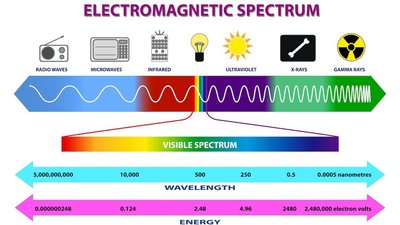
Radio waves have the longest wavelength and lowest energy.
Gamma rays have the shortest wavelength and highest energy.
Visible spectrum ranges from approximately 400 nm (violet) to 700 nm (red).
Bohr Model of the Atom
Bohr Model Postulates
The Bohr model was an early attempt to describe the structure of the hydrogen atom and the quantization of electron energies.
Quantized Orbits: Electrons in a hydrogen atom are only permitted in orbits of certain radii with specific energies.
Stable Orbits: An electron in an allowed orbital does not radiate energy and does not spiral into the nucleus.
Energy Transitions: Electrons absorb or emit energy only when changing between energy states, with the energy difference emitted or absorbed as a photon ().
Applications: Explains atomic emission spectra and the stability of atoms.
Atomic Interactions and Phenomena
Black body radiation: Emission of light from hot objects.
Photoelectric effect: Emission of electrons from metal surfaces when illuminated by light of sufficient frequency.
Emission spectra: Light emitted from electronically excited gas atoms, producing characteristic lines.
Quantum Numbers and Atomic Orbitals
Quantum Numbers: Definitions and Values
Quantum numbers describe the properties of atomic orbitals and the electrons within them.
Number | Symbol | Possible Values |
|---|---|---|
Principal Quantum Number | n | 1, 2, 3, 4, ... |
Angular Momentum Quantum Number | l | 0, 1, 2, 3, ... (n-1) |
Magnetic Quantum Number | m_l | -l, ..., 0, ..., +l |
Spin Quantum Number | m_s | +1/2, -1/2 |
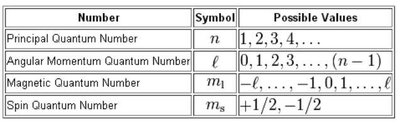
n (Principal): Indicates the main energy level or shell.
l (Angular momentum): Determines the shape of the orbital (s, p, d, f).
m_l (Magnetic): Specifies the orientation of the orbital in space.
m_s (Spin): Indicates the spin direction of the electron (+1/2 or -1/2).
Shapes of Atomic Orbitals
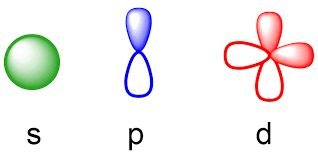
The value of the angular momentum quantum number (l) determines the shape of the orbital:
s orbital (l = 0): Spherical shape
p orbital (l = 1): Dumbbell shape
d orbital (l = 2): Cloverleaf or complex shapes
Rules for Electron Configuration
Pauli Exclusion Principle: No two electrons in the same atom can have the same set of four quantum numbers.
Hund’s Rule: For degenerate (equal energy) orbitals, each orbital is singly occupied before any is doubly occupied, and all electrons in singly occupied orbitals have the same spin.
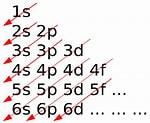
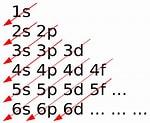
Aufbau Principle: Electrons fill orbitals starting with the lowest energy first.
Electron Configuration Notation
Electron configurations describe the distribution of electrons among the orbitals of an atom.
Condensed notation: Uses the previous noble gas in brackets to simplify the configuration (e.g., [Ne]3s23p6 for Argon).
Valence electrons: Electrons in the outermost shell, important for chemical reactivity.
Key Principles and Effects
Heisenberg Uncertainty Principle
The more precisely the momentum of a particle is known, the less precisely its position is known, and vice versa.
Mathematical expression:
Photoelectric Effect
The photoelectric effect is the ejection of electrons from a metal surface when it is struck by light of sufficient energy (frequency).
Threshold frequency: Each metal has a minimum frequency of light required to emit electrons.
Significance: Demonstrates the particle nature of light (photons).
Sample Calculations and Applications
Energy of a Photon
To calculate the energy of a photon given its frequency:
Equation:
Example: For s, J$
de Broglie Wavelength
The wavelength associated with a moving particle is given by:
Equation:
Example: For a 2.0-kg object moving at 50 m/s, m$
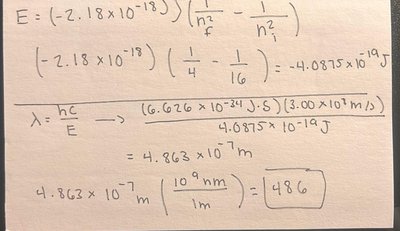
Bohr Model Energy Transitions
Energy changes when an electron transitions between energy levels in a hydrogen atom:
Equation:
Example: Transition from to emits a photon with a wavelength of 486 nm.
Practice Questions and Applications
Sample Multiple Choice Questions
Which quantum number defines the shape of an orbital? Answer: Angular momentum quantum number (l)
What is the condensed electron configuration of Argon (Z=18)? Answer: [Ne]3s23p6
Which of the following orbitals can hold two electrons? Answer: All of the above (2px, 4dxy, 3s)
The photoelectric effect is: Answer: The ejection of electrons by a metal when struck with light of sufficient energy
Summary Table: Quantum Numbers
Quantum Number | Symbol | Meaning | Possible Values |
|---|---|---|---|
Principal | n | Energy level | 1, 2, 3, ... |
Angular Momentum | l | Orbital shape | 0 to n-1 |
Magnetic | m_l | Orbital orientation | -l to +l |
Spin | m_s | Electron spin | +1/2, -1/2 |
Additional info:
For electron configurations, the periodic table can be divided into s, p, d, and f blocks, which correspond to the filling of these subshells.
Hund’s rule and the Pauli exclusion principle are essential for predicting the arrangement of electrons in multi-electron atoms.
