 뒤로
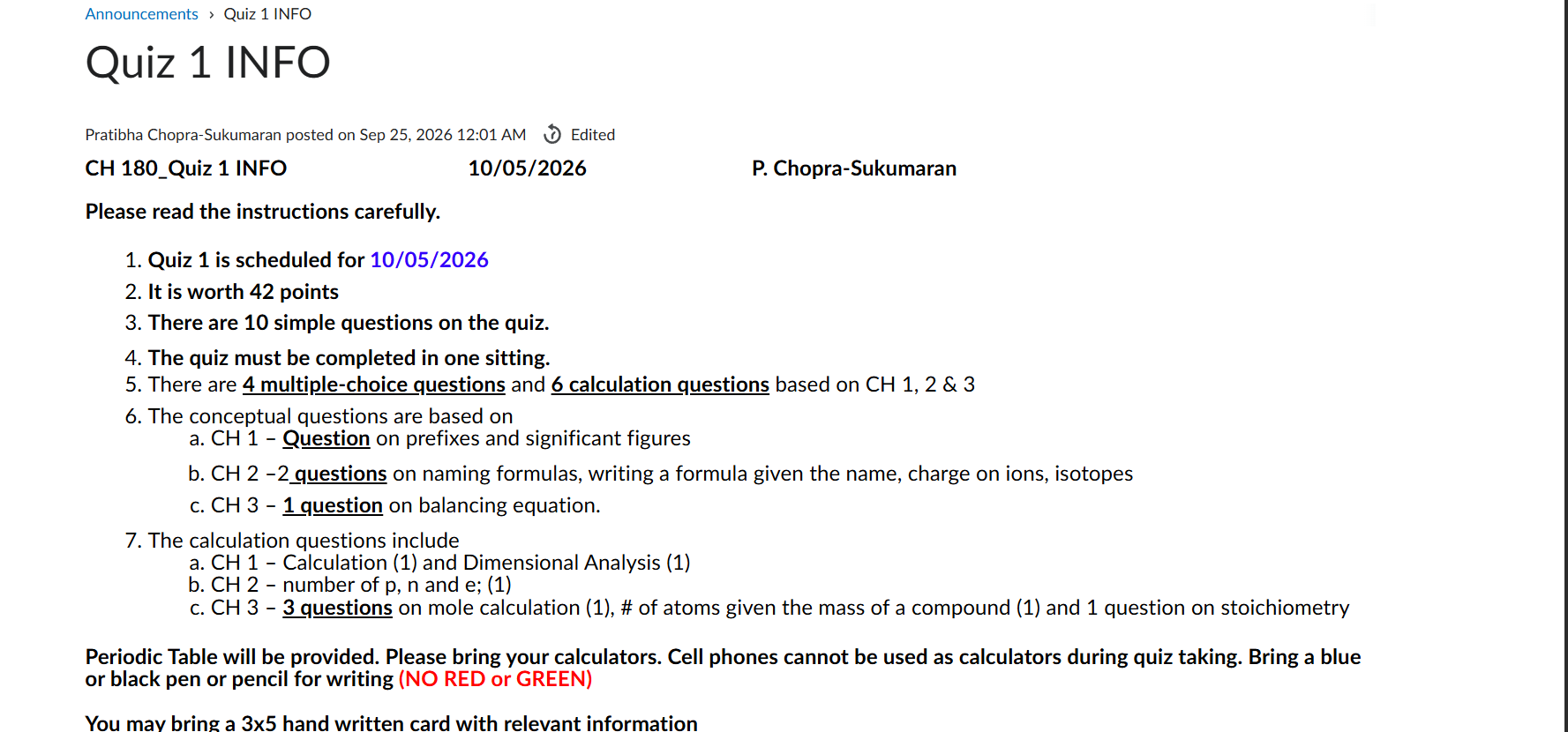
Quiz 1 Study Guide: CH 1, 2 & 3 (General Chemistry)
스터디 가이드 - 스마트 노트
 자료에 맞춘 맞춤형 노트, 핵심 정의, 예시, 맥락을 확장해 제공합니다.
Quiz 1 Overview
Structure and Content
Quiz 1 covers foundational topics from Chapters 1, 2, and 3 of General Chemistry. The quiz consists of both conceptual and calculation questions, focusing on key principles and skills required for early chemistry coursework.
Number of Questions: 10 (4 multiple-choice, 6 calculation)
Relevant Chapters: CH 1 (Matter, Energy, Measurement), CH 2 (Atoms, Molecules, Ions), CH 3 (Chemical Reactions and Stoichiometry)
Tools Allowed: Periodic Table, calculator, 3x5 handwritten card
Chapter 1: Matter, Energy, and Measurement
Prefixes and Significant Figures
This section tests your understanding of measurement units, metric prefixes, and the rules for determining significant figures in calculations.
Metric Prefixes: Used to express quantities in the metric system. Examples include kilo- (103), centi- (10-2), milli- (10-3).
Significant Figures: Digits in a measurement that are known with certainty plus one digit that is estimated. Important for expressing precision in calculations.
Rules:
All nonzero digits are significant.
Zeros between nonzero digits are significant.
Leading zeros are not significant.
Trailing zeros in a decimal number are significant.
Example: The number 0.00450 has three significant figures.
Dimensional Analysis
Dimensional analysis is a method for converting units using conversion factors.
Key Steps:
Identify the starting unit and the desired unit.
Set up conversion factors so units cancel appropriately.
Multiply through to obtain the final answer.
Formula:
Example: Convert 25 cm to meters:
Chapter 2: Atoms, Molecules, and Ions
Naming Formulas and Writing Formulas
Understanding chemical nomenclature and formula writing is essential for identifying compounds and their composition.
Key Terms:
Ion: An atom or molecule with a net electric charge due to loss or gain of electrons.
Isotope: Atoms of the same element with different numbers of neutrons.
Naming Ionic Compounds:
Name the cation first, then the anion.
For transition metals, indicate charge with Roman numerals (e.g., Fe2+ is iron(II)).
Writing Formulas:
Balance charges to ensure neutrality.
Example: Sodium chloride is NaCl.
Example: Magnesium oxide: MgO
Charge on Ions and Isotopes
Questions may ask for the charge of common ions or the composition of isotopes.
Charge Calculation:
Isotope Notation: Example:
Example: Chlorine-37 has 17 protons, 20 neutrons, 17 electrons.
Chapter 3: Chemical Reactions and Reaction Stoichiometry
Balancing Chemical Equations
Balancing equations ensures the conservation of mass and atoms in a chemical reaction.
Steps:
Write the unbalanced equation.
Count atoms of each element on both sides.
Add coefficients to balance atoms.
Example: becomes
Mole Calculations and Stoichiometry
Stoichiometry involves quantitative relationships between reactants and products in a chemical reaction.
Mole Calculation:
Number of Atoms:
Stoichiometry:
Use balanced equations to relate moles of reactants and products.
Example: If 2 mol H2 react with 1 mol O2, 2 mol H2O are produced.
Preparation Tips
Review metric prefixes, significant figures, and dimensional analysis.
Practice naming and writing formulas for compounds.
Understand how to determine the charge on ions and identify isotopes.
Practice balancing equations and performing mole calculations.
Bring allowed materials: calculator, periodic table, 3x5 card, blue/black pen or pencil.
Additional info: The quiz is designed to assess both conceptual understanding and calculation skills foundational to General Chemistry. Focus on accuracy and clarity in your answers.
