 뒤로
뒤로Reactions in Aqueous Solution: Solutions, Molarity, Solubility, Electrolytes, and Redox Reactions
스터디 가이드 - 스마트 노트
 자료에 맞춘 맞춤형 노트, 핵심 정의, 예시, 맥락을 확장해 제공합니다.
Solutions and Mixtures
Concept of Solutions
Solutions are homogeneous mixtures composed of two or more substances that form a uniform composition throughout. The solute is the substance dissolved, while the solvent is the substance present in the greatest amount, which dissolves the solute. Concentration measures the amount of solute in a given quantity of solvent or solution.
Solute: The component present in a lesser amount and dissolved in the solvent.
Solvent: The component present in a greater amount, dissolving the solute.
Concentration: Expressed in units such as molarity (mol/L), it quantifies the amount of solute per unit volume of solution.
Suspensions vs. Colloids vs. Solutions
Mixtures can be classified based on the size of solute particles and their behavior in the solvent:
Solutions: Homogeneous mixtures with solute particles smaller than 1 nm; particles do not settle.
Colloids: Heterogeneous mixtures with intermediate particle sizes (1–500 nm); particles do not settle.
Suspensions: Heterogeneous mixtures with large particles (>500 nm); particles settle out over time.
Example: Salad dressing is a suspension, while milk is a colloid.
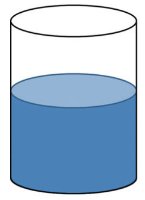
Visual Identification of Mixtures
Solutions, colloids, and suspensions can be visually distinguished by the appearance and behavior of their particles in a container.
Molarity and Solution Calculations
Concept of Molarity
Molarity (M) is a common unit of concentration, defined as the number of moles of solute per liter of solution:
Formula:
Example: If 23.7 g NaOH is dissolved in 2.50 L of solution, first convert grams to moles, then divide by volume in liters.
Using Molarity in Calculations
Molarity is used as a conversion factor in stoichiometric calculations involving solutions. For example, to find the volume of solution needed to provide a certain number of moles of solute, rearrange the molarity formula:
Osmolarity
Concept of Osmolarity
Osmolarity measures the total concentration of all ions in solution. It is calculated by multiplying the molarity of the compound by the number of ions it produces upon dissociation.
Formula:
Example: 0.350 M Ga(OH)3 produces 0.350 × 4 = 1.40 M OH− ions.
Dilutions
Concept of Dilution
Dilution involves adding solvent to a solution to decrease its concentration. The relationship between the initial and final concentrations and volumes is given by:
Formula:
M1, V1: Initial molarity and volume before dilution.
M2, V2: Final molarity and volume after dilution.
Example: To prepare 3.5 L of 2.7 M HBr from 5.2 M HBr, solve for the required volume of the concentrated solution.

Solubility Rules
Solubility and Insolubility
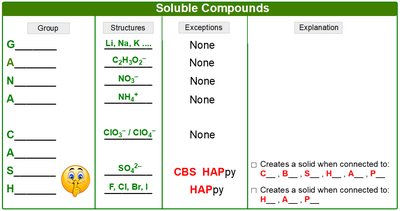
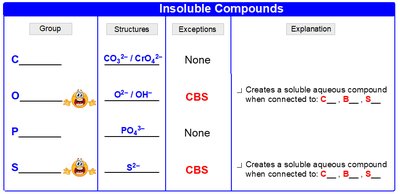
Solubility refers to the ability of a solute to dissolve in a solvent. The Solubility Rules help predict whether an ionic compound will dissolve in water.
Soluble: Compounds that dissolve in water.
Insoluble: Compounds that do not dissolve in water.
Mnemonic devices such as "GANA CASH" and "COPS" help remember the rules and exceptions.

Electrolytes
Types of Electrolytes
Electrolytes are substances that conduct electricity when dissolved in water due to the presence of ions. They are classified as:
Strong Electrolytes: Completely dissociate into ions (e.g., strong acids, strong bases, soluble ionic compounds).
Weak Electrolytes: Partially dissociate into ions (e.g., weak acids, weak bases).
Non-Electrolytes: Do not dissociate into ions (e.g., sugars, alcohols, most covalent compounds).
Molecular, Complete Ionic, and Net Ionic Equations
Molecular Equations
A molecular equation shows all reactants and products as intact compounds. It is used to represent the overall reaction.
Complete Ionic Equations
Complete ionic equations show all soluble ionic compounds as dissociated ions. Solids, liquids, and gases are not broken into ions.
Net Ionic Equations
Net ionic equations include only the ions and molecules directly involved in the reaction, omitting spectator ions.
Oxidation Numbers and Redox Reactions
Oxidation Numbers
The oxidation number is a value assigned to an atom to indicate its degree of oxidation or reduction. Rules are used to assign oxidation numbers in compounds and ions.
Redox Reactions
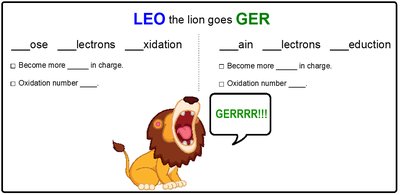
Redox reactions involve the transfer of electrons between substances. Oxidation is the loss of electrons, and reduction is the gain of electrons. The mnemonic "LEO the lion says GER" helps remember this:
Lose Electrons = Oxidation (LEO)
Gain Electrons = Reduction (GER)
Balancing Redox Reactions
Acidic Solutions
Redox reactions in acidic solutions are balanced by splitting the reaction into half-reactions, balancing all elements except H and O, then balancing O with H2O, H with H+, and charge with electrons.
Basic Solutions
For basic solutions, after balancing as in acidic conditions, add OH− to both sides to neutralize H+ and form water.

Activity Series
Single Displacement Reactions and the Activity Series
The activity series ranks elements by their ability to displace others in compounds. An element higher in the series can displace one below it in a single displacement reaction.

Example: Magnesium can displace hydrogen from hydrochloric acid, producing hydrogen gas and magnesium chloride.
