 뒤로
Significant Figures and Dimensional Analysis: Measurement in Chemistry
스터디 가이드 - 스마트 노트
 자료에 맞춘 맞춤형 노트, 핵심 정의, 예시, 맥락을 확장해 제공합니다.
Measurement in Chemistry
What is Measurement?
Measurement is the process of comparing a physical quantity to a standard unit, providing both a numerical value and a unit. This is fundamental in chemistry, as the unit gives meaning to the number and allows for clear communication of results.
Measured value = number + unit (e.g., 17.5 cm)
Common quantities: length, mass, time, temperature, volume
A number without a unit is ambiguous and lacks scientific meaning.

SI Units and Derived Units
Base SI Units
The International System of Units (SI) is the globally accepted standard for scientific measurement. It is based on seven base units, five of which are commonly used in chemistry:
Length: meter (m)
Mass: kilogram (kg)
Time: second (s)
Temperature: kelvin (K)
Amount of substance: mole (mol)
Derived Units
Many chemical quantities are expressed using derived units, which are combinations of base units. These are constructed from equations relating measured quantities.
Area:
Volume: or
Density: or
Speed:
Force: newton (N)
Pressure: pascal (Pa)
Energy: joule (J)
Metric Prefixes
Metric prefixes are used to express very large or very small quantities conveniently by indicating powers of ten.
Prefix | Symbol | Meaning |
|---|---|---|
kilo- | k | |
centi- | c | |
milli- | m | |
micro- | \mu | |
nano- | n |
Example:
Example:
Precision, Accuracy, and Significant Figures
Precision and Accuracy
Measurements can vary in their accuracy and precision. Understanding these concepts is essential for evaluating data quality.
Accuracy: How close a measurement is to the true value.
Precision: How close repeated measurements are to each other.
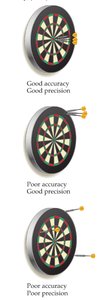
Significant Figures
Significant figures (sig figs) indicate the precision of a measured value. The rules for counting significant figures are:
All nonzero digits are significant.
Zeros between nonzero digits (captive zeros) are significant.
Leading zeros are not significant.
Trailing zeros are significant only if there is a decimal point.
Example: 12.3 cm (3 sig figs), 0.00450 g (3 sig figs), 2500 mL (ambiguous unless in scientific notation)
How to Measure and Report
When recording a measurement, read to the smallest marked division and estimate one additional digit. This ensures the reported value reflects the instrument's precision.
Example: If a ruler is marked in millimeters, and the length is slightly over 6.2 cm, report as 6.23 cm (3 sig figs).
Rules for Calculations with Significant Figures
Addition/Subtraction: Round the result to the same decimal place as the least precise measurement.
Multiplication/Division: Round the result to the same number of significant figures as the measurement with the fewest significant figures.
Example (Addition): (rounded to tenths place)
Example (Multiplication): (2 sig figs)
Dimensional Analysis (Factor-Label Method)
What is Dimensional Analysis?
Dimensional analysis is a systematic method for converting between units by treating units as algebraic quantities that can be canceled or combined using conversion factors.
Units cancel just like numbers when multiplied by appropriate conversion factors.
Conversion Factors
A conversion factor is a ratio of equivalent quantities expressed in different units. It is always equal to one and does not change the value of a measurement.
Example:
Conversion factors based on definitions (e.g., 1 in = 2.54 cm) are considered exact and have infinite significant figures.
Single-Step and Multi-Step Conversions
Start with the known quantity.
Multiply by conversion factors so that unwanted units cancel, leaving only the desired unit.
Example (Single-step):
Example (Multi-step):
Using Multiple Units and Physical Relationships
Some conversions require switching between different types of quantities, such as mass and volume, using physical relationships like density.
Example: Given 24.0 g of a substance with a density of 2.0 g/mL, find the volume:
Summary of Dimensional Analysis
Dimensional analysis is a powerful tool for unit conversion in chemistry.
Conversion factors are based on equalities and have infinite significant figures if exact.
Switching between different quantities (e.g., mass to volume) requires a measured physical relationship, which limits significant figures.
Always check that units cancel correctly and that the final answer makes sense.
