 뒤로
Significant Figures and Measurement Reliability in Chemistry
스터디 가이드 - 스마트 노트
 자료에 맞춘 맞춤형 노트, 핵심 정의, 예시, 맥락을 확장해 제공합니다.
Chapter One: Matter, Measurement, and Problem Solving
Significant Figures and the Reliability of Measurements
In scientific measurements, the reliability and precision of the data are crucial. Every digit in a measurement is certain except the last, which is estimated. The number of significant figures in a measurement reflects the precision of the measuring instrument and the care of the observer. Preserving this precision during calculations is essential for accurate scientific reporting.
Significant Figures are the digits in a measurement that are known with certainty plus one digit that is estimated.
The precision of a measurement depends on the instrument quality, measurement technique, environmental conditions, and the observer’s skill.
Significant figures must be preserved during calculations to reflect the true reliability of the data.
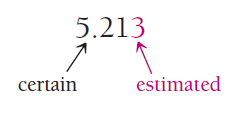
Example: In the measurement 5.213, the digits 5, 2, and 1 are certain, while 3 is estimated.
Reading Measurements: The Meniscus
When measuring the volume of a liquid in a graduated cylinder, always read the value at the bottom of the meniscus at eye level. This ensures accuracy and consistency in measurement.
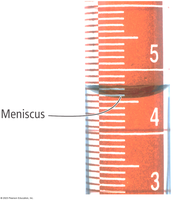
Example: The correct reading of the meniscus in the image is 4.58 mL.
Counting Significant Figures
Rules for Identifying Significant Figures
To determine the number of significant figures in a measurement, follow these rules:
Rule 1: All nonzero digits are significant.
Rule 2: Interior zeroes (zeroes between nonzero digits) are significant.
Rule 3: Leading zeroes (zeroes to the left of the first nonzero digit) are not significant; they only serve to locate the decimal point.
Rule 4: Trailing zeroes (zeroes at the end of a number):
Trailing zeroes after a decimal point are always significant.
Trailing zeroes before a decimal point (and after a nonzero number) are always significant.
Trailing zeroes before an implied decimal point are ambiguous and should be avoided by using scientific notation or placing decimal points.
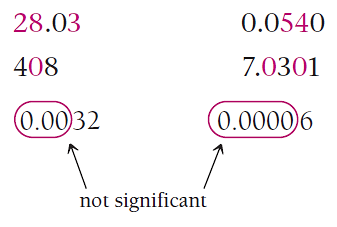
Example: In 0.0032, only the digits 3 and 2 are significant; the leading zeroes are not.
Examples: Determining Significant Figures
1002.7 → 5 significant figures
1.00000 → 6 significant figures
0.0000000009 → 1 significant figure
0.00090 → 2 significant figures
5000 → ambiguous (could be 1, 2, 3, or 4 significant figures; use scientific notation for clarity)
5000.0 → 5 significant figures
Significant Figures in Calculations
Rules for Mathematical Operations
When performing calculations with measured quantities, the result must reflect the precision of the least precise measurement.
Multiplication and Division: The result should have the same number of significant figures as the factor with the fewest significant figures.
Addition and Subtraction: The result should have the same number of decimal places as the quantity with the fewest decimal places.
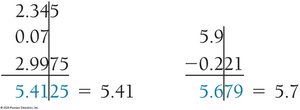
Example: 2.345 + 0.07 + 2.9975 = 5.41 (rounded to two decimal places, matching the least precise measurement).
Rounding Rules
Round down if the last digit being dropped is four or less.
Round up if the last digit being dropped is five or more.
Only the last (or leftmost) digit being dropped determines the direction of rounding; ignore all digits to the right of it.
Examples:
5.37 rounds to 5.4 (since 7 > 5; rounded up)
5.34 rounds to 5.3 (since 4 < 5; rounded down)
5.35 rounds to 5.4 (rounded up)
5.349 rounds to 5.3 (since 4 < 5; rounded down)
Rounding in Multistep Calculations
Follow the BODMAS/PEMDAS rule for the order of operations.
To avoid rounding errors, round only the final answer, not intermediate steps.
If you write down intermediate answers, keep track of significant figures by underlining the least significant digit.
Precision and Accuracy
Definitions and Differences
Understanding the difference between precision and accuracy is essential in scientific measurement:
Accuracy: How close a measured value is to the actual (true) value.
Precision: How close or consistent a series of measurements are to one another.
Measurements are:
Precise if they are consistent with one another.
Accurate only if they are close to the actual value.
Random error causes inconsistency (lack of precision), while systematic error causes inaccuracy (results consistently too high or too low).
Example: Student Measurements
Student A: Inaccurate and imprecise (not close to true value, not consistent)
Student B: Precise but inaccurate (consistent, but not close to true value)
Student C: Accurate and precise (close to true value and consistent)
Practice Problems
Practice identifying significant figures, applying calculation rules, and distinguishing between accuracy and precision to master these foundational concepts in chemistry.
