 뒤로
Solutions and Aqueous Reactions: Concentration, Solubility, and Reaction Types
스터디 가이드 - 스마트 노트
 자료에 맞춘 맞춤형 노트, 핵심 정의, 예시, 맥락을 확장해 제공합니다.
Introduction to Solutions and Aqueous Reactions
Solutions are homogeneous mixtures composed of a solvent (majority component) and one or more solutes (minority components). When water is the solvent, the solution is termed aqueous. Understanding the properties and behaviors of solutions is fundamental in general chemistry, especially for reactions occurring in aqueous media.
Solution Concentration
Defining Solution Concentration
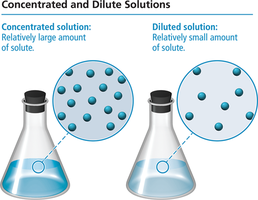
Concentration describes the amount of solute dissolved in a given quantity of solvent or solution. Solutions can be classified as dilute (small amount of solute) or concentrated (large amount of solute).
Molarity (M) is the most common unit of concentration, defined as moles of solute per liter of solution:
Example: A 1.00 M NaCl solution contains 1.00 mole of NaCl in every liter of solution.
Using Molarity in Calculations
Molarity serves as a conversion factor between moles of solute and volume of solution. For example, a 0.500 M NaCl solution contains 0.500 mol NaCl per liter.
Calculation Example: To prepare 3.0 L of a 2.0 M solution, you need moles of solute.
Solution Dilution
To make a less concentrated solution from a stock solution, add more solvent. The amount of solute remains constant; only the volume changes. The dilution equation is:
Where: and are the molarity and volume of the stock solution, and are those of the diluted solution.
Types of Aqueous Solutions and Solubility
Solute and Solvent Interactions
Solubility depends on the interactions between solute and solvent particles. If the attraction between solute and solvent is strong enough, the solute dissolves.
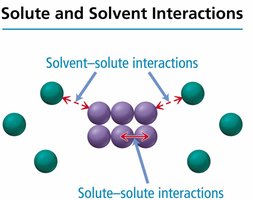
Example: Salt (NaCl) and sugar both dissolve in water due to favorable interactions with water molecules.
Dissolution of Ionic Compounds
When an ionic compound dissolves in water, the ions are separated and surrounded by water molecules, a process called hydration. This results in free-moving ions that can conduct electricity.
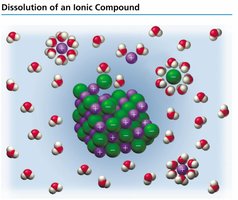
Example: NaCl dissolves to form Na+ and Cl- ions in solution.
Electrolytes and Nonelectrolytes
Electrolytes: Substances that dissolve in water to form ions and conduct electricity (e.g., NaCl).
Nonelectrolytes: Substances that dissolve as molecules and do not conduct electricity (e.g., sugar).
Strong electrolytes: Completely dissociate into ions (ionic compounds, strong acids).
Weak electrolytes: Partially dissociate (weak acids).
Solubility Rules for Ionic Compounds
Solubility rules help predict whether an ionic compound will dissolve in water. These rules are based on experimental observations and are summarized in tables and flowcharts.
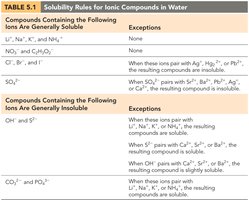
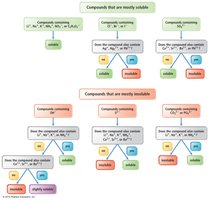
Example: Compounds containing Na+, K+, or NO3- are generally soluble.
Precipitation Reactions
Formation of a Precipitate
When two aqueous solutions of ionic compounds are mixed, an insoluble product (precipitate) may form if one of the possible products is insoluble according to the solubility rules.

Example: Mixing solutions of AgNO3 and NaCl forms a white precipitate of AgCl.
Predicting Precipitation Reactions
Identify the ions present in each reactant.
Exchange ions to form possible products.
Use solubility rules to determine if any product is insoluble.
If a precipitate forms, write its formula with (s); otherwise, write "no reaction."
Representing Aqueous Reactions
Molecular, Complete Ionic, and Net Ionic Equations
Molecular equation: Shows complete, neutral formulas for all compounds.
Complete ionic equation: Shows all strong electrolytes as ions.
Net ionic equation: Shows only the species that actually change during the reaction (spectator ions are omitted).
Acid–Base and Gas-Evolution Reactions
Acid–Base (Neutralization) Reactions
An acid reacts with a base to produce water and a salt. The net ionic equation for a strong acid–strong base reaction is:
Acids: Produce H+ in solution (Arrhenius definition).
Bases: Produce OH- in solution.
Gas-Evolution Reactions
Some reactions produce a gas either directly or by decomposition of an intermediate product. Bubbling is observed as evidence of gas formation.
Oxidation–Reduction (Redox) Reactions
Definition and Electron Transfer
Redox reactions involve the transfer of electrons between reactants. Oxidation is the loss of electrons; reduction is the gain of electrons. These reactions are essential for processes such as combustion and metal reactivity.
Oxidizing agent: Causes oxidation and is itself reduced.
Reducing agent: Causes reduction and is itself oxidized.
Assigning Oxidation States
Oxidation states (numbers) are assigned to atoms in compounds to track electron transfer. Key rules include:
Free elements: 0
Monatomic ions: Equal to their charge
Sum of oxidation states in a compound: 0
Sum in a polyatomic ion: Equals the ion's charge
Group 1 metals: +1; Group 2 metals: +2
Activity Series of Metals
The activity series ranks metals by their tendency to lose electrons (be oxidized). Metals at the top are more easily oxidized and more reactive.
Additional info: This summary integrates textbook-style explanations, examples, and relevant images to reinforce key concepts in solution chemistry and aqueous reactions, as covered in a typical General Chemistry curriculum.
