 뒤로
lecture 7 =)(ns) Solutions, Molarity, and Stoichiometry: Study Notes for General Chemistry
스터디 가이드 - 스마트 노트
 자료에 맞춘 맞춤형 노트, 핵심 정의, 예시, 맥락을 확장해 제공합니다.
Solutions and Solution Vocabulary
Definition and Components of Solutions
A solution is a homogeneous mixture composed of two or more substances. The major component is called the solvent, and the minor component is the solute. The solute is dissolved in the solvent, forming a uniform phase.
Solvent: The substance present in the largest amount; typically determines the phase of the solution.
Solute: The substance present in a smaller amount; dissolved by the solvent.
Aqueous solution: A solution where water is the solvent.



Can a solution be a heterogeneous mixture? No, by definition, solutions are homogeneous mixtures. Heterogeneous mixtures do not have uniform composition throughout.
Solution Concentration Units
Mass Percent
Mass percent expresses the concentration of a solute in a solution as a percentage of the total mass:
Formula:
Example: 1.5% NaCl solution means 1.5 grams NaCl per 100 grams of solution.
Mass percent is not ideal for stoichiometric calculations but can be used as a conversion factor.
Mass-by-Volume Percent (% m/v)
This unit expresses concentration as grams of solute per 100 mL of solution:
Formula:
Example: 1.5% (m/v) NaCl solution means 1.5 grams NaCl per 100 mL of solution.
Parts Per Million (ppm) and Parts Per Billion (ppb)
These units are used for very dilute solutions:
ppm:
ppb:
Example: 3 ppm Hg means 3 grams of mercury per 1,000,000 grams of solution.
Molarity (M)
Molarity is the most common unit for solution concentration in chemistry, defined as moles of solute per liter of solution:
Formula:
Example: 1.5 M NaCl solution contains 1.5 moles NaCl per 1 L solution.
Molarity is used as a conversion factor in stoichiometric calculations.
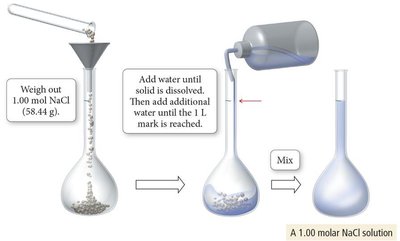
Concentration Gradient
Concentration refers to the amount of solute in a given volume of solution. Solutions can range from dilute to concentrated.
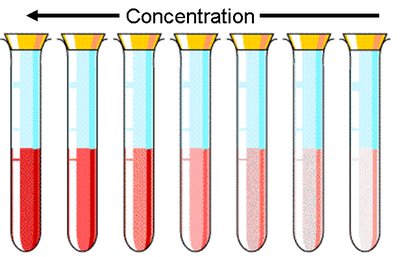
Making Solutions of Standard Concentration
Preparation Steps
To prepare a solution of known molarity:
Calculate the mass of solute needed using molarity and molar mass.
Weigh out the calculated mass of solute.
Dissolve the solute in a portion of solvent.
Add more solvent until the desired total volume is reached.
Mix thoroughly.
Example: To make 1.00 L of 1.00 M NaCl, weigh 58.44 g NaCl and dissolve in water to a final volume of 1.00 L.
Using Molarity as a Conversion Factor
Calculating Moles from Volume and Molarity
Molarity allows calculation of moles of solute from a given volume:
Formula:
Example: 1.00 L of 5.00 M NaCl contains 5.00 moles NaCl.
Dilution of Solutions
Dilution Equation
To dilute a stock solution to a desired concentration, use:
Formula:
= initial molarity, = initial volume
= final molarity, = final volume
Process for Dilution
Measure the required volume of stock solution.
Add to a volumetric flask.
Add water up to the desired total volume.
Mix thoroughly.
Electrolytes and Non-Electrolytes
Classification
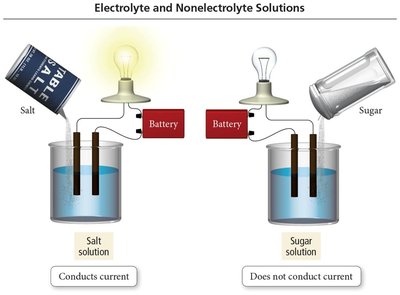
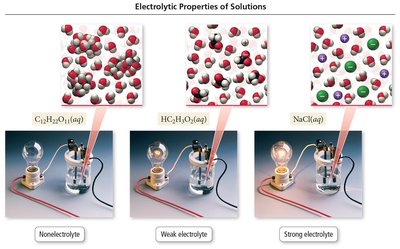
Electrolytes are substances that dissociate into ions in solution, enabling electrical conductivity.
Strong Electrolytes: Fully dissociate into ions (e.g., soluble ionic compounds, strong acids).
Weak Electrolytes: Partially dissociate into ions (e.g., weak acids).
Non-Electrolytes: Do not dissociate into ions (e.g., most molecular compounds like sugar).
Solubility Rules
Soluble and Insoluble Compounds
Solubility rules help predict whether an ionic compound will dissolve in water.
Soluble: Salts of NH4+, Group 1A ions, NO3-, C2H3O2-, ClO3-, ClO4-, most halides (except with Ag+, Pb2+, Hg22+), most sulfates (except with Ca2+, Ba2+, Pb2+, Ag+, Hg2+).
Insoluble: Carbonates, phosphates, oxides, sulfides, hydroxides (except with NH4+, Group 1A, and large Group 2A ions).
Mnemonics
CAASHNG1A: Chlorates/perchlorates, Ammonium, Acetates, Sulfates (except with HAPs CBS), Halides (except with HAPs), Nitrates, Group 1A metals.
CHOPS: Carbonates, Hydroxides (soluble with CBS and G1A), Oxides, Phosphates, Sulfides (soluble with CBS and G1A).
Solution Stoichiometry
Stoichiometric Calculations with Solutions
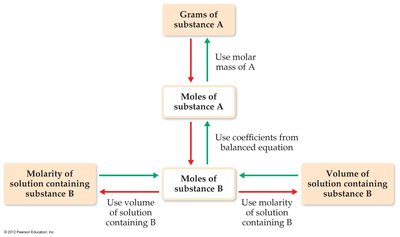
Stoichiometry involves using balanced chemical equations and solution concentrations to calculate quantities of reactants and products.
Use molarity to convert between volume and moles.
Apply mole ratios from balanced equations.
Calculate mass using molar mass.
Titrations
Principle and Process
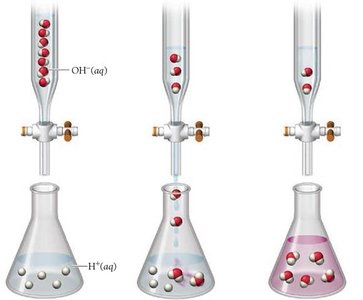
Titration is a technique used to determine the concentration of an unknown solution by reacting it with a solution of known concentration (titrant). The endpoint is often indicated by a color change.
Measure a known volume of the unknown solution.
Add titrant until the reaction is complete (equivalence point).
Calculate the unknown concentration using stoichiometry.
Practice Problems and Applications
Sample Calculations
Calculating mass of solute from molarity and volume.
Determining volume of stock solution needed for dilution.
Identifying limiting reactant and calculating percent yield in precipitation reactions.
Using titration data to find unknown concentrations.
Example: To make 250.0 mL of 0.500 M KI solution from 6.00 M KI stock, use mL of stock solution.
Example: In a titration, if 22.97 mL of 0.150 M NaOH is required to neutralize 25.00 mL of H3PO4, the concentration of H3PO4 is M.
Example: For a precipitation reaction, identify the limiting reactant by comparing moles of reactants, calculate theoretical yield, and percent yield.
Additional info: These notes expand on brief lecture points to provide full academic context, definitions, and examples for each concept.
