 뒤로
Some Basic Concepts of Chemistry: Properties, Classification of Matter, and Laws of Chemical Combination
스터디 가이드 - 스마트 노트
 자료에 맞춘 맞춤형 노트, 핵심 정의, 예시, 맥락을 확장해 제공합니다.
Some Basic Concepts of Chemistry
Physical and Chemical Properties
Chemistry involves the study of matter, its properties, and the changes it undergoes. Understanding the distinction between physical and chemical properties is fundamental to the study of chemistry.
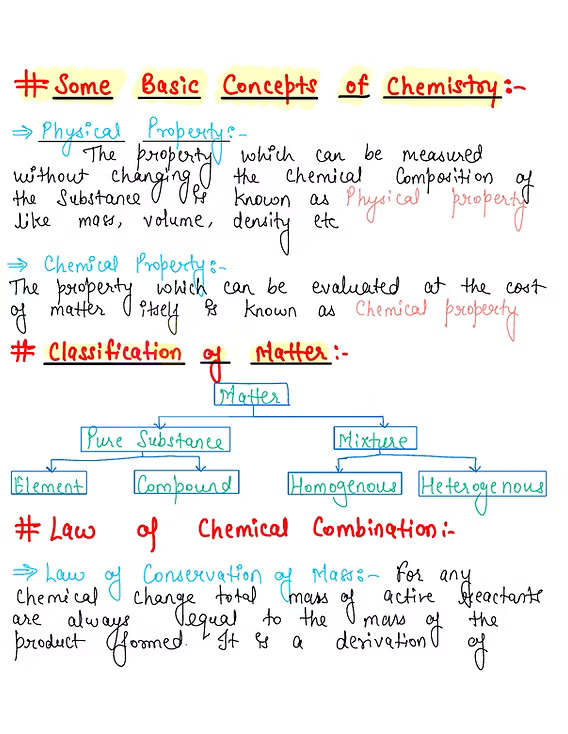
Physical Property: A property that can be measured or observed without changing the chemical composition of a substance. Examples include mass, volume, and density.
Chemical Property: A property that can only be observed by changing the chemical identity of a substance. This involves the substance undergoing a chemical reaction, such as flammability or reactivity with acids.
Example: Measuring the boiling point of water is a physical property, while observing iron rusting is a chemical property.
Classification of Matter
Types of Matter
Matter can be classified based on its composition and uniformity. The two main categories are pure substances and mixtures.
Pure Substance: Matter with a fixed composition and distinct properties. Pure substances are further divided into:
Element: A substance that cannot be broken down into simpler substances by chemical means (e.g., oxygen, gold).
Compound: A substance composed of two or more elements chemically combined in a fixed ratio (e.g., water, carbon dioxide).
Mixture: A combination of two or more substances in which each retains its own identity and properties. Mixtures are classified as:
Homogeneous Mixture: Has a uniform composition throughout (also called a solution; e.g., saltwater).
Heterogeneous Mixture: Does not have a uniform composition (e.g., sand in water).
Matter | Pure Substance | Mixture |
|---|---|---|
Element | Homogeneous | |
Compound | Heterogeneous |
Law of Chemical Combination
Law of Conservation of Mass
The laws of chemical combination describe how substances interact and combine during chemical reactions. One of the most fundamental is the Law of Conservation of Mass.
Law of Conservation of Mass: In any chemical reaction, the total mass of the reactants is always equal to the total mass of the products formed. This means that mass is neither created nor destroyed during a chemical reaction.
Mathematical Expression:
Example: When hydrogen gas reacts with oxygen gas to form water, the combined mass of hydrogen and oxygen before the reaction equals the mass of water produced.
Additional info: The Law of Conservation of Mass is foundational for stoichiometry, which involves calculating the quantities of reactants and products in chemical reactions.
