 뒤로
Stoichiometry and Chemical Equations: Study Notes for General Chemistry
스터디 가이드 - 스마트 노트
 자료에 맞춘 맞춤형 노트, 핵심 정의, 예시, 맥락을 확장해 제공합니다.
Chemical Equations and Stoichiometry
Distinguishing Elements, Compounds, and Ions
Understanding the differences between elements, compounds, and ions is fundamental in chemistry. An element is a pure substance consisting of only one type of atom (e.g., Carbon). A compound is a substance formed from two or more elements chemically bonded (e.g., Carbon dioxide, CO2). An ion is an atom or molecule with a net electric charge due to the loss or gain of electrons (e.g., O2-).
Subatomic Particles
Atoms are composed of three main subatomic particles:
Electron: Negatively charged, ~0 amu, located outside the nucleus.
Proton: Positively charged, ~1 amu, located inside the nucleus.
Neutron: Neutral, ~1 amu, located inside the nucleus.
Atomic Number and Mass Number
The atomic number is the number of protons in an atom and defines the element. The mass number is the sum of protons and neutrons. For example, carbon has an atomic number of 6 and a mass number of approximately 12.01.
Ionic vs. Molecular (Covalent) Compounds
Ionic compounds are formed from the electrostatic attraction between cations and anions (e.g., NaCl). Molecular (covalent) compounds are formed by sharing electrons between atoms (e.g., BrCl).
Writing and Balancing Chemical Equations
Interpreting Chemical Equations
Chemical equations represent the reactants and products in a chemical reaction. Coefficients indicate the number of molecules or moles involved, while subscripts indicate the number of atoms in each molecule.
Reactants: Substances consumed in the reaction.
Products: Substances formed in the reaction.
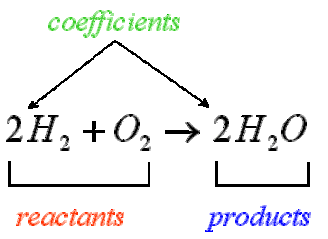
Balancing Chemical Equations
Balancing equations ensures the law of conservation of mass is obeyed: atoms are neither created nor destroyed. The number of each type of atom must be equal on both sides of the equation.
Balance non-hydrogen and non-oxygen atoms first.
Balance hydrogen atoms second.
Balance oxygen atoms last.
Check your work by counting atoms on both sides.
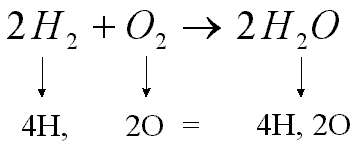
States of Matter in Chemical Equations
Physical states are indicated by abbreviations:
Abbreviation | State |
|---|---|
(g) | gas |
(l) | liquid |
(s) | solid |
(aq) | aqueous (water solution) |
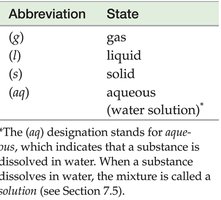
Example: Combustion of Octane
Octane (C8H18) reacts with oxygen to produce carbon dioxide and water. This reaction is important in understanding fuel combustion.
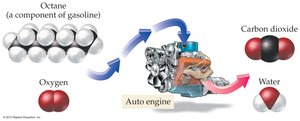
The chemical equation is:
Balancing Example: Methane Combustion
Balancing the combustion of methane:
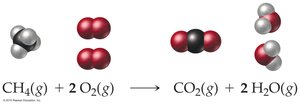
Stoichiometry: Quantitative Relationships in Reactions
Stoichiometry Concepts
Stoichiometry is the calculation of reactant and product quantities in chemical reactions. It relies on balanced equations to relate moles and masses.
Limiting reactant: The reactant that is completely consumed first.
Theoretical yield: The maximum amount of product that can be formed.
Actual yield: The amount of product actually obtained.
Percent yield:
Stoichiometry: Mole-to-Mole Calculations
Balanced equations provide conversion factors between moles of reactants and products. For example, in ammonia synthesis:
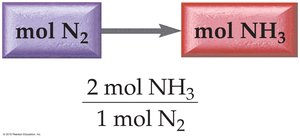
Stoichiometry: Mass-to-Mass Calculations
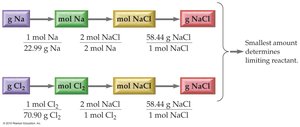
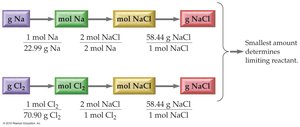
To convert between masses, use molar masses and mole ratios from the balanced equation:

Limiting Reactant and Theoretical Yield
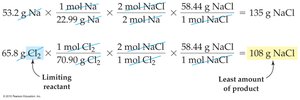
When reactants are not present in exact stoichiometric proportions, the limiting reactant determines the maximum product yield. Theoretical yield is calculated based on the limiting reactant.



Percent Yield
Percent yield measures the efficiency of a reaction:

Example: Limiting Reactant Calculation
For the reaction , given 1.8 mol Ti and 3.2 mol Cl2, calculate the limiting reactant and theoretical yield:
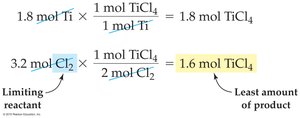
Example: Mass-to-Mass Limiting Reactant
For , given 53.2 g Na and 65.8 g Cl2, find the limiting reactant and theoretical yield:
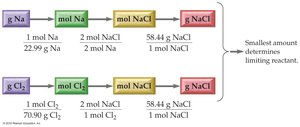
Summary Table: Key Stoichiometric Terms
Term | Definition |
|---|---|
Limiting Reactant | The reactant that is completely consumed in a reaction |
Theoretical Yield | The maximum amount of product that can be formed |
Actual Yield | The amount of product actually obtained |
Percent Yield |
Practice Problems
Balance chemical equations and identify limiting reactants.
Calculate theoretical and actual yields, and percent yield.
Convert between mass and moles using molar masses and stoichiometric ratios.
Additional info: These notes cover the core concepts of chemical reactions, stoichiometry, and balancing equations, directly relevant to General Chemistry chapters on chemical reactions and chemical quantities.
