 뒤로
Stoichiometry and Reaction Calculations in General Chemistry
스터디 가이드 - 스마트 노트
 자료에 맞춘 맞춤형 노트, 핵심 정의, 예시, 맥락을 확장해 제공합니다.
Stoichiometry and Reaction Calculations
Molar Mass and Its Applications
The molar mass of a substance (in g/mol) is numerically equal to its formula weight (in amu), and it serves as a bridge between the atomic scale and laboratory measurements. This allows chemists to convert between moles, mass, and the number of molecules.
Definition: Molar mass is the mass of one mole of a substance, expressed in grams per mole (g/mol).
Conversion: To find the mass of a given number of moles, multiply the number of moles by the molar mass.
Single Molecule Mass: The mass of a single molecule can be found by dividing the molar mass by Avogadro’s number ( molecules/mol).
Example: For ethyl alcohol (MW = 336.5 g/mol): \frac{336.5 \text{ g/mol}}{6.02 \times 10^{23} \text{ molecules/mol}} = 5.6 \times 10^{-22} \text{ g}$
Stoichiometry in Experimental Design
Stoichiometry is essential for designing controlled experiments, ensuring the correct proportions of reactants and predicting product yields.
Balanced Equation Example:
Application: Calculating the mass of iodine () needed to produce a desired amount of nitrogen triiodide (): $
Theoretical Yield: The maximum amount of product predicted by stoichiometry, assuming complete conversion of the limiting reagent.
Experimental Yield: The actual amount of product obtained from an experiment, usually less than the theoretical yield due to losses.
Percent Yield:
Example:

Combustion Analysis and Empirical Formulas
Combustion of Hydrocarbons
Combustion analysis is used to determine the empirical formula of organic compounds by measuring the amounts of and produced.
General Reaction:
Example: If , , the formula is , empirical formula .
Combustion Analysis of Metals
When a metal is heated in air, it forms an oxide, and the mass gain corresponds to the oxygen added. The empirical formula of the oxide can be deduced from mass changes.
Example: 22.2 g metal heated to 37.0 g oxide (mass gain = 14.8 g O, mol O).
Possible Oxides: or .
Calculation: For , (Mg); for , (Ti).
Conclusion: Closest match is Ti, so likely .
The Combustion Train
For organic samples, a combustion train is used to absorb and measure and produced during combustion, allowing for empirical formula determination.
Water Absorption:
Carbon Dioxide Absorption:
Mass Changes: The increase in absorber mass corresponds to the amount of or produced.
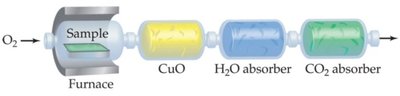
Worked Example: Empirical Formula from Combustion Data
Given a sample containing C, H, and N, the empirical formula can be determined from the masses of and absorbed.
Step 1: Calculate moles of and :
Step 2: Find moles of H and C:
Step 3: Find mass and moles of N by difference:
Step 4: Find empirical formula by dividing by the smallest value: C: H: N: Empirical formula: C5H5N (pyridine)
Limiting Reagents and Reaction Yields
Limiting Reagent Concept
The limiting reagent is the reactant that is completely consumed first in a chemical reaction, thus determining the maximum amount of product that can be formed. Any reactant left over is called the excess reagent.
Steps to Identify Limiting Reagent:
Write a balanced chemical equation.
Convert the given amounts of reactants to moles.
Use stoichiometry to determine how many moles of product each reactant could produce.
The reactant that produces the least amount of product is the limiting reagent.
Example (Skateboards): If you have 100 wheels, 20 decks, and 36 trucks, and each skateboard needs 4 wheels, 1 deck, and 2 trucks: Wheels: Decks: Trucks: Trucks are limiting; you can make 18 skateboards.
Example: The Thermite Reaction
The thermite reaction is a highly exothermic process where a metal oxide reacts with another metal, transferring oxygen and releasing heat. It is commonly used in welding and metal extraction.
Balanced Equation:
Given: 15.0 g and 4.0 g Al
Calculations:
From :
From Al:
Limiting Reagent: Al (produces less Fe)
Mass of Fe Produced:
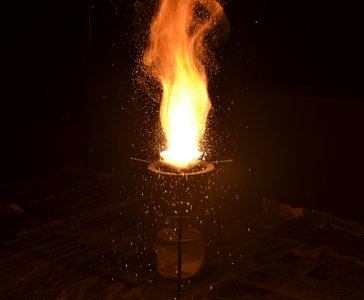
Example: Iron Oxidation in Confined Spaces
Iron can react with oxygen to form rust, which can dangerously deplete oxygen in confined spaces, posing a risk of asphyxiation.
Balanced Equation:
Given: 7.5 kg (234.4 mol), 4.0 kg Fe (71.62 mol)
Rust Formation:
From :
From Fe:
Limiting Reagent: Fe (produces less rust)
Oxygen Consumed:
Oxygen Left Over: ( kg)
Safety Note: A 76% drop in oxygen is close to fatal; drops of 90% are extremely dangerous.
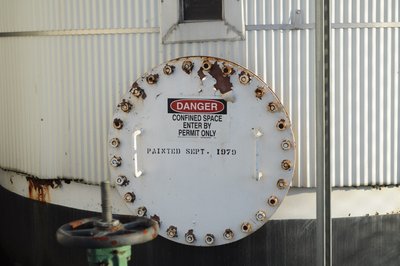
Additional info: The images included are directly relevant to the chemical demonstrations and apparatus described in the notes, reinforcing the concepts of explosive decomposition, combustion analysis, the thermite reaction, and the dangers of oxygen depletion in confined spaces.
