 뒤로
Stoichiometry and Reactions in Aqueous Solution: Study Notes for General Chemistry
스터디 가이드 - 스마트 노트
 자료에 맞춘 맞춤형 노트, 핵심 정의, 예시, 맥락을 확장해 제공합니다.
Stoichiometry: Chemical Reactions and Reaction Stoichiometry
Introduction to Stoichiometry
Stoichiometry is the quantitative study of the relationships between the amounts of reactants and products in chemical reactions. It is based on the Law of Conservation of Mass, which states that mass is neither created nor destroyed in a chemical reaction.
Chemical equations represent reactions, with reactants on the left and products on the right, separated by an arrow.
Coefficients are used to balance equations, ensuring the number of atoms for each element is equal on both sides.
Subscripts in chemical formulas should not be changed when balancing equations; only coefficients are adjusted.
Types of Chemical Reactions
Chemical reactions can be classified into several types, including combination, decomposition, and combustion reactions.
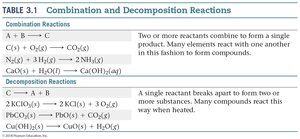
Combination reactions: Two or more substances react to form one product.
Decomposition reactions: One substance breaks down into two or more substances.
Combustion reactions: Rapid reactions that produce a flame, often involving oxygen as a reactant.
Balancing Chemical Equations
A chemical equation is balanced when the number of atoms of each element is the same on both sides. Coefficients are used to achieve this balance.
Example:
Changing subscripts alters the identity of the compound, which is not allowed.
Formula Weight and Molecular Weight
Formula weight is the sum of atomic weights for the atoms in a chemical formula (expressed in amu).
Molecular weight is the sum of atomic weights for the atoms in a molecule.
For ionic compounds, use the empirical formula to calculate formula weight.
Percent Composition
The percentage of mass contributed by each element in a compound can be calculated using:
Avogadro’s Number and the Mole Concept
One mole contains particles (atoms, molecules, or ions).
Molar mass is the mass of 1 mole of a substance (g/mol).
The formula weight (in amu) is numerically equal to the molar mass (in g/mol).

Stoichiometric Calculations
Stoichiometric calculations involve converting between mass, moles, and number of particles using balanced equations and molar relationships.
Use mole ratios from balanced equations to relate quantities of reactants and products.
Example: Calculating grams of water produced from 1.00 g of glucose:


Limiting Reactant, Theoretical Yield, and Percent Yield
Limiting reactant: The reactant present in the smallest stoichiometric amount, which limits the amount of product formed.
Theoretical yield: The maximum amount of product that can be formed from the limiting reactant.
Actual yield: The amount of product actually obtained from the reaction.
Percent yield:
Reactions in Aqueous Solution
Properties of Solutions
Solution: Homogeneous mixture of two or more pure substances.
Solvent: Substance present in greatest abundance.
Solute: All other substances in the solution.
Aqueous solution: Solution where water is the solvent.
Electrolytes and Nonelectrolytes
Electrolyte: Substance that dissociates into ions when dissolved in water.
Nonelectrolyte: Substance that does not dissociate into ions in water.
Strong electrolyte: Dissociates completely in water.
Weak electrolyte: Dissociates partially in water.
Solubility of Ionic Compounds
Not all ionic compounds dissolve in water. Solubility rules help predict which compounds are soluble. 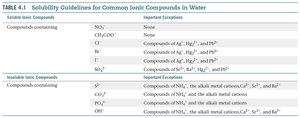
Precipitation Reactions
Occur when two solutions containing soluble salts are mixed and an insoluble salt (precipitate) forms.
Metathesis (double displacement) reactions involve exchange of ions between reactants.
Acids and Bases
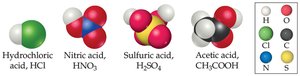
Acids: Substances that ionize in aqueous solution to form H+ ions (proton donors).
Bases: Substances that accept H+ ions or increase OH– concentration in water.
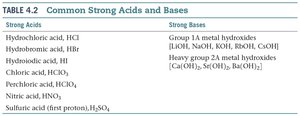
Strong acids and bases dissociate completely; weak acids and bases dissociate partially.
Neutralization Reactions
Reactions between an acid and a base produce water and a salt.
Can be written as molecular, complete ionic, or net ionic equations.

Redox and Displacement Reactions
Oxidation: Loss of electrons.
Reduction: Gain of electrons.
Redox reactions involve transfer of electrons; displacement reactions involve replacement of ions by elements.
Molarity and Solution Concentration
Molarity (M):
Concentration can be changed by dilution:
Titration: Analytical technique to determine concentration of a solute.
Summary Table: Combination and Decomposition Reactions
Type | General Equation | Example | Description |
|---|---|---|---|
Combination | A + B → C | 2K(s) + Cl2(g) → 2KCl(s) | Two or more reactants combine to form a single product. |
Decomposition | C → A + B | 2KClO3(s) → 2KCl(s) + 3O2(g) | A single reactant breaks apart to form two or more substances. |
Summary Table: Common Strong Acids and Bases
Strong Acids | Strong Bases |
|---|---|
Hydrochloric acid (HCl) Hydrobromic acid (HBr) Hydroiodic acid (HI) Chloric acid (HClO3) Perchloric acid (HClO4) Nitric acid (HNO3) Sulfuric acid (H2SO4) | Group 1A metal hydroxides (LiOH, NaOH, KOH, RbOH, CsOH) Heavy group 2A metal hydroxides (Ca(OH)2, Sr(OH)2, Ba(OH)2) |
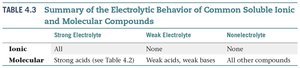
Summary Table: Electrolytic Behavior of Compounds
Strong Electrolyte | Weak Electrolyte | Nonelectrolyte | |
|---|---|---|---|
Ionic | All | None | None |
Molecular | Strong acids | Weak acids, weak bases | All other compounds |
Summary Table: Solubility Guidelines for Ionic Compounds
Soluble Ionic Compounds | Important Exceptions |
|---|---|
NO3–, CH3COO–, Cl–, Br–, I–, SO42– | Compounds of Ag+, Hg22+, Pb2+ (for Cl–, Br–, I–); Compounds of Ba2+, Hg22+, Pb2+ (for SO42–) |
Insoluble Ionic Compounds | Important Exceptions |
S2–, CO32–, PO43–, OH– | Compounds of NH4+, alkali metal cations (for all); Ca2+, Sr2+, Ba2+ (for OH–) |
Summary Table: Steps in Stoichiometric Calculations
Step | Description |
|---|---|
1 | Convert grams of substance A to moles using molar mass. |
2 | Use coefficients from balanced equation to convert moles of A to moles of B. |
3 | Convert moles of B to grams using molar mass. |
Example: Acid-Base Neutralization
Reaction:
Acid reacts with base to produce water and salt.
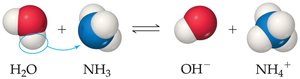
Example: Acid-Base Molecular Models
Example: Acid-Base Reaction Mechanism
Example: Stoichiometric Calculation for Water Produced
Example: Conversion Pathways in Stoichiometry
Example: Steps in Stoichiometric Calculations
Additional info:
Tables and images included are directly relevant to the explanation of combination/decomposition reactions, acid-base chemistry, stoichiometric calculations, and solubility rules.
All equations are provided in LaTeX format for clarity and academic rigor.
