 뒤로
Stoichiometry of Formulas and Equations: The Mole, Chemical Formulas, and Reaction Calculations
스터디 가이드 - 스마트 노트
 자료에 맞춘 맞춤형 노트, 핵심 정의, 예시, 맥락을 확장해 제공합니다.
Stoichiometry of Formulas and Equations
The Mole
The mole (mol) is the SI unit for the amount of substance. It is defined as the amount of a substance that contains as many entities (atoms, molecules, ions, etc.) as there are atoms in exactly 12 grams of carbon-12. This number is known as Avogadro’s number:
Avogadro’s number (NA): entities/mol
The mass in atomic mass units (amu) of one atom or molecule is numerically equal to the mass in grams of one mole of that substance.
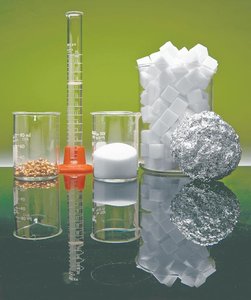
Molar Mass
The molar mass (M) of a substance is the mass of one mole of its entities, expressed in grams per mole (g/mol).
For monatomic elements, the molar mass is the atomic mass from the periodic table (in g/mol).
For molecules or compounds, the molar mass is the sum of the atomic masses of all atoms in the formula.
Example: Molar mass of O2 = g/mol
Example: Molar mass of SO2 = g/mol
Interconverting Moles, Mass, and Number of Entities
Stoichiometric calculations often require converting between mass, moles, and number of entities (atoms, molecules, etc.). The following relationships are fundamental:
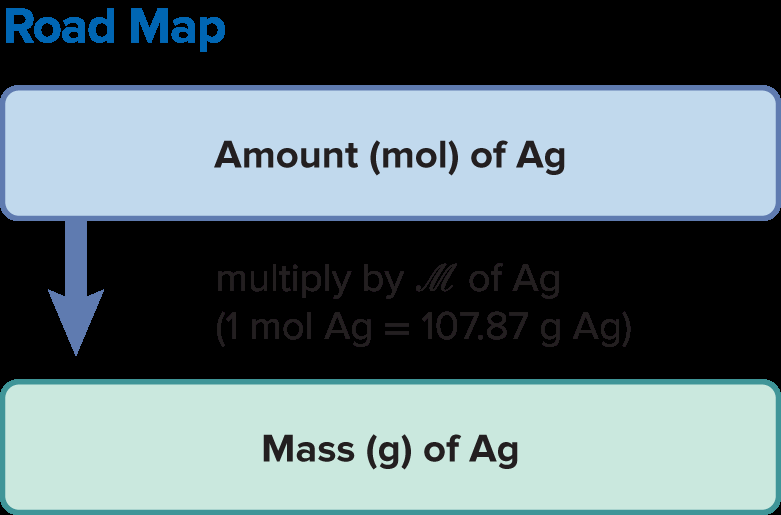
Mass (g) = Amount (mol) Molar Mass (g/mol):
Amount (mol) = Mass (g) Molar Mass (g/mol):
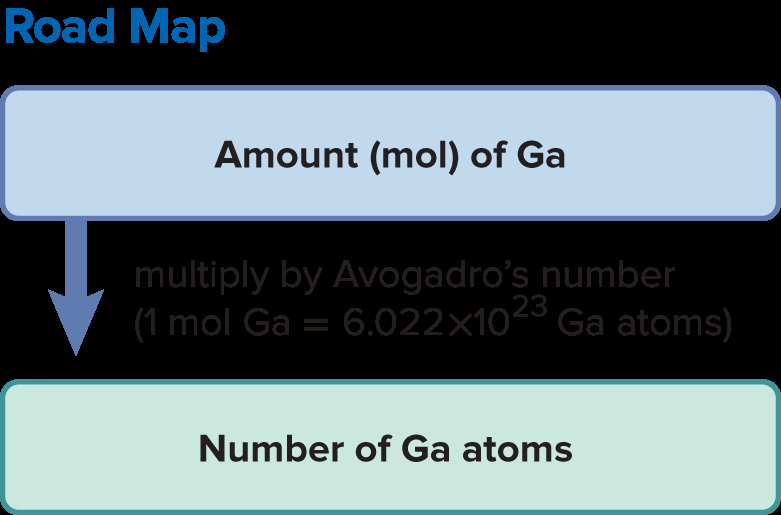
Number of entities = Amount (mol) Avogadro’s number:
Amount (mol) = Number of entities Avogadro’s number:
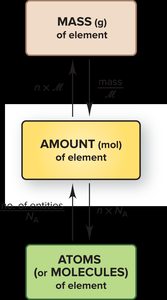
Sample Calculations: Mass, Moles, and Entities
To convert moles to mass: multiply by molar mass.
To convert moles to number of entities: multiply by Avogadro’s number.
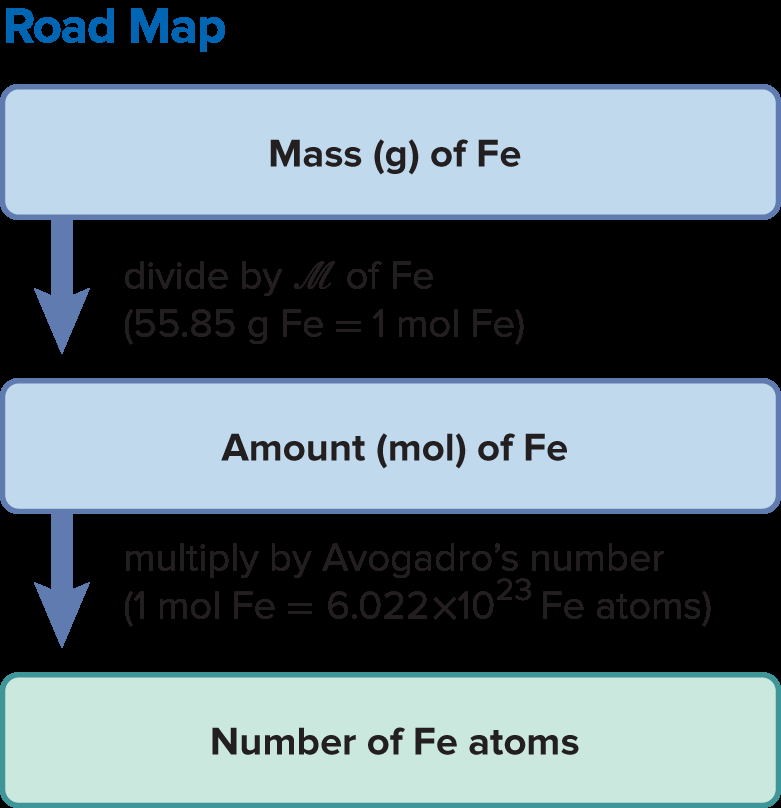
To convert mass to number of entities: first convert mass to moles, then moles to entities.
Mass Percent Composition
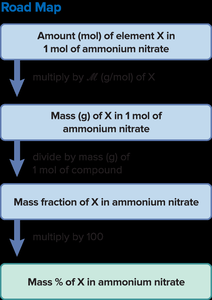
The mass percent of an element in a compound is the fraction by mass of that element, expressed as a percentage:
Mass % of element X =
Empirical, Molecular, and Structural Formulas
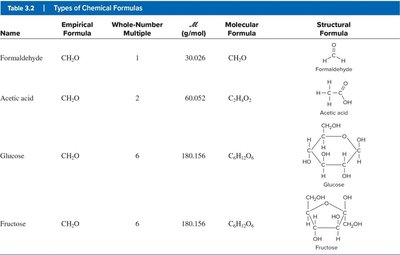
Compounds can be represented by different types of formulas:
Empirical formula: Simplest whole-number ratio of elements in a compound.
Molecular formula: Actual number of atoms of each element in a molecule.
Structural formula: Shows the arrangement of atoms within the molecule.
Determining Empirical and Molecular Formulas
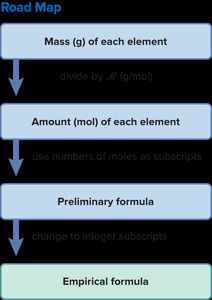
To determine the empirical formula from elemental analysis:
Convert masses of elements to moles.
Divide by the smallest number of moles to get the simplest ratio.
Multiply to obtain whole numbers if necessary.
Combustion Analysis
Combustion analysis is a technique used to determine the amounts of carbon and hydrogen in organic compounds by burning a known mass of the compound and measuring the masses of CO2 and H2O produced.
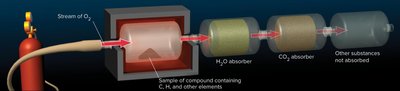
Chemical Equations and Balancing
Writing and Balancing Chemical Equations
A chemical equation uses chemical formulas to represent the substances involved in a chemical reaction. The equation must be balanced so that the number and type of atoms are the same on both sides.
Translate the reaction into a skeleton equation.
Balance atoms by adjusting coefficients.
Check that all atoms are balanced.
Specify the physical states (s, l, g, aq).
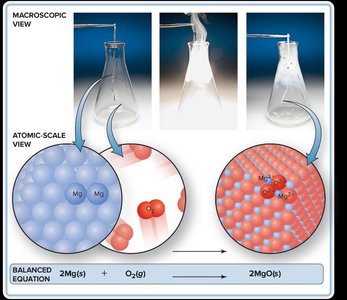
Visualizing Chemical Reactions
Chemical reactions can be visualized at the macroscopic, atomic, and symbolic levels. For example, the combustion of octane (C8H18) in oxygen produces carbon dioxide and water:
Balanced equation:
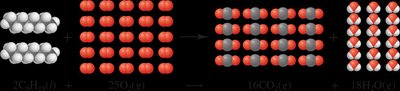
Stoichiometric Calculations
Stoichiometric Relationships in Chemical Equations
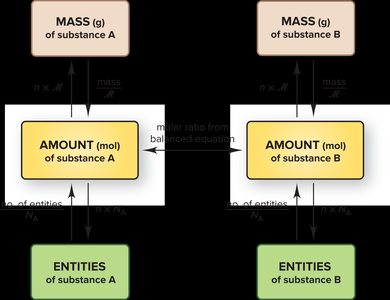
In a balanced chemical equation, the coefficients represent the stoichiometric ratios between reactants and products. These ratios are used as conversion factors in calculations.
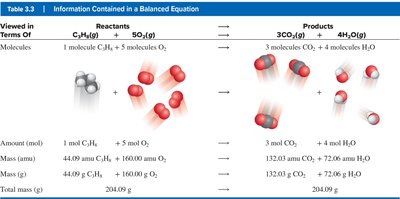
Calculating Quantities of Reactants and Products
To calculate the amount of a reactant or product:
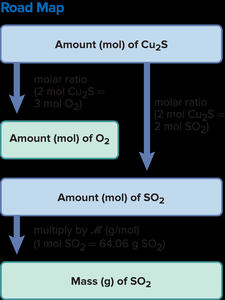
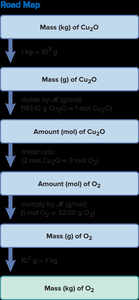
Convert the given quantity to moles.
Use the stoichiometric ratio from the balanced equation to find moles of the desired substance.
Convert moles to mass or number of entities as needed.
Limiting Reactants and Excess Reactants
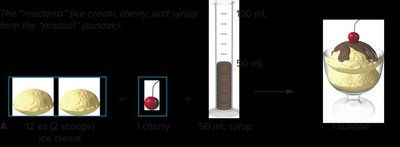
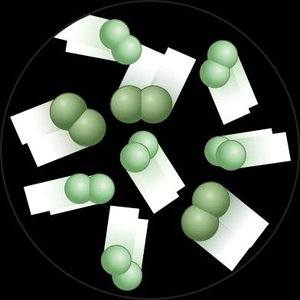
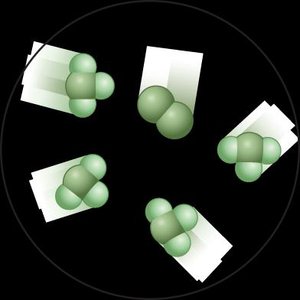
In many reactions, one reactant is completely consumed first, limiting the amount of product formed. This is the limiting reactant. The other reactant(s) are in excess.
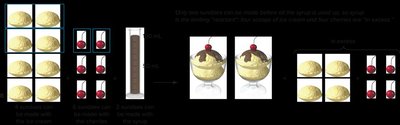
Using Molecular Depictions in Limiting-Reactant Problems
Molecular depictions can help visualize which reactant is limiting and how many molecules of product can be formed.
Reaction Yields
The theoretical yield is the maximum amount of product that can be formed from the limiting reactant. The actual yield is the amount actually obtained. The percent yield is calculated as:
Summary Table: Key Stoichiometric Relationships
Quantity Given | Conversion | Quantity Sought |
|---|---|---|
Mass (g) | Divide by molar mass | Moles |
Moles | Multiply by Avogadro’s number | Number of entities |
Moles of A | Stoichiometric ratio from equation | Moles of B |
Moles | Multiply by molar mass | Mass (g) |
