뒤로
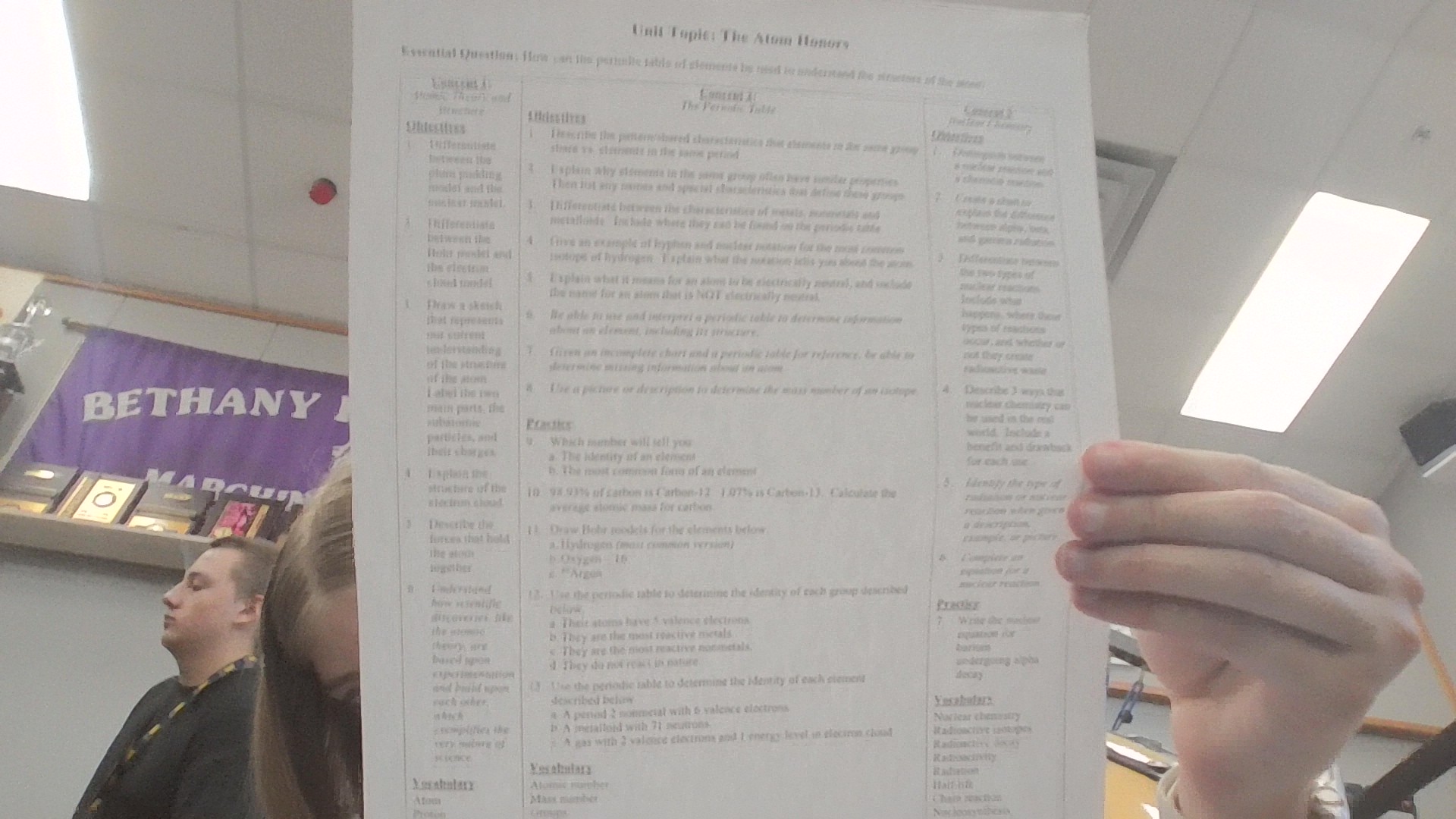
Study Guide: The Atom, Periodic Table, and Nuclear Chemistry
스터디 가이드 - 스마트 노트
 자료에 맞춘 맞춤형 노트, 핵심 정의, 예시, 맥락을 확장해 제공합니다.
The Atom: History and Structure
Objectives
This section introduces the fundamental concepts of atomic structure and the historical development of atomic theory. Understanding these concepts is essential for grasping the behavior of elements and their interactions.
Differentiation: Distinguish between the proton, neutron, and electron, including their charges and locations within the atom.
Bohr Model: Draw and interpret Bohr models to represent atomic structure, including main parts, subatomic particles, and their charges.
Atomic Structure: Explain the structure of the atom, including the nucleus and electron cloud.
Forces: Describe the forces that hold the atom together, such as electromagnetic and nuclear forces.
Historical Context: Understand how scientific models of the atom have evolved based on experimentation and evidence.
Key Vocabulary
Atom: The smallest unit of an element, consisting of protons, neutrons, and electrons.
Atomic Number: The number of protons in the nucleus of an atom.
Mass Number: The sum of protons and neutrons in the nucleus.
Example
Hydrogen has 1 proton, 0 neutrons, and 1 electron. Its atomic number is 1, and its mass number is 1.
The Periodic Table
Objectives
The periodic table organizes elements based on their properties and atomic structure. This section covers how to interpret and use the periodic table for chemical analysis.
Group Characteristics: Identify patterns and characteristics that elements in the same group share.
Valence Electrons: Explain why elements in the same group have similar properties due to their valence electrons.
Metals, Nonmetals, Metalloids: List and describe the properties of metals, nonmetals, and metalloids.
Electroneutrality: Explain what it means for an atom to be electrically neutral and identify ions.
Periodic Table Interpretation: Use and interpret the periodic table to determine information about elements, including their symbols and atomic numbers.
Isotopes: Use pictures or descriptions to determine the mass number of an isotope.
Practice Questions
Which number tells you:
The identity of an element?
The most common form of an element?
If 98.93% of carbon is Carbon-12 and 1.07% is Carbon-13, calculate the average atomic mass for carbon.
Draw Bohr models for hydrogen, oxygen, and argon.
Use the periodic table to determine the identity of elements based on valence electrons and other properties.
Key Vocabulary
Valence Electrons: Electrons in the outermost shell of an atom, important for chemical bonding.
Isotope: Atoms of the same element with different numbers of neutrons.
Nuclear Chemistry
Objectives
Nuclear chemistry explores the changes that occur in the nucleus of atoms, including radioactive decay and nuclear reactions. This section covers the types of radiation and their effects.
Radioactive Isotopes: Distinguish between radioactive and non-radioactive isotopes.
Types of Radiation: Create charts to explain differences between alpha, beta, and gamma radiation.
Nuclear Reactions: Differentiate between types of nuclear reactions and describe their effects.
Applications: Describe ways nuclear chemistry is used in the real world, including benefits and drawbacks.
Radiation Identification: Identify types of radiation and write nuclear equations for reactions.
Practice Questions
Write nuclear equations for alpha decay.
Identify the type of radiation in a given reaction.
Key Vocabulary
Nuclear Chemistry: The study of changes in atomic nuclei.
Radioactive Isotope: An isotope that undergoes radioactive decay.
Radiation: Energy emitted from a nucleus during decay.
Alpha, Beta, Gamma: Types of radiation emitted during nuclear reactions.
Example
Alpha decay:
Summary Table: Atomic Structure and Periodic Table
Term | Definition | Example |
|---|---|---|
Atomic Number | Number of protons in nucleus | Hydrogen: 1 |
Mass Number | Protons + Neutrons | Carbon-12: 12 |
Isotope | Same element, different neutrons | Carbon-12, Carbon-13 |
Valence Electrons | Electrons in outer shell | Oxygen: 6 |
Summary Table: Types of Radiation
Type | Symbol | Penetration | Example |
|---|---|---|---|
Alpha | Low | ||
Beta | Medium | ||
Gamma | High | Accompanies other decay |