 뒤로
The Discovery of the Electron: Key Experiments and Models
스터디 가이드 - 스마트 노트
 자료에 맞춘 맞춤형 노트, 핵심 정의, 예시, 맥락을 확장해 제공합니다.
Atoms and Elements
The Discovery of the Electron
The structure of the atom was first explored through a series of experiments in the late 19th and early 20th centuries. Early atomic theory, as proposed by John Dalton, described atoms as indivisible particles. However, experiments with cathode rays revealed the existence of subatomic particles, specifically the electron.
John Dalton's Model: Atoms are solid, indivisible particles ("billiard balls").
Discovery of Subatomic Particles: Experiments with cathode ray tubes (CRT) led to the identification of electrons as components of atoms.
Key Contributors: Johann Hittorf, William Crookes, Karl Ferdinand Braun, J. J. Thomson, and Robert Millikan.
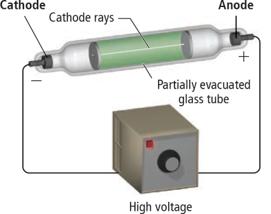
Thomson’s Cathode Ray Experiment
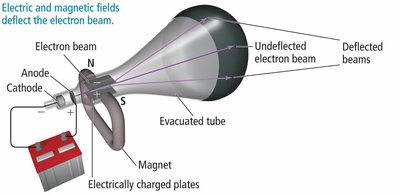
J. J. Thomson used a cathode ray tube to investigate the properties of cathode rays. He observed that these rays originated from the cathode (negative electrode) and traveled to the anode (positive electrode), regardless of the metal used for the electrodes.
Cathode Ray Tube (CRT): A partially evacuated glass tube with electrodes at each end, connected to a high voltage power source.
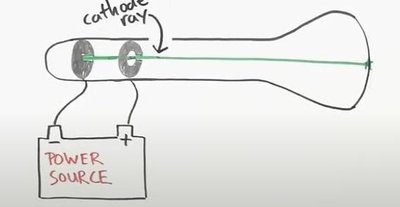
Observation: A beam (cathode ray) travels from the cathode to the anode.
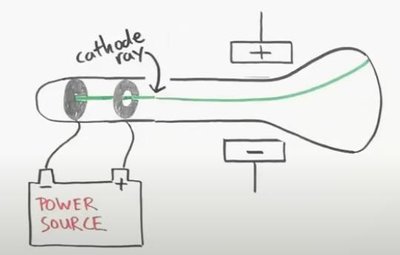
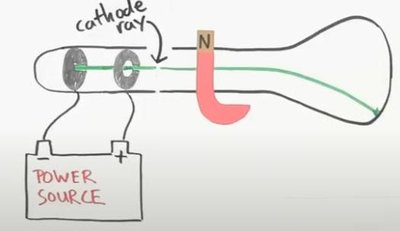
Deflection by Electric and Magnetic Fields
Thomson applied electric and magnetic fields to the cathode ray tube. He observed that the rays bent toward the positive plate and away from the negative plate, indicating that the particles in the rays carried a negative charge. The rays also bent in the presence of a magnetic field, further confirming their particle nature.
Electric Field: Cathode rays are attracted to the positive plate and repelled by the negative plate.
Magnetic Field: The path of the rays bends in the presence of a magnetic field, consistent with the behavior of charged particles.
Conclusion: Cathode rays are composed of negatively charged particles, later named electrons.
Universality of Electrons
Thomson found that the same results occurred regardless of the metal used for the cathode, suggesting that electrons are a universal component of all atoms.
Determining the Charge-to-Mass Ratio of the Electron
Thomson measured the extent of deflection of cathode rays in the presence of known electric and magnetic fields. By balancing the forces, he was able to calculate the charge-to-mass ratio (e/m) of the electron.
Key Equations:
Kinetic energy:
Force balance:
Charge-to-mass ratio:
Result: or
Thomson’s Atomic Model: The Plum Pudding Model
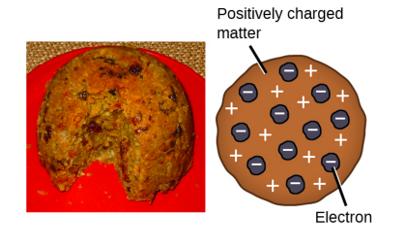
Based on his findings, Thomson proposed the "plum pudding" model of the atom, in which electrons are embedded in a sphere of positive charge, much like raisins in a pudding or blueberries in a muffin.
Electrons: Negatively charged, low-mass particles within the atom.
Positive Charge: Spread throughout the atom to balance the negative electrons, making the atom overall neutral.
Millikan’s Oil Drop Experiment: Measuring the Electron’s Charge
Experimental Setup and Method
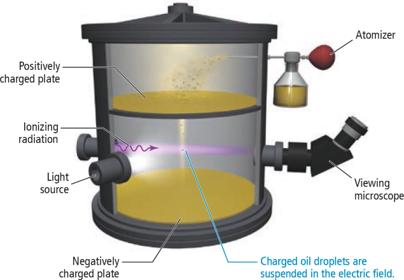
Robert Millikan performed the oil drop experiment to determine the charge of a single electron. He sprayed tiny oil droplets into a chamber, where they became electrically charged by ionizing radiation. The droplets were suspended between two electrically charged plates, and their motion was observed through a microscope.
Electric Force (upward): The positively charged plate attracts, and the negatively charged plate repels the negatively charged oil droplets.
Gravitational Force (downward): The weight of the droplets pulls them downward.
Balance Point: When the electric force equals the gravitational force, the droplet remains suspended.
Results and Calculations
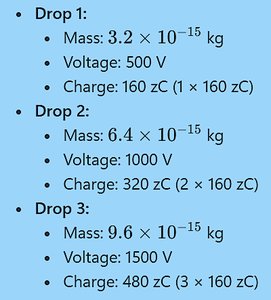
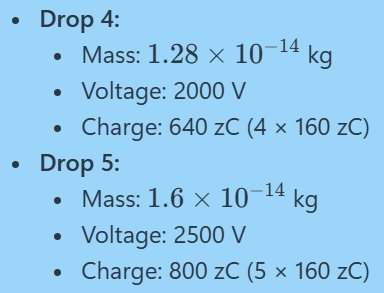
Millikan measured the mass and charge of individual oil droplets. He found that the charges were always multiples of a fundamental value, which he identified as the charge of a single electron.
Fundamental Charge: (negative for electrons)
Calculation of Electron Mass: Using Thomson’s charge-to-mass ratio and Millikan’s charge value, the mass of the electron was determined to be .
Key Discoveries and Contributions
Exact Charge of Electron:
Mass of Electron:
Conceptual Application
Example Problem
Suppose that one of Millikan’s oil drops has a charge of . How many electrons does the drop contain?
Solution: Number of electrons electrons.
