 뒤로
The Mole Concept and Chemical Quantities: Study Notes for General Chemistry
스터디 가이드 - 스마트 노트
 자료에 맞춘 맞춤형 노트, 핵심 정의, 예시, 맥락을 확장해 제공합니다.
The Mole Concept
Avogadro’s Number
Avogadro’s number is a fundamental constant in chemistry, representing the number of atoms, molecules, or particles in one mole of a substance. It is defined as the number of atoms in exactly 12.01 grams of carbon-12.
Avogadro’s number (N): particles per mole
Application: Used to relate microscopic particles to macroscopic quantities.
Example: 1 mole of sodium contains sodium atoms.
The Mole
The mole (mol) is the SI unit for the amount of substance. It allows chemists to count particles by weighing them.
Definition: 1 mole = Avogadro’s number of particles
Usage: Used to convert between atoms/molecules and grams.
Mole Calculations
Mole calculations are essential for converting between mass, moles, and number of particles. The unit analysis method is used to systematically solve these problems.
Step 1: Write down the unit asked for in the answer.
Step 2: Write down the given value related to the answer.
Step 3: Apply unit factor(s) to convert the unit in the given value to the unit in the answer.
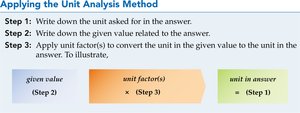
Example: To find the number of sodium atoms in 0.240 mol Na, multiply 0.240 mol by Avogadro’s number.
Molar Mass
Definition and Calculation
The molar mass (MM) of a substance is the mass of one mole of that substance, expressed in grams. It is numerically equal to the atomic or molecular mass in atomic mass units (amu).
Atomic mass of carbon: 12.01 amu
Molar mass of carbon: 12.01 g/mol
Molar mass of nitrogen gas (N2): g/mol
Calculation: Sum the atomic masses of each element in the compound.
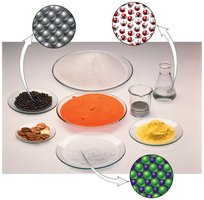
Example: The molar mass of copper(II) nitrite is the sum of the atomic masses of copper, nitrogen, and oxygen.
Mole–Mass and Mole–Particle Calculations
Conversions Using Molar Mass and Avogadro’s Number
To convert between mass, moles, and particles, use the following relationships:
Mass to moles:
Moles to particles:
Particles to mass: Convert particles to moles, then moles to mass.
Example: To find the mass of 1.33 moles of titanium, multiply by the molar mass: g.
Molar Volume of Gases
Standard Temperature and Pressure (STP)
At STP (0°C and 1 atm), one mole of any gas occupies 22.4 liters. This is known as the molar volume.
STP conditions: 0°C (273.15 K), 1 atm
Molar volume: 1 mol = 22.4 L
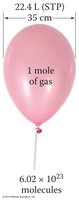
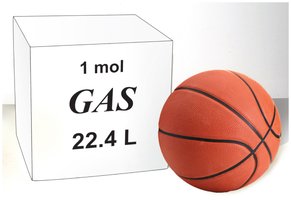
Example: To find the number of moles in 4.50 L of methane at STP, use .
Gas Density and Molar Mass
The density of a gas at STP can be calculated using its molar mass and molar volume.
Gas density formula:
Example: The density of methane at STP is g/L.
Percent Composition
Definition and Calculation
Percent composition expresses the mass percent of each element in a compound. It is calculated by dividing the mass of each element by the total molar mass and multiplying by 100%.
Formula:
Example: Water (H2O) is 11% hydrogen and 89% oxygen by mass.
Steps for Calculating Percent Composition
Assume 1 mole of the compound.
Calculate the mass of each element in 1 mole.
Divide each element’s mass by the total molar mass.
Multiply by 100% to get the percent composition.
Empirical and Molecular Formulas
Empirical Formula
The empirical formula is the simplest whole-number ratio of atoms in a compound. It can be determined from mass or percent composition data.
Example: Benzene’s molecular formula is C6H6, empirical formula is CH.
Calculation: Convert mass or percent composition to moles, then find the simplest ratio.
Molecular Formula
The molecular formula is a whole-number multiple of the empirical formula. It represents the actual number of atoms in a molecule.
Formula:
Find n:
Example: Acetylene’s empirical formula is CH; molecular formula is C2H2 (n = 2).
Summary Table: Mole Relationships for Selected Gases
Below is a summary table describing the relationships between moles, mass, volume, and particles for gases at STP:
Quantity | Unit Factor | Example |
|---|---|---|
Moles to Mass | 1 mol = molar mass (g) | 1 mol C = 12.01 g |
Moles to Particles | 1 mol = particles | 1 mol Na = atoms |
Moles to Volume (gas at STP) | 1 mol = 22.4 L | 1 mol O2 = 22.4 L |
Additional info: These relationships are fundamental for stoichiometric calculations in chemistry, allowing conversion between different units commonly used in laboratory and theoretical work.
