 뒤로
Thermochemistry and Calorimetry: Study Notes for General Chemistry
스터디 가이드 - 스마트 노트
 자료에 맞춘 맞춤형 노트, 핵심 정의, 예시, 맥락을 확장해 제공합니다.
Thermochemistry and Thermodynamics
Introduction to Thermochemistry
Thermochemistry is the branch of chemistry concerned with the energy changes, particularly heat, that accompany chemical reactions. Thermodynamics more broadly studies the movement and transformation of energy from one form to another.
Energy: The capacity to do work or transfer heat. It cannot be created or destroyed (First Law of Thermodynamics).
Work: Energy used to move an object against a force.
Heat: Energy transferred due to temperature difference.
Units: Joule (J), Calorie (cal), 1 cal = 4.184 J.
Forms of Energy
Energy exists in two main forms: kinetic and potential.
Kinetic Energy (Ek): Energy of motion, given by where m is mass (kg) and v is velocity (m/s).
Potential Energy: Stored energy due to position or configuration, such as chemical bonds or gravitational position.
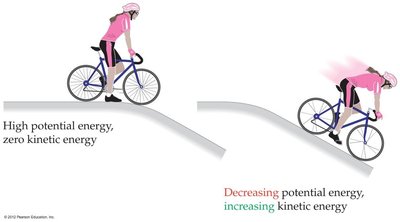
Example: A cyclist at the top of a hill has high potential energy and zero kinetic energy. As the cyclist descends, potential energy decreases and kinetic energy increases.
Electrostatic Potential Energy
Electrostatic potential energy is crucial in chemistry, as it relates to the interactions between charged particles (ions, electrons).
Formula: , where is Coulomb's constant, and are charges, and is the separation distance.
Like charges repel, opposite charges attract.
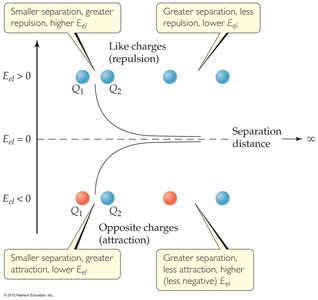
Example: The energy between two ions depends on their charges and the distance between them.
Energy Transfer: Heat and Work
Transferring Energy
Energy can be transferred as heat (q) or work (w).
Heat flows from high to low temperature.
Work is done when a force moves an object: .
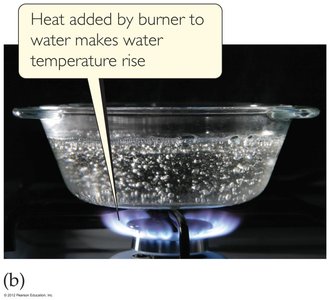
Example: Heating water on a stove transfers energy as heat, raising the water's temperature.
System and Surroundings
To analyze energy changes, chemists define a system (the part under study) and its surroundings (everything else).
Open system: Both energy and matter can be exchanged.
Closed system: Only energy can be exchanged.
Isolated system: Neither energy nor matter can be exchanged.
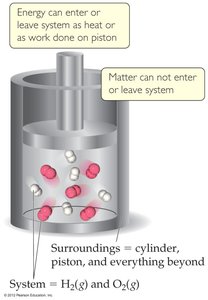

Example: A thermos bottle approximates an isolated system, minimizing heat exchange with surroundings.
First Law of Thermodynamics
Internal Energy and Energy Changes
The First Law states that the total energy of the universe is constant. Energy can change form but cannot be created or destroyed.
Internal energy (E): The sum of all kinetic and potential energies within a system.
Change in internal energy:
Energy change in a process:
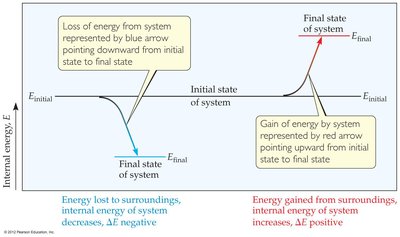
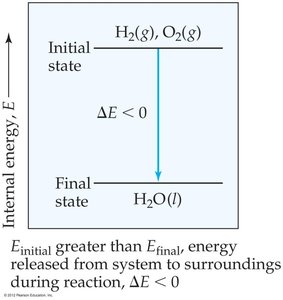
Example: In a chemical reaction, if the system releases energy, is negative (exothermic).
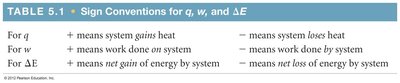
Sign Conventions
Quantity | Positive (+) | Negative (-) |
|---|---|---|
q (heat) | System gains heat | System loses heat |
w (work) | Work done on system | Work done by system |
Net gain of energy | Net loss of energy |
Endothermic and Exothermic Processes
Endothermic: System absorbs heat (), e.g., melting ice.
Exothermic: System releases heat (), e.g., combustion.
Enthalpy and Heats of Reaction
Enthalpy () and Enthalpy Change ()
Enthalpy is a state function used to describe heat flow at constant pressure.
Definition:
Enthalpy change:
Sign notation: (endothermic), (exothermic)
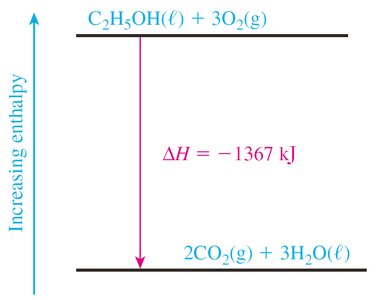
Example: Combustion of ethanol: kJ, indicating an exothermic reaction.
Standard Enthalpy of Formation ()
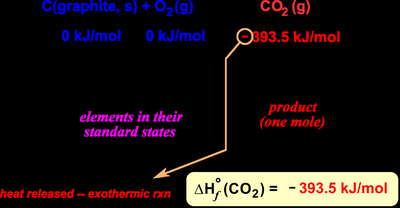
The standard enthalpy of formation is the enthalpy change when one mole of a compound forms from its elements in their standard states at 1 atm and 298 K.
for elements in their standard state.
Pay attention to the physical state (solid, liquid, gas) of substances.
Enthalpy and Stoichiometry
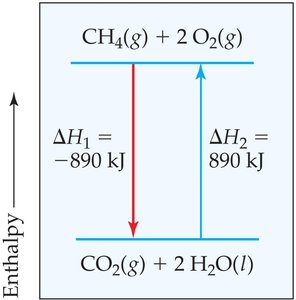
Enthalpy is an extensive property, depending on the amount of substance. The enthalpy change for a reaction is proportional to the stoichiometric coefficients.
Example: If 1 mol CH4 reacts, 890 kJ of heat is released.
Reversing a reaction changes the sign of .
Hess's Law
Combining Reactions
Hess's Law states that the enthalpy change for a reaction is the sum of the enthalpy changes for individual steps.
Overall can be calculated from tabulated values:
Calorimetry
Measuring Heat Flow
Calorimetry is the experimental measurement of heat flow during a chemical reaction.
Heat capacity (C): Amount of heat required to raise temperature by 1°C or 1 K.
Specific heat capacity (Cs): Heat capacity per gram,
Molar heat capacity: Heat capacity per mole.
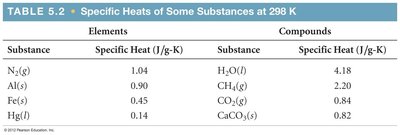
Substance | Specific Heat (J/g·K) |
|---|---|
H2O (l) | 4.18 |
Al (s) | 0.90 |
Fe (s) | 0.45 |
CO2 (g) | 0.84 |
CaCO3 (s) | 0.82 |
Types of Calorimeters
Bomb calorimeter: Measures heat at constant volume, used for combustion reactions.
Coffee cup calorimeter: Measures heat at constant pressure, used for reactions in solution.
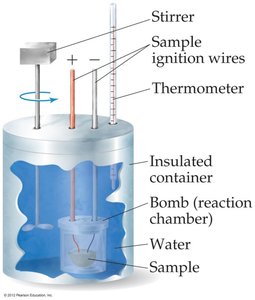
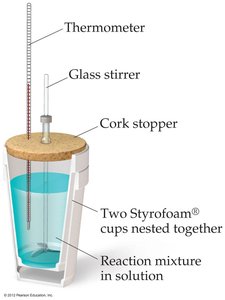
Example: In a coffee cup calorimeter, the heat absorbed by the solution equals the heat released by the reaction: .
Summary of Key Equations
Kinetic energy:
Electrostatic potential energy:
Work:
Internal energy change:
Enthalpy:
Enthalpy change:
Hess's Law:
Specific heat:
Additional info: These notes expand on the original material by providing definitions, examples, and equations in a structured format suitable for exam preparation. All included images directly reinforce the concepts explained in the adjacent paragraphs.
