 뒤로
Thermochemistry: Energy, Systems, and Enthalpy in Chemical Reactions
스터디 가이드 - 스마트 노트
 자료에 맞춘 맞춤형 노트, 핵심 정의, 예시, 맥락을 확장해 제공합니다.
Thermochemistry
Introduction to Thermochemistry
Thermochemistry is a branch of thermodynamics that studies the energy changes, particularly heat, associated with chemical reactions. Understanding these energy changes is essential for predicting reaction behavior and designing chemical processes.
Energy and Its Measurement
Units of Energy
Energy is the ability to do work or transfer heat. The SI unit of energy is the joule (J), defined as:
1 J = 1 kg·m2/s2
Alternate unit: calorie (cal) — the energy required to raise the temperature of 1 gram of water by 1°C.
Conversion: 1 cal = 4.184 J; 1 J = 0.2390 cal
















Systems and Surroundings
Definitions
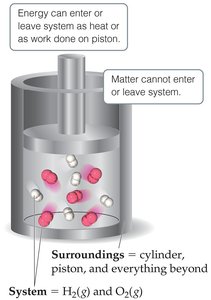
The system is the part of the universe chosen for study (e.g., reactants in a reaction), while the surroundings are everything else.
System: Hydrogen and oxygen molecules in a cylinder.
Surroundings: Cylinder, piston, and everything beyond.
Types of Systems
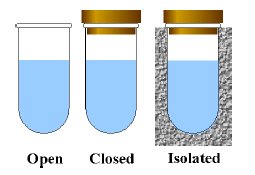
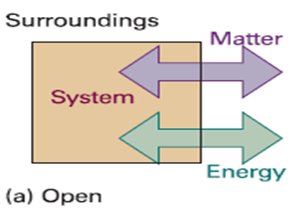
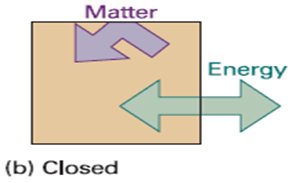
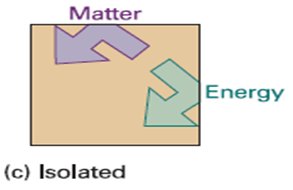
Systems are classified based on their ability to exchange matter and energy with surroundings:
Open system: Exchanges both matter and energy.
Closed system: Exchanges energy but not matter.
Isolated system: Exchanges neither matter nor energy.
Internal Energy and Its Changes
Internal Energy
The internal energy (U) of a system is the sum of all kinetic and potential energies of its components. The change in internal energy is:
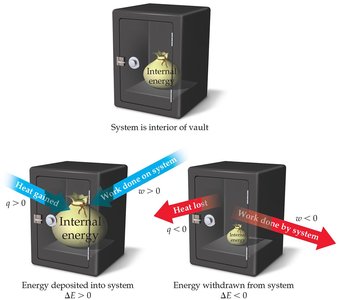
Energy can be transferred as heat (q) or work (w):
Sign Conventions
Thermodynamic quantities have three parts: a number, a unit, and a sign. The sign indicates the direction of energy transfer:
Positive : System gains energy.
Negative : System loses energy.
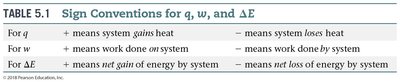
Quantity | Positive Sign | Negative Sign |
|---|---|---|
q | System gains heat | System loses heat |
w | Work done on system | Work done by system |
ΔE | Net gain of energy by system | Net loss of energy by system |
Heat Exchange: Endothermic and Exothermic Processes
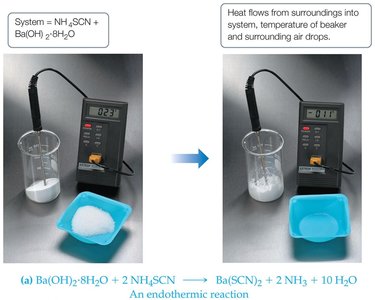
Endothermic Processes
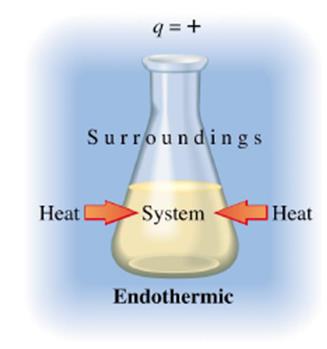
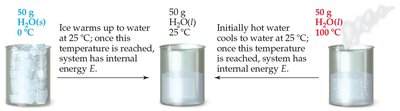
When heat is absorbed by the system from the surroundings, the process is endothermic. The temperature of the surroundings decreases.
Exothermic Processes
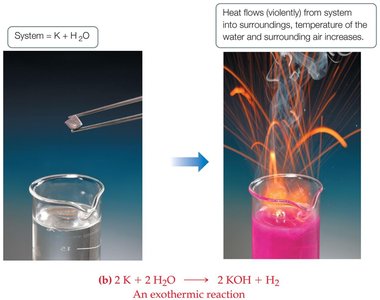
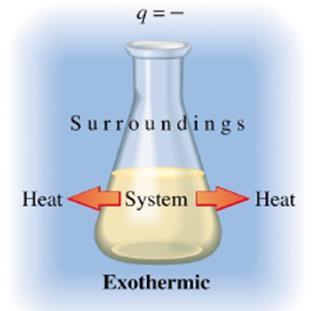
When heat is released by the system into the surroundings, the process is exothermic. The temperature of the surroundings increases.
State Functions
Definition and Examples
A state function depends only on the current state of the system, not the path taken to reach that state. Internal energy is a state function.
Examples: Internal energy, enthalpy, pressure, volume, temperature.
Work in Thermochemistry
Pressure-Volume Work
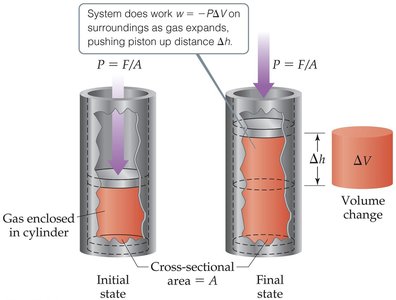
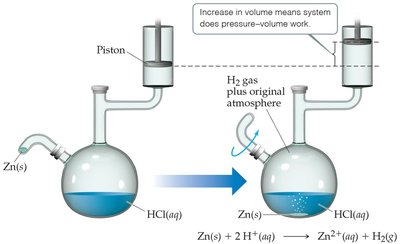
Work is often associated with changes in volume of gases. The work done by a system at constant pressure is:
The negative sign indicates work done by the system on the surroundings.
Example Calculation
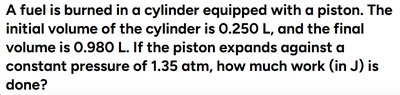
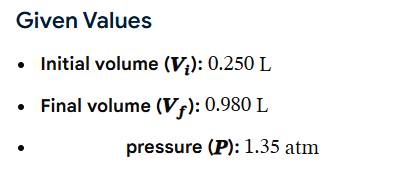
Given: Initial volume = 0.250 L, Final volume = 0.980 L, Pressure = 1.35 atm.
Convert to m3:
Pressure:
Enthalpy (H)
Definition and Properties
Enthalpy (H) is the internal energy plus the product of pressure and volume:
At constant pressure, the change in enthalpy () is the heat gained or lost:
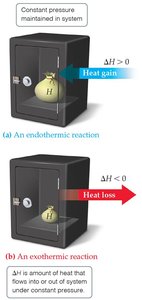
Endothermic vs. Exothermic Reactions
Endothermic: Heat absorbed,
Exothermic: Heat released,
Enthalpy of Reaction
The enthalpy of reaction () is the difference between the enthalpy of products and reactants:
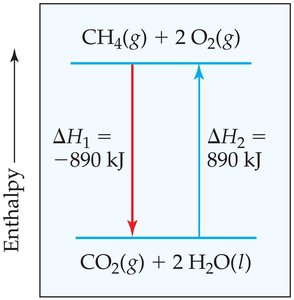
Properties of Enthalpy
Enthalpy is a state function.
It is an extensive property (depends on the amount of substance).
for the forward reaction is equal in magnitude but opposite in sign to $\Delta H$ for the reverse reaction.
depends on the physical state of reactants and products.

Calorimetry
Measurement of Heat Flow
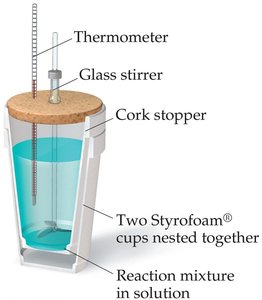
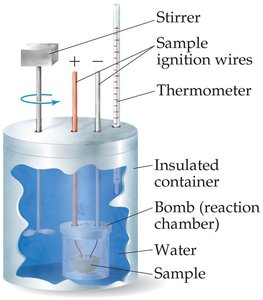
Calorimetry is the measurement of heat flow during a chemical reaction. The instrument used is a calorimeter.
Heat capacity: Amount of heat required to raise the temperature of a substance by 1 K (or 1°C).
Specific heat capacity: Heat capacity per gram.
Molar heat capacity: Heat capacity per mole.
Constant Pressure Calorimetry
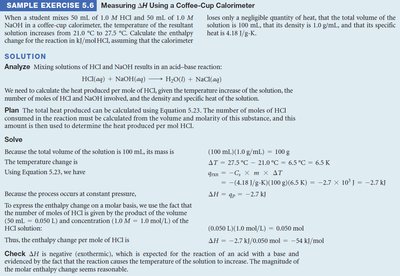
In constant pressure calorimetry, the heat change for the system is found by measuring the heat change for water in the calorimeter:
Bomb Calorimetry
Combustion reactions are measured in a bomb calorimeter at constant volume. The heat transferred corresponds to rather than .
Hess's Law
Statement and Application
Hess's Law states that if a reaction is carried out in a series of steps, for the overall reaction equals the sum of the enthalpy changes for the individual steps. This is because enthalpy is a state function.
Enthalpy of Formation
Standard Enthalpy of Formation
The standard enthalpy of formation () is the enthalpy change for the formation of one mole of a compound from its elements in their standard states at 25°C and 1 atm.
Calculation of Reaction Enthalpy
Reaction enthalpy can be calculated using standard enthalpies of formation:
Bond Enthalpy
Definition and Use
Bond enthalpy is the energy required to break one mole of a particular bond in a gaseous substance. It is always positive because energy is required to break bonds. The greater the bond enthalpy, the stronger the bond.
Estimating Enthalpy of Reaction
Enthalpy of reaction can be estimated using bond enthalpies:
Example: For the reaction :
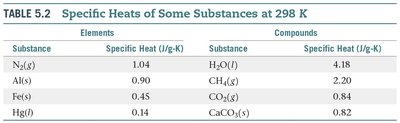
Summary Table: Specific Heats of Substances
Substance | Specific Heat (J/g·K) |
|---|---|
N2(g) | 1.04 |
Al(s) | 0.90 |
Fe(s) | 0.45 |
Hg(l) | 0.14 |
H2O(l) | 4.18 |
CH4(g) | 2.20 |
CO2(g) | 0.84 |
CaCO3(s) | 0.82 |
Key Equations
Additional info: The notes include practical examples, sample calculations, and diagrams to reinforce understanding of thermochemical concepts. These are essential for exam preparation and laboratory applications in General Chemistry.
