 뒤로
Valence Bond Theory, Hybridization, and Molecular Orbital Theory: Study Notes for General Chemistry
스터디 가이드 - 스마트 노트
 자료에 맞춘 맞춤형 노트, 핵심 정의, 예시, 맥락을 확장해 제공합니다.
Valence Bond Theory
Orbital Overlap and Chemical Bond Formation
Valence Bond Theory explains how atomic orbitals overlap to form chemical bonds. The strength and directionality of these bonds depend on the extent and orientation of orbital overlap.
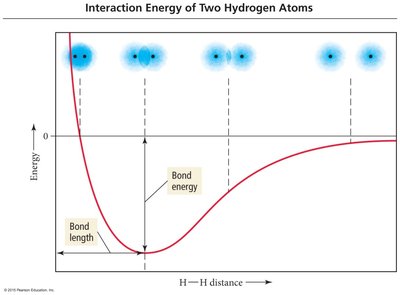
Orbital Overlap: When two atomic orbitals from different atoms overlap, a bond is formed. The greater the overlap, the stronger the bond.
Bond Energy and Bond Length: The optimal distance between atoms (bond length) is where the energy is minimized, resulting in a stable bond.
Example: The formation of the H2 molecule involves overlap of two 1s orbitals from hydrogen atoms.
Hybridization
Concept and Types of Hybridization
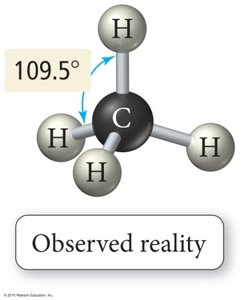
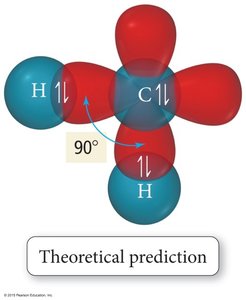
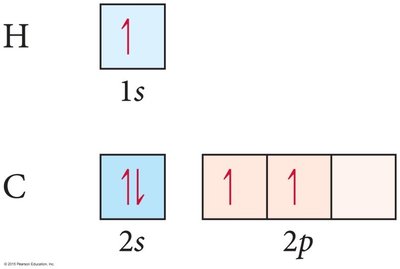
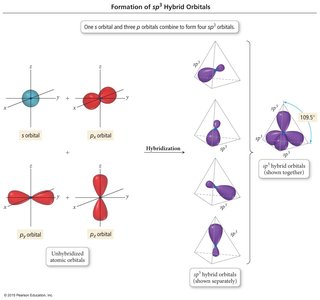
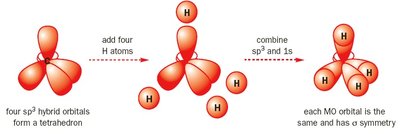
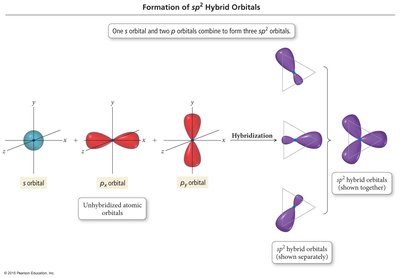
Hybridization is the process by which atomic orbitals mix to form new, equivalent hybrid orbitals, which can explain observed molecular geometries that differ from simple predictions based on atomic orbitals.
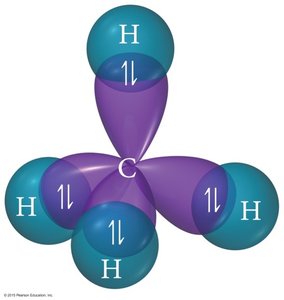
sp3 Hybridization: Occurs when one s and three p orbitals mix to form four sp3 hybrid orbitals. This explains the tetrahedral geometry of methane (CH4).
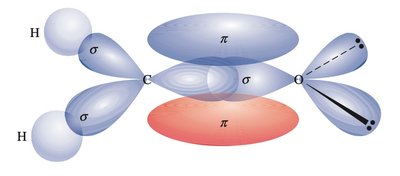
sp2 Hybridization: One s and two p orbitals mix to form three sp2 hybrid orbitals, seen in molecules like formaldehyde (H2CO).
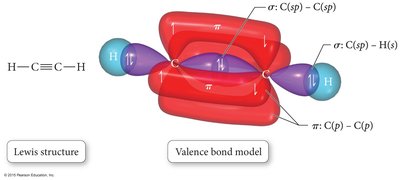
sp Hybridization: One s and one p orbital mix to form two sp hybrid orbitals, as in acetylene (C2H2).
Expanded Octet Hybridization: Involves d orbitals, such as sp3d and sp3d2, for molecules with more than four electron groups.
Hybridization in Other Molecules
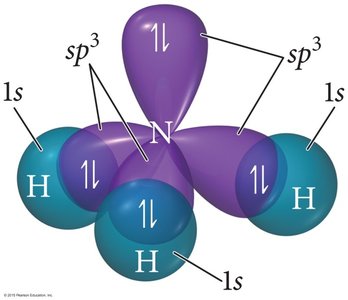
Ammonia (NH3): Nitrogen is sp3 hybridized, resulting in a trigonal pyramidal geometry.
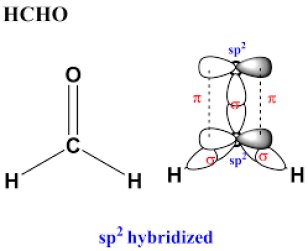
Formaldehyde (H2CO): Carbon is sp2 hybridized, with a planar geometry and both sigma and pi bonds.
Bond Types: Sigma (σ) and Pi (π) Bonds
Bonds are classified based on the type of orbital overlap:
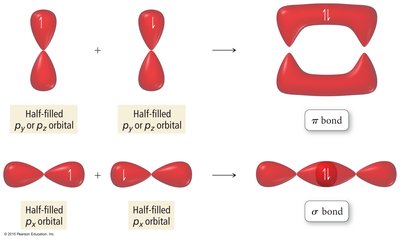
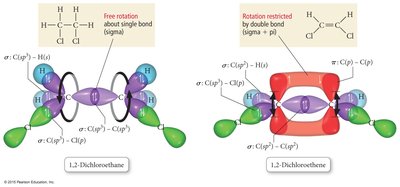
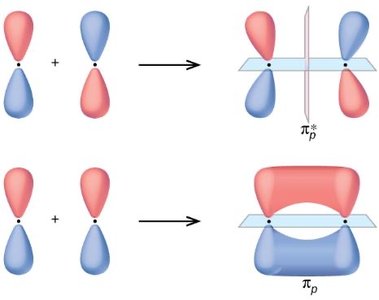
Sigma (σ) Bonds: Formed by head-to-head overlap along the bond axis. All single bonds are sigma bonds.
Pi (π) Bonds: Formed by side-to-side overlap of p orbitals. Double bonds consist of one sigma and one pi bond; triple bonds have one sigma and two pi bonds.
Bond Rotation
Single Bonds: Allow free rotation due to sigma bond symmetry.
Double/Triple Bonds: Rotation is restricted because pi bonds must remain aligned.
sp Hybridization and Triple Bonds
sp Hybridization: Linear geometry, seen in molecules like acetylene (C2H2).
Triple Bonds: Consist of one sigma and two pi bonds.
Hybridization Table
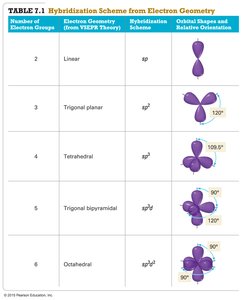
The following table summarizes hybridization schemes based on electron group geometry:
Number of Electron Groups | Electron Geometry | Hybridization Scheme | Orbital Shape and Orientation |
|---|---|---|---|
2 | Linear | sp | 180° |
3 | Trigonal planar | sp2 | 120° |
4 | Tetrahedral | sp3 | 109.5° |
5 | Trigonal bipyramidal | sp3d | 90°, 120° |
6 | Octahedral | sp3d2 | 90° |
Molecular Orbital Theory
Basic Principles
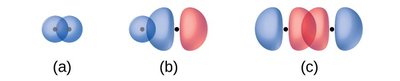
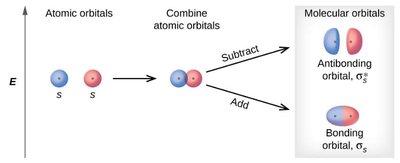
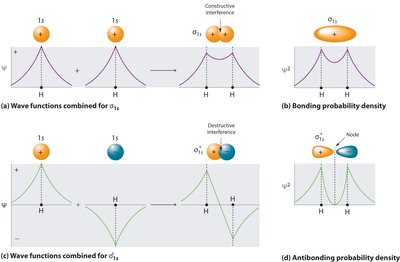
Molecular Orbital (MO) Theory describes the formation of molecular orbitals from atomic orbitals, using the concept of constructive and destructive interference.
Linear Combination of Atomic Orbitals (LCAO): Molecular orbitals are formed by adding or subtracting atomic orbitals.
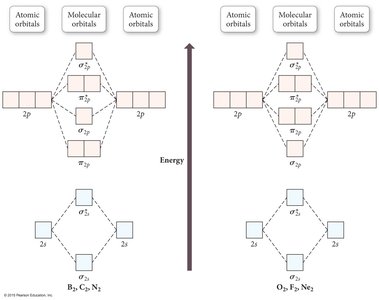
Bonding and Antibonding Orbitals: Constructive interference creates bonding orbitals (lower energy), while destructive interference creates antibonding orbitals (higher energy).
Electron Filling: Electrons fill molecular orbitals in order of increasing energy, following the Pauli exclusion principle and Hund's rule.
Molecular Orbital Diagrams for Diatomic Molecules
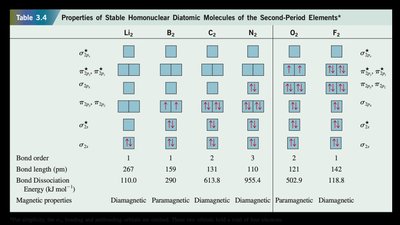
MO diagrams show the relative energies and electron configurations of molecular orbitals for homonuclear diatomic molecules. The order of orbitals changes between N2 and O2 due to increasing nuclear charge.
Bond Order: Calculated as
Magnetic Properties: Molecules with unpaired electrons are paramagnetic; those with all paired electrons are diamagnetic.
Applications and Comparisons
Stability: Molecules are more stable when more electrons occupy bonding orbitals than antibonding orbitals.
Bond Length and Dissociation Energy: Higher bond order correlates with shorter bond length and greater bond dissociation energy.
Example: O2 is paramagnetic due to unpaired electrons in its MO diagram.
Molecule | Bond Order | Bond Length (pm) | Bond Dissociation Energy (kJ/mol) | Magnetic Properties |
|---|---|---|---|---|
Li2 | 1 | 267 | 110 | Diamagnetic |
B2 | 1 | 159 | 290 | Paramagnetic |
C2 | 2 | 131 | 613.8 | Diamagnetic |
N2 | 3 | 110 | 955.4 | Diamagnetic |
O2 | 2 | 121 | 502 | Paramagnetic |
F2 | 1 | 142 | 118.8 | Diamagnetic |
Molecular Orbital Theory Summary
LCAO: Molecular orbitals are linear combinations of atomic orbitals.
Bonding vs. Antibonding: Stability depends on the number of electrons in bonding versus antibonding orbitals.
Electron Filling: Molecular orbitals are filled in order of increasing energy, similar to atomic orbitals.
Additional info: These notes expand on the brief points in the original materials, providing definitions, examples, and tables for clarity and completeness.
