 뒤로
Wave Nature of Light, Electromagnetic Spectrum, Quantum Concepts, and Electron Configurations – Guided Study Notes
스터디 가이드 - 스마트 노트
 자료에 맞춘 맞춤형 노트, 핵심 정의, 예시, 맥락을 확장해 제공합니다.
Q1. Indicate whether the following statements regarding the wave nature of light are true (T) or false (F). Justify your answer in each case.
Background
Topic: Electromagnetic Radiation and Properties of Light
This question tests your understanding of the characteristics and behavior of electromagnetic waves, including visible light, ultraviolet light, X rays, and the speed of electromagnetic radiation compared to sound waves.
Key Terms:
Electromagnetic radiation: Energy transmitted through space as waves.
Wavelength (): The distance between two consecutive peaks of a wave.
Speed of light (): m/s.
Step-by-Step Guidance
Review the electromagnetic spectrum and identify where visible light, ultraviolet light, and X rays are located.
Recall that all electromagnetic radiation travels at the same speed in a vacuum (), regardless of wavelength or frequency.
Compare the speed of electromagnetic waves to the speed of sound (which is much slower, about 343 m/s in air).
Consider the relationship between wavelength and frequency: .
Try solving on your own before revealing the answer!
Final Answer:
a) True. Visible light is a form of electromagnetic radiation.
b) False. Ultraviolet light has shorter wavelengths than visible light.
c) False. X rays and microwaves travel at the same speed in a vacuum.
d) False. Electromagnetic radiation travels much faster than sound waves.
Justification: All electromagnetic waves travel at the speed of light in a vacuum. Ultraviolet light is higher energy and shorter wavelength than visible light. X rays and microwaves are both electromagnetic waves, so their speed is the same. Sound is a mechanical wave and travels much slower.
Q2. Arrange the following kinds of electromagnetic radiation in order of increasing wavelength: infrared, green light, red light, radio waves, X rays, ultraviolet light.
Background
Topic: Electromagnetic Spectrum
This question tests your ability to compare different types of electromagnetic radiation based on their wavelengths.
Key Terms:
Electromagnetic spectrum: The range of all types of electromagnetic radiation.
Wavelength (): Longer wavelength means lower energy.
Step-by-Step Guidance
Recall the order of the electromagnetic spectrum from shortest to longest wavelength: X rays, ultraviolet, visible (green/red), infrared, radio waves.
Identify the approximate wavelength ranges for each type:
X rays: to m
Ultraviolet: to m
Visible (green/red): to m
Infrared: to m
Radio waves: to m
Arrange the types from shortest to longest wavelength.
Try solving on your own before revealing the answer!
Final Answer:
Order of increasing wavelength: X rays < ultraviolet < green light < red light < infrared < radio waves.
This order follows the electromagnetic spectrum from high energy/short wavelength to low energy/long wavelength.
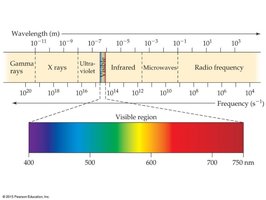
Q3. What is the frequency of radiation that has a wavelength of 10 µm?
Background
Topic: Relationship between Wavelength and Frequency
This question tests your ability to use the speed of light equation to convert between wavelength and frequency.
Key formula:
Where:
= speed of light ( m/s)
= wavelength (in meters)
= frequency (in Hz)
Step-by-Step Guidance
Convert the wavelength from micrometers (µm) to meters: m.
Use the formula and rearrange to solve for frequency: .
Plug in the values for and .
Try solving on your own before revealing the answer!
Final Answer:
Hz$
The frequency of radiation with a wavelength of 10 µm is Hz.
Q4. What is the wavelength of radiation that has a frequency of Hz?
Background
Topic: Relationship between Wavelength and Frequency
This question tests your ability to use the speed of light equation to convert between frequency and wavelength.
Key formula:
Where:
= speed of light ( m/s)
= wavelength (in meters)
= frequency (in Hz)
Step-by-Step Guidance
Rearrange the formula to solve for wavelength: .
Plug in the values for and .
Calculate the wavelength in meters, then convert to nanometers if needed.
Try solving on your own before revealing the answer!
Final Answer:
m = 545 nm$
The wavelength of radiation with a frequency of Hz is 545 nm, which is in the visible region.
Q5. A laser pointer used in a lecture hall emits light at 650 nm. What is the frequency of this radiation? Using the figure shown below, predict the color associated with this wavelength.
Background
Topic: Wavelength, Frequency, and Color of Visible Light
This question tests your ability to convert wavelength to frequency and identify the color of visible light based on wavelength.
Key formula:
Where:
= speed of light ( m/s)
= wavelength (in meters)
= frequency (in Hz)
Step-by-Step Guidance
Convert the wavelength from nanometers to meters: m.
Use the formula to solve for frequency.
Refer to the electromagnetic spectrum diagram to identify the color corresponding to 650 nm.
Try solving on your own before revealing the answer!
Final Answer:
Hz$
The color associated with 650 nm is red, as shown in the visible spectrum diagram.
