

Ch.11 - Liquids and Intermolecular Forces
Brown - Chemistry: The Central Science 14th Edition
Brown14th EditionChemistry: The Central ScienceISBN: 9780134414232당신이 사용하는 게 아니라요?교과서 변경
11장, 문제 13b

At standard temperature and pressure, the molar volumes of Cl2 and NH3 gases are 22.06 and 22.40 L, respectively (b) On cooling to 160 K, both substances form crystalline solids. Do you expect the molar volumes to decrease or increase on cooling the gases to 160 K?

검증된 단계별 안내
1
Step 1: Understand the concept of molar volume. The molar volume of a gas is the volume that one mole of the gas occupies at a specific temperature and pressure. At standard temperature and pressure (STP), the molar volumes of most gases are approximately 22.4 L.
Step 2: Consider the state of matter. Gases have the highest molar volumes because their particles are spread out and move freely. In contrast, the particles in solids are tightly packed together, resulting in a lower molar volume.
Step 3: Apply this understanding to the problem. Both Cl2 and NH3 are gases at standard temperature and pressure, but they form crystalline solids when cooled to 160 K.
Step 4: Based on the change in state from gas to solid, we can infer that the molar volumes of Cl2 and NH3 will decrease when they are cooled to 160 K. This is because the particles will be more closely packed in the solid state than in the gaseous state.
Step 5: Therefore, we expect the molar volumes to decrease on cooling the gases to 160 K.

비슷한 문제에 대한 검증된 영상 답변:

이 영상 해법은 위 문제에 도움이 된다고 튜터들이 추천한 것입니다.
영상 길이:
1m

주요 개념

질문에 올바르게 답하기 위해 반드시 이해해야 하는 핵심 개념들은 다음과 같습니다.

Molar Volume

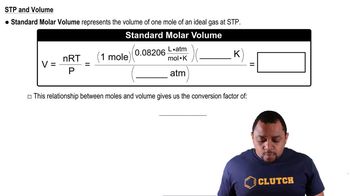
Molar volume is the volume occupied by one mole of a substance at a given temperature and pressure, typically measured in liters per mole (L/mol). At standard temperature and pressure (STP), gases have a molar volume of approximately 22.4 L/mol. This concept is crucial for understanding how gases behave under different conditions, including changes in temperature.
추천 영상:
가이드 코스
01:21
Standard Molar Volume

Phase Changes

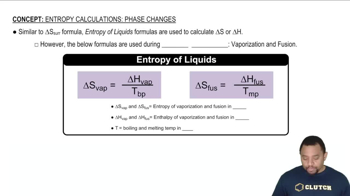
Phase changes refer to the transitions between solid, liquid, and gas states of matter, driven by temperature and pressure changes. When gases cool, they can condense into liquids or solidify into solids, which typically results in a decrease in volume due to the closer packing of particles in the solid state. Understanding these transitions helps predict how substances behave when subjected to temperature changes.
추천 영상:
가이드 코스
01:46
Entropy in Phase Changes

Kinetic Molecular Theory

The Kinetic Molecular Theory explains the behavior of gases in terms of particle motion. It posits that gas particles are in constant, random motion and that temperature is a measure of the average kinetic energy of these particles. As temperature decreases, the kinetic energy of the particles also decreases, leading to reduced volume as the particles come closer together in a solid state.
추천 영상:
가이드 코스
01:19
Kinetic Molecular Theory