
At standard temperature and pressure, the molar volumes of Cl2 and NH3 gases are 22.06 and 22.40 L, respectively. (c) The densities of crystalline Cl2 and NH3 at 160 K are 2.02 and 0.84 g/cm3, respectively. Calculate their molar volumes.
Ch.11 - Liquids and Intermolecular Forces
11장, 문제 13d
At standard temperature and pressure, the molar volumes of Cl2 and NH3 gases are 22.06 and 22.40 L, respectively (d) Are the molar volumes in the solid state as similar as they are in the gaseous state? Explain.
검증된 단계별 안내1
Step 1: Understand the concept of molar volume. The molar volume of a gas is the volume occupied by one mole of that gas at a certain temperature and pressure. In this case, we are given the molar volumes of Cl2 and NH3 gases at standard temperature and pressure (STP).
Step 2: Recognize that the molar volumes of gases are similar at STP due to the ideal gas law, which states that one mole of any gas at STP occupies a volume of approximately 22.4 L. This is because gases are mostly empty space, and the size of the individual gas molecules doesn't significantly affect the overall volume.
Step 3: Understand that the situation is different for solids. In the solid state, the particles are closely packed together, and the volume is greatly influenced by the size and shape of the individual particles. Therefore, the molar volumes of solids are not as similar as they are in the gaseous state.
Step 4: Consider the specific substances in question. Cl2 and NH3 have different sizes and shapes of molecules, and they form different types of crystal structures in the solid state. Therefore, their molar volumes in the solid state would not be as similar as in the gaseous state.
Step 5: Conclude that the molar volumes in the solid state are not as similar as they are in the gaseous state due to the differences in particle size, shape, and crystal structure.

비슷한 문제에 대한 검증된 영상 답변:
이 영상 해법은 위 문제에 도움이 된다고 튜터들이 추천한 것입니다.
영상 길이:
2m주요 개념
질문에 올바르게 답하기 위해 반드시 이해해야 하는 핵심 개념들은 다음과 같습니다.
Molar Volume
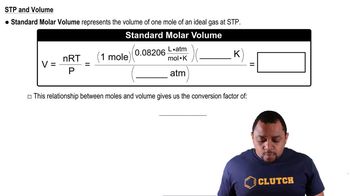
Molar volume is the volume occupied by one mole of a substance at a given temperature and pressure, typically measured in liters per mole (L/mol). At standard temperature and pressure (STP), gases have a molar volume of approximately 22.4 L/mol. This concept is crucial for comparing the behavior of different substances in gaseous and solid states, as it reflects how much space a mole of particles occupies.
추천 영상:
가이드 코스
Standard Molar Volume
States of Matter
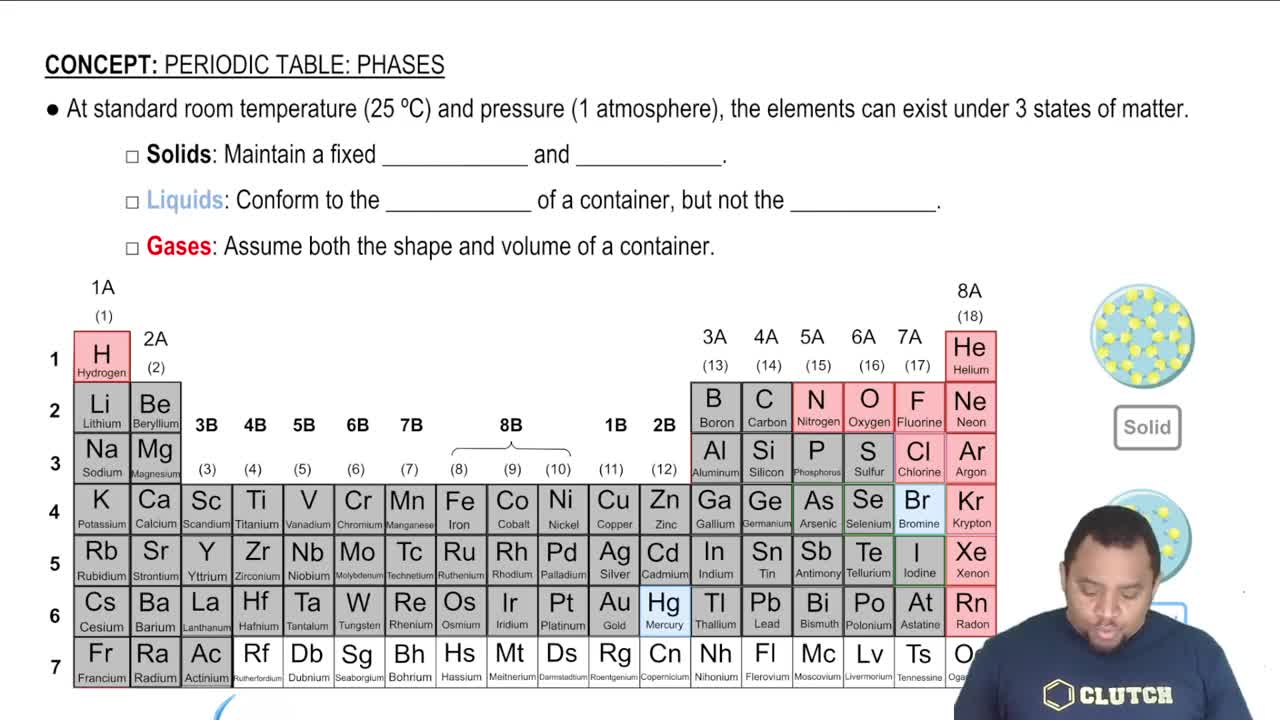
The states of matter—solid, liquid, and gas—are defined by the arrangement and energy of particles. In solids, particles are closely packed in a fixed arrangement, leading to a much lower molar volume compared to gases, where particles are far apart and move freely. Understanding these states helps explain why molar volumes differ significantly between gases and solids, as the intermolecular forces and particle spacing vary greatly.
추천 영상:
가이드 코스
Element States of Matter
Intermolecular Forces
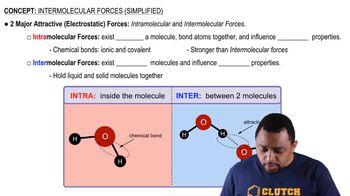
Intermolecular forces are the forces of attraction or repulsion between molecules, which significantly influence the physical properties of substances. In solids, strong intermolecular forces keep particles tightly packed, resulting in a small molar volume. In contrast, gases experience weaker forces, allowing for greater separation and larger molar volumes. Analyzing these forces is essential for understanding the differences in molar volumes between the gaseous and solid states.
추천 영상:
가이드 코스
Intermolecular vs Intramolecular Forces
관련 실천
교과서 질문
2410
views
교과서 질문
(a) Which type of intermolecular attractive force operates between all molecules?
506
views
교과서 질문
At standard temperature and pressure, the molar volumes of Cl2 and NH3 gases are 22.06 and 22.40 L, respectively (b) On cooling to 160 K, both substances form crystalline solids. Do you expect the molar volumes to decrease or increase on cooling the gases to 160 K?
605
views
교과서 질문
Benzoic acid, C6H5COOH, melts at 122 °C. The density in the liquid state at 130 °C is 1.08 g/cm3. The density of solid benzoic acid at 15 °C is 1.266 g/cm3. (b) If you converted a cubic centimeter of liquid benzoic acid into a solid, would the solid take up more, or less, volume than the original cubic centimeter of liquid?
1698
views
