
Ch.11 - Liquids and Intermolecular Forces
Brown - Chemistry: The Central Science 14th Edition
Brown14th EditionChemistry: The Central ScienceISBN: 9780134414232당신이 사용하는 게 아니라요?교과서 변경
11장, 문제 48a

The critical temperatures and pressures of a series of halogenated methanes are as follows:
(a) List the intermolecular forces that occur for each compound.

검증된 단계별 안내
1
Identify the type of halogenated methanes mentioned in the problem or in the data provided.
Understand the types of intermolecular forces: London dispersion forces, dipole-dipole interactions, and hydrogen bonding.
Analyze the molecular structure of each halogenated methane to determine the presence of polar bonds due to differences in electronegativity between carbon, hydrogen, and the halogen atoms.
Assess whether any of the halogenated methanes have the necessary structure for hydrogen bonding (i.e., a hydrogen atom directly bonded to a highly electronegative atom like fluorine, oxygen, or nitrogen).
List the applicable intermolecular forces for each compound based on the molecular structure and types of atoms involved. Typically, halogenated methanes will exhibit London dispersion forces and possibly dipole-dipole interactions if the molecule is polar.

비슷한 문제에 대한 검증된 영상 답변:

이 영상 해법은 위 문제에 도움이 된다고 튜터들이 추천한 것입니다.
영상 길이:
3m

주요 개념

질문에 올바르게 답하기 위해 반드시 이해해야 하는 핵심 개념들은 다음과 같습니다.

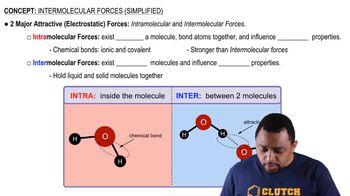
Intermolecular Forces

Intermolecular forces are the attractive forces between molecules that influence physical properties such as boiling and melting points. The main types include hydrogen bonding, dipole-dipole interactions, and London dispersion forces. Understanding these forces is crucial for predicting the behavior of halogenated methanes, as their strength and type will vary based on molecular structure and polarity.
추천 영상:
가이드 코스
01:59
Intermolecular vs Intramolecular Forces

Halogenated Methanes

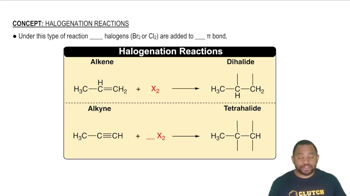
Halogenated methanes are organic compounds derived from methane (CH4) where one or more hydrogen atoms are replaced by halogen atoms (such as fluorine, chlorine, bromine, or iodine). These compounds exhibit unique chemical and physical properties due to the presence of halogen atoms, which can significantly affect their intermolecular forces and reactivity.
추천 영상:
가이드 코스
01:11
Halogenation Reactions

Critical Temperature and Pressure

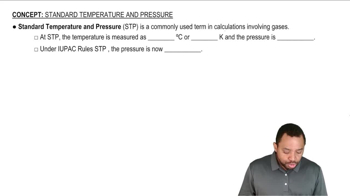
Critical temperature and pressure are the conditions at which a substance can no longer exist as a liquid, regardless of the pressure applied. Above the critical temperature, the substance enters a supercritical state, where distinct liquid and gas phases do not exist. This concept is important for understanding the phase behavior of halogenated methanes under varying conditions, particularly in relation to their intermolecular forces.
추천 영상:
가이드 코스
01:08
Standard Temperature and Pressure