
Ch.11 - Liquids and Intermolecular Forces
Brown - Chemistry: The Central Science 14th Edition
Brown14th EditionChemistry: The Central ScienceISBN: 9780134414232당신이 사용하는 게 아니라요?교과서 변경
11장, 문제 48c

The critical temperatures and pressures of a series of halogenated methanes are as follows: (c) Predict the critical temperature and pressure for CCl4 based on the trends in this table. Look up the experimentally determined critical temperatures and pressures for CCl4, using a source such as the CRC Handbook of Chemistry and Physics, and suggest a reason for any discrepancies.

검증된 단계별 안내
1
Identify the trend in critical temperatures and pressures for the given series of halogenated methanes.
Analyze how the molecular structure and intermolecular forces of CCl4 compare to those of the other halogenated methanes.
Predict the critical temperature and pressure for CCl4 based on the observed trends and molecular analysis.
Look up the experimentally determined critical temperature and pressure for CCl4 from a reliable source like the CRC Handbook of Chemistry and Physics.
Compare the predicted values with the experimental values and suggest reasons for any discrepancies, considering factors like molecular size, shape, and intermolecular forces.

비슷한 문제에 대한 검증된 영상 답변:

이 영상 해법은 위 문제에 도움이 된다고 튜터들이 추천한 것입니다.
영상 길이:
1m

주요 개념

질문에 올바르게 답하기 위해 반드시 이해해야 하는 핵심 개념들은 다음과 같습니다.

Critical Temperature and Pressure

Critical temperature is the highest temperature at which a substance can exist as a liquid, while critical pressure is the minimum pressure required to maintain that liquid state at the critical temperature. Above these values, the substance becomes a supercritical fluid, exhibiting unique properties. Understanding these concepts is essential for predicting phase behavior in substances like halogenated methanes.
추천 영상:
가이드 코스
01:08
Standard Temperature and Pressure

Trends in Halogenated Methanes

Halogenated methanes, such as CCl4, exhibit trends in their critical properties based on molecular structure and intermolecular forces. Generally, as the size and number of halogen atoms increase, the critical temperature and pressure also tend to increase due to stronger van der Waals forces. Recognizing these trends allows for informed predictions about the critical properties of similar compounds.
추천 영상:
가이드 코스
01:11
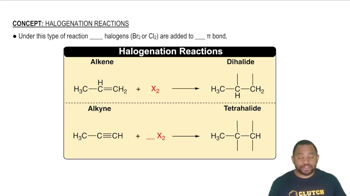
Halogenation Reactions

Experimental vs. Theoretical Values

Discrepancies between experimentally determined and predicted critical temperatures and pressures can arise from various factors, including measurement errors, purity of the sample, and the limitations of theoretical models. Understanding these potential sources of error is crucial when comparing predicted values with literature data, as it helps in assessing the reliability of the predictions made.
추천 영상:
가이드 코스
05:50
Experimental Error