
Ch.14 - Chemical Kinetics
Brown - Chemistry: The Central Science 14th Edition
Brown14th EditionChemistry: The Central ScienceISBN: 9780134414232당신이 사용하는 게 아니라요?교과서 변경
14장, 문제 110

The following mechanism has been proposed for the gasphase reaction of chloroform 1CHCl32 and chlorine: Step 1: Cl21g2 Δ k1 k - 1 2 Cl1g2 1fast2 Step 2: Cl1g2 + CHCl31g2 ¡k2 HCl1g2 + CCl31g2 1slow2 Step 3: Cl1g2 + CCl31g2 ¡k3 CCl4 1fast2 (a) What is the overall reaction?

검증된 단계별 안내
1
Identify the reactants and products in each step of the mechanism.
Write down the reactants and products for each step: Step 1: Cl2(g) -> 2 Cl(g), Step 2: Cl(g) + CHCl3(g) -> HCl(g) + CCl3(g), Step 3: Cl(g) + CCl3(g) -> CCl4(g).
Add up all the reactants and products from each step to find the overall reaction.
Cancel out any intermediates that appear on both sides of the equation. In this case, Cl(g) and CCl3(g) are intermediates.
Write the simplified overall reaction after canceling intermediates: Cl2(g) + CHCl3(g) -> HCl(g) + CCl4(g).

비슷한 문제에 대한 검증된 영상 답변:

이 영상 해법은 위 문제에 도움이 된다고 튜터들이 추천한 것입니다.
영상 길이:
2m

주요 개념

질문에 올바르게 답하기 위해 반드시 이해해야 하는 핵심 개념들은 다음과 같습니다.

Reaction Mechanism

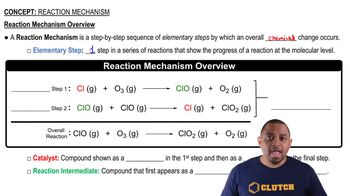
A reaction mechanism is a step-by-step description of the pathway through which reactants are converted into products. It outlines individual elementary steps, including the sequence of bond-breaking and bond-forming events. Understanding the mechanism helps in predicting the rate of reaction and the overall stoichiometry of the process.
추천 영상:
가이드 코스
03:06
Reaction Mechanism Overview

Rate-Determining Step

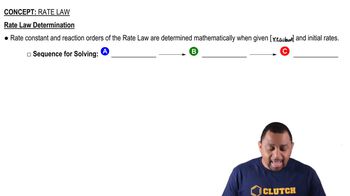
The rate-determining step (RDS) is the slowest step in a reaction mechanism that controls the overall reaction rate. In the provided mechanism, the second step is identified as slow, indicating that it is the RDS. Recognizing the RDS is crucial for understanding how changes in conditions can affect the reaction rate.
추천 영상:
가이드 코스
01:15
Rate Law Determination

Overall Reaction Equation

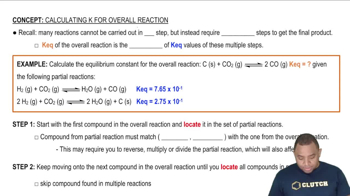
The overall reaction equation summarizes the net change from reactants to products, combining all elementary steps while canceling out intermediates. To derive the overall reaction from the mechanism, one must add the individual steps and eliminate any species that appear on both sides of the equation, leading to a balanced representation of the chemical transformation.
추천 영상:
가이드 코스
07:02
Overall Reaction Equilibrium Constant
관련 실천
교과서 질문

The gas-phase decomposition of ozone is thought to occur by the following two-step mechanism.

Step 1: O3(g) ⇌ O2(g) + O(g) (fast)

Step 2: O(g) + O3(g) → 2 O2 (slow)

(b) Derive the rate law that is consistent with this mechanism. (Hint: The product appears in the rate law.)

867
views
교과서 질문

The following mechanism has been proposed for the gasphase reaction of chloroform 1CHCl32 and chlorine:

Step 1: Cl2(g) k1⇌ k-1 2 Cl(g) (fast)

Step 2: Cl(g) + CHCl3(g) k2→ HCl(g) + CCl3(g) (slow)

Step 3: Cl(g0 + CCl3(g) k3→ CCl4 (fast)

(e) What is the rate law predicted by this mechanism? (Hint: The overall reaction order is not an integer.)

교과서 질문

In a hydrocarbon solution, the gold compound (CH3)3AuPH3 decomposes into ethane (C2H6) and a different gold compound, (CH3)AuPH3. The following mechanism has been proposed for the decomposition of (CH3)3AuPH3:

Step 1: (CH3)3AuPH3 k1⇌k-1 (CH3)3Au + PH3 (fast)

Step 2: (CH3)3Au k2→ C2H6 + (CH3)Au (slow)

Step 3: (CH3)Au + PH3 k3→ (CH3)AuPH3 (fast)

(a) What is the overall reaction?

(b) What are the intermediates in the mechanism?

교과서 질문

The gas-phase decomposition of ozone is thought to occur by the following two-step mechanism.

Step 1: O3(g) ⇌ O2(g) + O(g) (fast)

Step 2: O(g) + O3(g) → 2 O2 (slow)

(a) Write the balanced equation for the overall reaction.

교과서 질문

The gas-phase decomposition of ozone is thought to occur by the following two-step mechanism.

Step 1: O3(g) ⇌ O2(g) + O(g) (fast)

Step 2: O(g) + O3(g) → 2 O2 (slow)

(d) If instead the reaction occurred in a single step, would the rate law change? If so, what would it be?

1055
views