Ch.14 - Chemical Kinetics
Brown - Chemistry: The Central Science 14th Edition
Brown14th EditionChemistry: The Central ScienceISBN: 9780134414232당신이 사용하는 게 아니라요?교과서 변경
14장, 문제 109d

The gas-phase decomposition of ozone is thought to occur by the following two-step mechanism.
Step 1: O3(g) ⇌ O2(g) + O(g) (fast)
Step 2: O(g) + O3(g) → 2 O2 (slow)
(d) If instead the reaction occurred in a single step, would the rate law change? If so, what would it be?

검증된 단계별 안내
1
Step 1: Identify the rate-determining step. In this case, the rate-determining step is the slowest step, which is Step 2: O(g) + O3(g) → 2 O2.
Step 2: Write the rate law based on the rate-determining step. The rate law for a reaction is generally of the form rate = k[A]^m[B]^n, where A and B are reactants, m and n are their respective orders, and k is the rate constant. For the given reaction, the rate law would be rate = k[O][O3].
Step 3: Consider what would happen if the reaction occurred in a single step. If the reaction occurred in a single step, it would be O3(g) → 2 O2(g).
Step 4: Write the rate law for the single-step reaction. The rate law for this reaction would be rate = k[O3], because there is only one reactant in the rate-determining step.
Step 5: Compare the two rate laws. The rate law for the two-step reaction is rate = k[O][O3], and the rate law for the single-step reaction is rate = k[O3]. Therefore, the rate law would change if the reaction occurred in a single step.

비슷한 문제에 대한 검증된 영상 답변:

이 영상 해법은 위 문제에 도움이 된다고 튜터들이 추천한 것입니다.
영상 길이:
2m

주요 개념

질문에 올바르게 답하기 위해 반드시 이해해야 하는 핵심 개념들은 다음과 같습니다.

Reaction Mechanism

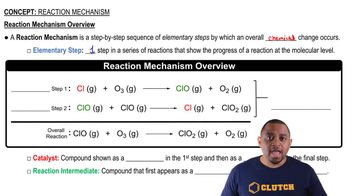
A reaction mechanism describes the step-by-step sequence of elementary reactions by which overall chemical change occurs. Understanding the individual steps, including their rates and intermediates, is crucial for predicting the behavior of the overall reaction. In this case, the two-step mechanism for ozone decomposition illustrates how the rate of the reaction can be influenced by the slowest step, known as the rate-determining step.
추천 영상:
가이드 코스
03:06
Reaction Mechanism Overview

Rate Law

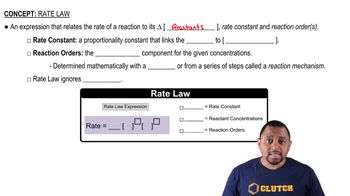
The rate law expresses the relationship between the rate of a chemical reaction and the concentration of its reactants. It is determined experimentally and can vary depending on the reaction mechanism. For the two-step mechanism provided, the rate law is influenced by the slow step, while a single-step reaction would yield a different rate law based on the stoichiometry of that single step.
추천 영상:
가이드 코스
01:52
Rate Law Fundamentals

Elementary Reactions

Elementary reactions are single-step processes that occur in a chemical reaction, each with its own rate constant. The overall reaction can consist of multiple elementary steps, and the rate law for the overall reaction is derived from the elementary steps. In the context of the ozone decomposition, recognizing whether the reaction occurs in one or multiple steps is essential for determining how the rate law is formulated.
추천 영상:
가이드 코스
03:06
Reaction Mechanism Overview