Ch.14 - Chemical Kinetics
Brown - Chemistry: The Central Science 14th Edition
Brown14th EditionChemistry: The Central ScienceISBN: 9780134414232당신이 사용하는 게 아니라요?교과서 변경
14장, 문제 120e

The gas-phase reaction of NO with F2 to form NOF and F has an activation energy of Ea = 6.3 kJ>mol. and a frequency factor of A = 6.0 * 108 M-1 s-1. The reaction is believed to be bimolecular: NO1g2 + F21g2 ¡ NOF1g2 + F1g2 (e) Suggest a reason for the low activation energy for the reaction.

검증된 단계별 안내
1
Identify the key components of the reaction: The reactants are NO and F2, and the products are NOF and F. The reaction is bimolecular, involving two molecules colliding.
Understand the concept of activation energy (Ea): Activation energy is the minimum energy required for a reaction to occur. It is the energy barrier that reactants must overcome to be transformed into products.
Analyze the given activation energy value: An activation energy of 6.3 kJ/mol is relatively low, which suggests that the energy barrier for this reaction is not very high.
Consider the nature of the reactants: NO is a radical with an unpaired electron, and F2 is a molecule that can easily dissociate into radicals. The presence of radicals generally leads to lower activation energies because radicals are highly reactive and can stabilize transition states.
Propose a reason for the low activation energy: The low activation energy could be due to the formation of a transient intermediate or transition state that is stabilized by the radical nature of the reactants, leading to a more efficient reaction pathway with a lower energy barrier.

비슷한 문제에 대한 검증된 영상 답변:

이 영상 해법은 위 문제에 도움이 된다고 튜터들이 추천한 것입니다.
영상 길이:
1m

주요 개념

질문에 올바르게 답하기 위해 반드시 이해해야 하는 핵심 개념들은 다음과 같습니다.

Activation Energy

Activation energy (Ea) is the minimum energy required for a chemical reaction to occur. It represents the energy barrier that reactants must overcome to transform into products. A low activation energy, such as 6.3 kJ/mol in this reaction, indicates that the reaction can proceed relatively easily, often due to favorable molecular interactions or the presence of a catalyst.
추천 영상:
가이드 코스
02:02
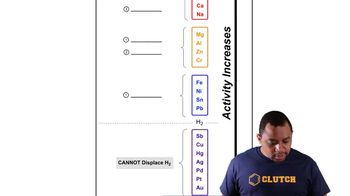
Activity Series Chart

Bimolecular Reactions

Bimolecular reactions involve two reactant molecules colliding to form products. The rate of bimolecular reactions is influenced by the concentration of both reactants and the frequency of their collisions. In this case, the reaction between NO and F2 suggests that the low activation energy may be due to effective collisions between these two species, leading to a faster reaction rate.
추천 영상:
가이드 코스
01:31
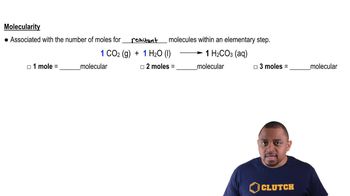
Molecularity in Reactions

Frequency Factor

The frequency factor (A) is a term in the Arrhenius equation that reflects the frequency of collisions and the orientation of reactant molecules during those collisions. A high frequency factor, like 6.0 x 10^8 M^-1 s^-1, suggests that the reactants are colliding frequently and with the correct orientation, which can contribute to a lower activation energy by increasing the likelihood of successful reactions.
추천 영상:
가이드 코스
00:31
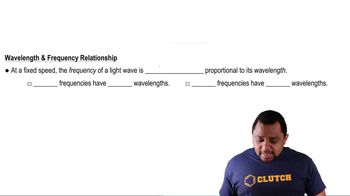
Frequency-Wavelength Relationship
관련 실천
교과서 질문

The reaction between ethyl iodide and hydroxide ion in ethanol (C2H5OH) solution, C2H5I(alc) + OH-(alc) → C2H5OH(l) + I-(alc), has an activation energy of 86.8 kJ/mol and a frequency factor of 2.10 × 10¹¹ M-1 s-1. (c) Which reagent in the reaction is limiting, assuming the reaction proceeds to completion?

810
views
교과서 질문

The reaction between ethyl iodide and hydroxide ion in ethanol (C2H5OH) solution, C2H5I(alc) + OH-(alc) → C2H5OH(l) + I-(alc), has an activation energy of 86.8 kJ/mol and a frequency factor of 2.10 × 10¹¹ M-1 s-1. (d) Assuming the frequency factor and activation energy do not change as a function of temperature, calculate the rate constant for the reaction at 50 C.

532
views
교과서 질문

The mechanism for the oxidation of HBr by O2 to form 2 H2O and Br2 is shown in Exercise 14.74. (a) Calculate the overall standard enthalpy change for the reaction process.

754
views
교과서 질문

The gas-phase reaction of NO with F2 to form NOF and F has an activation energy of Ea = 6.3 kJ/mol. and a frequency factor of A = 6.0 × 10⁸ M-1 s-1. The reaction is believed to be bimolecular: NO(g) + F2(g) → NOF(g) + F(g) (b) Draw the Lewis structures for the NO and the NOF molecules, given that the chemical formula for NOF is misleading because the nitrogen atom is actually the central atom in the molecule.

교과서 질문

The mechanism for the oxidation of HBr by O2 to form 2 H2O and Br2 is shown in Exercise 14.74. (c) Draw a plausible Lewis structure for the intermediate HOOBr. To what familiar compound of hydrogen and oxygen does it appear similar?

631
views