
Ch.14 - Chemical Kinetics
Brown - Chemistry: The Central Science 14th Edition
Brown14th EditionChemistry: The Central ScienceISBN: 9780134414232당신이 사용하는 게 아니라요?교과서 변경
14장, 문제 120b

The gas-phase reaction of NO with F2 to form NOF and F has an activation energy of Ea = 6.3 kJ/mol. and a frequency factor of A = 6.0 × 10⁸ M-1 s-1. The reaction is believed to be bimolecular: NO(g) + F2(g) → NOF(g) + F(g) (b) Draw the Lewis structures for the NO and the NOF molecules, given that the chemical formula for NOF is misleading because the nitrogen atom is actually the central atom in the molecule.

검증된 단계별 안내
1
To draw the Lewis structure for NO, start by counting the total number of valence electrons. Nitrogen (N) has 5 valence electrons and oxygen (O) has 6 valence electrons, giving a total of 11 valence electrons.
Place the nitrogen and oxygen atoms next to each other. Since NO is a diatomic molecule, there will be a bond between the nitrogen and oxygen atoms. Use a pair of electrons to form a single bond between N and O.
Distribute the remaining valence electrons to satisfy the octet rule as much as possible. Place the remaining electrons around the oxygen atom first, as it is more electronegative, and then place any remaining electrons on the nitrogen atom.
For the NOF molecule, start by counting the total number of valence electrons. Nitrogen (N) has 5 valence electrons, oxygen (O) has 6 valence electrons, and fluorine (F) has 7 valence electrons, giving a total of 18 valence electrons.
Place the nitrogen atom in the center, as it is the central atom in NOF. Connect the nitrogen atom to the oxygen and fluorine atoms with single bonds. Distribute the remaining valence electrons to satisfy the octet rule, starting with the more electronegative atoms (O and F), and then place any remaining electrons on the nitrogen atom.

비슷한 문제에 대한 검증된 영상 답변:

이 영상 해법은 위 문제에 도움이 된다고 튜터들이 추천한 것입니다.
영상 길이:
2m

주요 개념

질문에 올바르게 답하기 위해 반드시 이해해야 하는 핵심 개념들은 다음과 같습니다.

Activation Energy

Activation energy (Ea) is the minimum energy required for a chemical reaction to occur. It represents the energy barrier that reactants must overcome to transform into products. In the context of the given reaction, a low activation energy of 6.3 kJ/mol indicates that the reaction can proceed relatively easily, which is important for understanding reaction kinetics.
추천 영상:
가이드 코스
02:02
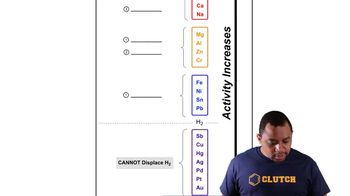
Activity Series Chart

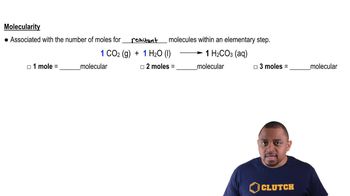
Bimolecular Reactions

Bimolecular reactions involve two reactant molecules colliding to form products. This type of reaction is characterized by a rate that depends on the concentration of both reactants. In the provided reaction, the bimolecular nature suggests that the rate of formation of NOF and F is influenced by the concentrations of both NO and F2, which is crucial for predicting reaction behavior.
추천 영상:
가이드 코스
01:31
Molecularity in Reactions

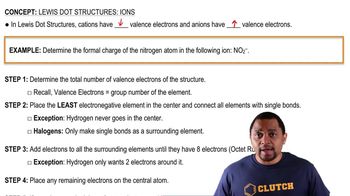
Lewis Structures

Lewis structures are diagrams that represent the bonding between atoms in a molecule and the lone pairs of electrons that may exist. They help visualize the arrangement of electrons and the connectivity of atoms. For the NO and NOF molecules, drawing Lewis structures will clarify the molecular geometry and the role of nitrogen as the central atom in NOF, which is essential for understanding its chemical properties.
추천 영상:
가이드 코스
04:28
Lewis Dot Structures: Ions
관련 실천