Methanol (CH3OH) can be made by the reaction of CO with H2: CO(𝑔) + 2 H2(𝑔) ⇌ CH3OH(𝑔) (b) To maximize the equilibrium yield of methanol, would you use a high or low temperature?
Ch.15 - Chemical Equilibrium
15장, 문제 66c
Methanol (CH3OH) can be made by the reaction of CO with H2: CO(𝑔) + 2 H2(𝑔) ⇌ CH3OH(𝑔) (c) To maximize the equilibrium yield of methanol, would you use a high or low pressure?
검증된 단계별 안내1
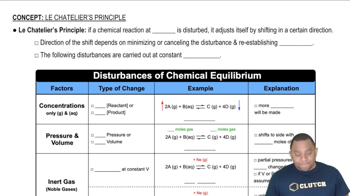
Understand the concept of Le Chatelier's Principle, which states that if a dynamic equilibrium is disturbed by changing the conditions, the position of equilibrium moves to counteract the change.
Identify the number of moles of gas on both sides of the reaction: 1 mole of CO and 2 moles of H2 on the left (total 3 moles) and 1 mole of CH3OH on the right.
Recognize that increasing the pressure of a system in equilibrium favors the side of the reaction with fewer moles of gas. In this reaction, the right side with CH3OH has fewer moles of gas compared to the left side.
Conclude that to maximize the equilibrium yield of methanol, a high pressure should be used because it will shift the equilibrium towards the formation of methanol, which has fewer moles of gas.
Consider other factors that might affect the yield, such as temperature and catalysts, but for pressure specifically, a high pressure is favorable for increasing the yield of methanol in this reaction.

비슷한 문제에 대한 검증된 영상 답변:
이 영상 해법은 위 문제에 도움이 된다고 튜터들이 추천한 것입니다.
영상 길이:
3m주요 개념
질문에 올바르게 답하기 위해 반드시 이해해야 하는 핵심 개념들은 다음과 같습니다.
Le Chatelier's Principle
Le Chatelier's Principle states that if a dynamic equilibrium is disturbed by changing the conditions, the position of equilibrium shifts to counteract the change. In the context of gas reactions, increasing pressure favors the side of the reaction with fewer moles of gas, while decreasing pressure favors the side with more moles.
추천 영상:
가이드 코스
Le Chatelier's Principle
Mole Ratio in Reactions
In the given reaction, the mole ratio of reactants to products is crucial for understanding how pressure affects equilibrium. The reaction CO(g) + 2 H2(g) ⇌ CH3OH(g) has three moles of gas on the reactant side and one mole on the product side, indicating that increasing pressure will favor the formation of methanol.
추천 영상:
가이드 코스
Neutron-Proton Ratio
Equilibrium Constant (K)
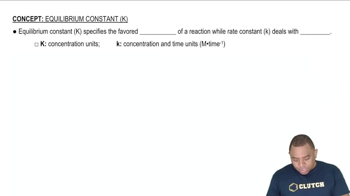
The equilibrium constant (K) quantifies the ratio of concentrations of products to reactants at equilibrium. Changes in pressure can influence the concentrations of gaseous reactants and products, thereby affecting the position of equilibrium and the yield of methanol. A higher pressure shifts the equilibrium towards the side with fewer gas moles, potentially increasing K for the product.
추천 영상:
가이드 코스
Equilibrium Constant K
관련 실천
교과서 질문
583
views
교과서 질문
(a) Is the dissociation of fluorine molecules into atomic fluorine, F2(𝑔) ⇌ 2 F(𝑔), an exothermic or endothermic process?
711
views
교과서 질문
Methanol (CH3OH) can be made by the reaction of CO with H2: CO(𝑔) + 2 H2(𝑔) ⇌ CH3OH(𝑔) (a) Use thermochemical data in Appendix C to calculate ΔH° for this reaction.
1098
views
교과서 질문
The water–gas shift reaction CO1g2 + H2O1g2Δ
CO21g2 + H21g2 is used industrially to produce hydrogen.
The reaction enthalpy is H = -41 kJ.
(b) Could you increase the equilibrium yield
of hydrogen by controlling the pressure of this reaction? If
so would high or low pressure favor formation of H2(g)?
1407
views
1
rank
교과서 질문
Ozone, O3, decomposes to molecular oxygen in the stratosphere according to the reaction 2 O31g2¡3 O21g2. Would an increase in pressure favor the formation of ozone or of oxygen?
806
views
교과서 질문
Consider the following equilibrium between oxides of nitrogen
3 NO(g) ⇌ NO2(g) + N2O(g)
(c) At constant temperature, would a change in the volume of the container affect the fraction of products in the equilibrium mixture?