Ch.15 - Chemical Equilibrium
Brown - Chemistry: The Central Science 14th Edition
Brown14th EditionChemistry: The Central ScienceISBN: 9780134414232당신이 사용하는 게 아니라요?교과서 변경
15장, 문제 66b

Methanol (CH3OH) can be made by the reaction of CO with H2: CO(𝑔) + 2 H2(𝑔) ⇌ CH3OH(𝑔) (b) To maximize the equilibrium yield of methanol, would you use a high or low temperature?

검증된 단계별 안내
1
Understand the nature of the reaction: The reaction CO(g) + 2 H2(g) ⇌ CH3OH(g) is an exothermic reaction, meaning it releases heat.
Recall Le Chatelier's Principle: This principle states that if a system at equilibrium is subjected to a change in concentration, temperature, volume, or pressure, then the system will adjust itself to counteract that change and restore a new equilibrium.
Apply Le Chatelier's Principle to temperature: Increasing the temperature of an exothermic reaction will shift the equilibrium to the left, favoring the reactants. Conversely, decreasing the temperature shifts the equilibrium to the right, favoring the formation of products.
Determine the effect of temperature on yield: Since the formation of methanol (CH3OH) is exothermic, lowering the temperature will shift the equilibrium towards the right, increasing the yield of methanol.
Conclusion on optimal conditions: To maximize the equilibrium yield of methanol in this reaction, a low temperature should be used.

비슷한 문제에 대한 검증된 영상 답변:

이 영상 해법은 위 문제에 도움이 된다고 튜터들이 추천한 것입니다.
영상 길이:
5m

주요 개념

질문에 올바르게 답하기 위해 반드시 이해해야 하는 핵심 개념들은 다음과 같습니다.

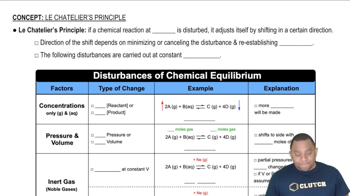
Le Chatelier's Principle

Le Chatelier's Principle states that if a dynamic equilibrium is disturbed by changing the conditions, the position of equilibrium shifts to counteract the change. In the context of the methanol synthesis reaction, altering temperature can influence the equilibrium position, favoring either the reactants or products depending on whether the reaction is exothermic or endothermic.
추천 영상:
가이드 코스
07:32
Le Chatelier's Principle

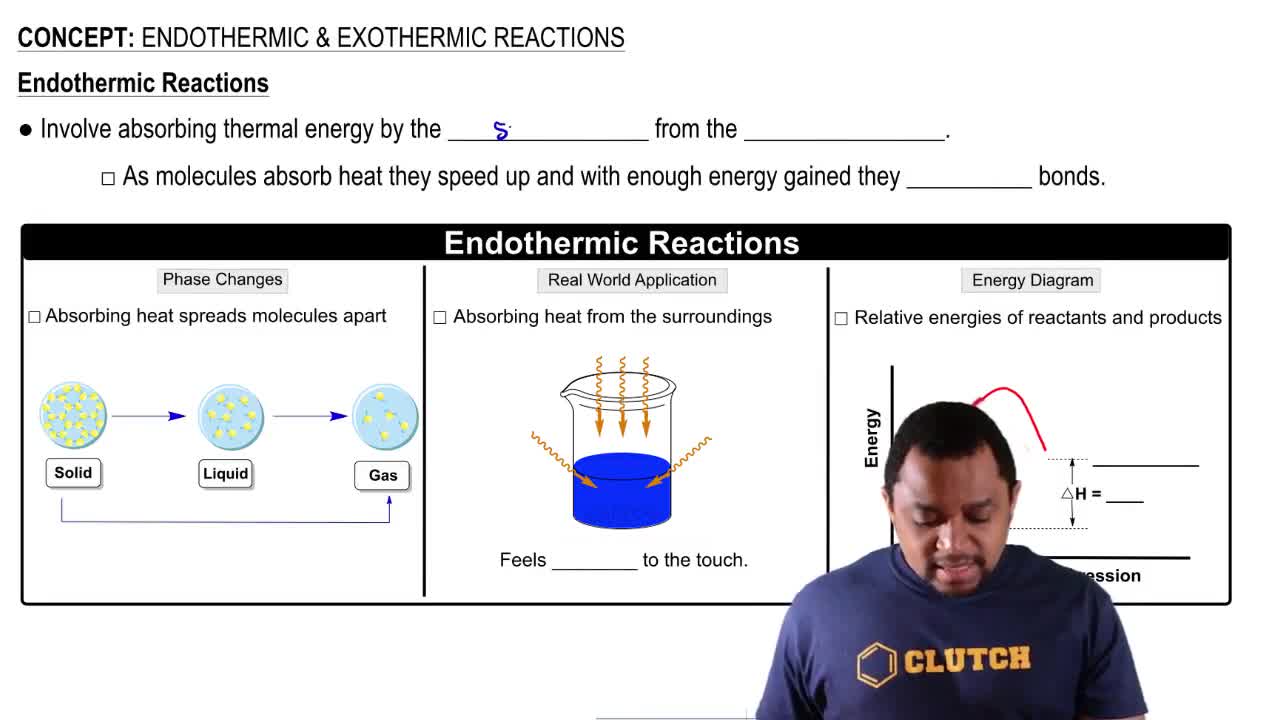
Exothermic and Endothermic Reactions

Reactions can be classified as exothermic or endothermic based on heat exchange. An exothermic reaction releases heat, while an endothermic reaction absorbs heat. The methanol synthesis reaction is exothermic, meaning that lowering the temperature would favor the formation of methanol, as the system will shift to produce more heat.
추천 영상:
가이드 코스
02:30
Endothermic & Exothermic Reactions

Equilibrium Constant (K)

The equilibrium constant (K) quantifies the ratio of concentrations of products to reactants at equilibrium for a given reaction at a specific temperature. Changes in temperature can alter the value of K, thus affecting the yield of products. For the methanol synthesis reaction, a lower temperature increases the equilibrium constant, favoring the production of methanol.
추천 영상:
가이드 코스
01:14
Equilibrium Constant K