
The following equilibria were measured at 823 K: CoO(s) + H2(g) ⇌ Co(s) + H2O(g) Kc = 67 H2(g) + CO2(g) ⇌ CO(g) + H2O(g) Kc = 0.14 (d) If the reaction vessel from part (c) is heated to 823 K and allowed to come to equilibrium, how much CoO(s) remains?
Ch.15 - Chemical Equilibrium
15장, 문제 96a
The following equilibria were measured at 823 K: CoO(s) + H2(g) ⇌ Co(s) + H2O(g) Kc = 67 H2(g) + CO2(g) ⇌ CO(g) + H2O(g) Kc = 0.14 (a) Use these equilibria to calculate the equilibrium constant, Kc, for the reaction CoO(s) + CO(g) ⇌ Co(s) + CO2(g) at 823 K.
검증된 단계별 안내1
Identify the given reactions and their equilibrium constants. The first reaction is CoO(s) + H2(g) ⇌ Co(s) + H2O(g) with Kc = 67. The second reaction is H2(g) + CO2(g) ⇌ CO(g) + H2O(g) with Kc = 0.14.
Write the target reaction: CoO(s) + CO(g) ⇌ Co(s) + CO2(g). Notice that this reaction can be obtained by reversing the first given reaction and adding it to the second given reaction.
Reverse the first reaction to get Co(s) + H2O(g) ⇌ CoO(s) + H2(g). The equilibrium constant for the reversed reaction will be the reciprocal of the original, which is 1/67.
Add the reversed first reaction to the second reaction. This involves adding Co(s) + H2O(g) ⇌ CoO(s) + H2(g) to H2(g) + CO2(g) ⇌ CO(g) + H2O(g). The H2(g) and H2O(g) will cancel out, resulting in CoO(s) + CO(g) ⇌ Co(s) + CO2(g).
Calculate the equilibrium constant for the target reaction by multiplying the constants of the individual reactions used. The equilibrium constant for the target reaction, Kc, is (1/67) * 0.14.

비슷한 문제에 대한 검증된 영상 답변:
이 영상 해법은 위 문제에 도움이 된다고 튜터들이 추천한 것입니다.
영상 길이:
3m주요 개념
질문에 올바르게 답하기 위해 반드시 이해해야 하는 핵심 개념들은 다음과 같습니다.
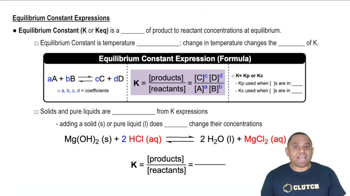
Equilibrium Constant (Kc)
The equilibrium constant, Kc, is a numerical value that expresses the ratio of the concentrations of products to reactants at equilibrium for a given reaction at a specific temperature. It is calculated using the formula Kc = [products]^[coefficients] / [reactants]^[coefficients]. A Kc value greater than 1 indicates that products are favored at equilibrium, while a value less than 1 suggests that reactants are favored.
추천 영상:
가이드 코스
Equilibrium Constant Expressions
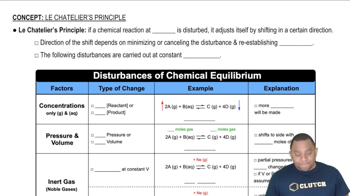
Le Chatelier's Principle
Le Chatelier's Principle states that if a dynamic equilibrium is disturbed by changing the conditions, the system will adjust itself to counteract the change and restore a new equilibrium. This principle is crucial for predicting how changes in concentration, pressure, or temperature will affect the position of equilibrium in a chemical reaction.
추천 영상:
가이드 코스
Le Chatelier's Principle
Manipulating Equilibrium Expressions
When dealing with multiple equilibria, it is essential to manipulate the equilibrium expressions correctly to derive the desired Kc for a new reaction. This involves using the relationships between the given reactions, such as reversing a reaction (which inverts Kc) or adding reactions (which multiplies Kc values). Understanding how to combine these expressions is key to solving complex equilibrium problems.
추천 영상:
가이드 코스
Equilibrium Constant Expressions
관련 실천
교과서 질문
573
views
교과서 질문
The phase diagram for SO2 is shown here. (d) At which of the three points marked in red does SO2(g) most closely approach ideal-gas behavior?
767
views
교과서 질문
At a temperature of 700 K, the forward and reverse rate constants for the reaction 2 HI(g) ⇌ H2(g) + I2(g) are kf = 1.8×10⁻³⁰ M−1s−1 and kr = 0.063 M−1s−1.
(a) What is the value of the equilibrium constant Kc at 700 K?
(b) Is the forward reaction endothermic or exothermic if the rate constants for the same reaction have values of kf = 0.097M−1s−1 and kr = 2.6 M−1s−1 at 800 K?
298
views
교과서 질문
The phase diagram for SO2 is shown here. (e) At which of the three red points does SO2(g) behave least ideally?
1361
views
