
Ch.15 - Chemical Equilibrium
Brown - Chemistry: The Central Science 14th Edition
Brown14th EditionChemistry: The Central ScienceISBN: 9780134414232당신이 사용하는 게 아니라요?교과서 변경
15장, 문제 96d

The following equilibria were measured at 823 K: CoO(s) + H2(g) ⇌ Co(s) + H2O(g) Kc = 67 H2(g) + CO2(g) ⇌ CO(g) + H2O(g) Kc = 0.14 (d) If the reaction vessel from part (c) is heated to 823 K and allowed to come to equilibrium, how much CoO(s) remains?

검증된 단계별 안내
1
Identify the relevant equilibrium reaction: CoO(s) + H2(g) ⇌ Co(s) + H2O(g).
Write down the expression for the equilibrium constant (Kc) for the reaction: Kc = [H2O]/([H2][CoO]). Note that solids like CoO and Co do not appear in the expression as their activity is considered to be 1.
Set up an ICE (Initial, Change, Equilibrium) table to track the concentrations of reactants and products. Assume initial moles of CoO and H2, and zero moles for Co and H2O. Define x as the amount of CoO that reacts.
Express the equilibrium concentrations in terms of x and substitute them into the Kc expression. Solve for x, which represents the amount of CoO that reacts at equilibrium.
Subtract the amount of CoO that reacted (x) from the initial amount of CoO to find the amount of CoO remaining at equilibrium.

비슷한 문제에 대한 검증된 영상 답변:

이 영상 해법은 위 문제에 도움이 된다고 튜터들이 추천한 것입니다.
영상 길이:
6m

주요 개념

질문에 올바르게 답하기 위해 반드시 이해해야 하는 핵심 개념들은 다음과 같습니다.

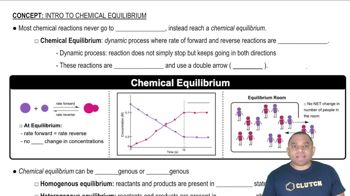
Chemical Equilibrium

Chemical equilibrium occurs when the rates of the forward and reverse reactions are equal, resulting in constant concentrations of reactants and products. In this state, the system is dynamic, meaning that reactions continue to occur, but there is no net change in the concentrations. Understanding equilibrium is crucial for predicting how changes in conditions, such as temperature or concentration, will affect the position of the equilibrium.
추천 영상:
가이드 코스
04:21
Chemical Equilibrium Concepts

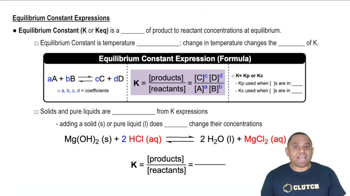
Equilibrium Constant (Kc)

The equilibrium constant (Kc) quantifies the ratio of the concentrations of products to reactants at equilibrium for a given reaction at a specific temperature. A larger Kc value indicates a greater concentration of products at equilibrium, while a smaller Kc suggests that reactants are favored. In the context of the question, the provided Kc values for the reactions will help determine the extent to which CoO remains after reaching equilibrium.
추천 영상:
가이드 코스
03:20
Equilibrium Constant Expressions

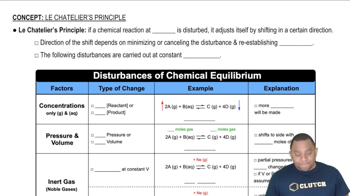
Le Chatelier's Principle

Le Chatelier's Principle states that if a system at equilibrium is subjected to a change in concentration, temperature, or pressure, the system will adjust to counteract that change and restore a new equilibrium. This principle is essential for predicting how the equilibrium position will shift in response to heating the reaction vessel, which can influence the amounts of CoO and other species present at equilibrium.
추천 영상:
가이드 코스
07:32
Le Chatelier's Principle