Ch.16 - Acid-Base Equilibria
Brown - Chemistry: The Central Science 14th Edition
Brown14th EditionChemistry: The Central ScienceISBN: 9780134414232당신이 사용하는 게 아니라요?교과서 변경
16장, 문제 44

Calculate the pH of each of the following strong acid solutions: (a) 0.0167 M HNO3 (b) 15.00 mL of 1.00 M HCl diluted to 0.500 L (c) a mixture formed by adding 50.0 mL of 0.020 M HCl to 125 mL of 0.010 M HI.

검증된 단계별 안내
1
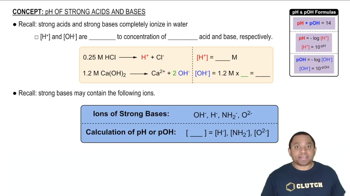
For part (a), recognize that HNO3 is a strong acid, which means it completely dissociates in water. The concentration of H+ ions is equal to the concentration of the acid. Therefore, [H+] = 0.0167 M. Use the formula for pH: \( \text{pH} = -\log[H^+] \) to find the pH.
For part (b), first calculate the number of moles of HCl before dilution using the formula: \( \text{moles} = \text{concentration} \times \text{volume} \). Here, \( \text{moles of HCl} = 1.00 \text{ M} \times 0.01500 \text{ L} \). Then, find the new concentration after dilution by dividing the moles of HCl by the new volume (0.500 L). Finally, calculate the pH using \( \text{pH} = -\log[H^+] \).
For part (c), calculate the moles of HCl and HI separately. For HCl: \( \text{moles} = 0.020 \text{ M} \times 0.0500 \text{ L} \). For HI: \( \text{moles} = 0.010 \text{ M} \times 0.125 \text{ L} \).
Add the moles of HCl and HI together to get the total moles of H+ ions in the solution. Then, calculate the total volume of the solution by adding the volumes of HCl and HI: \( 0.0500 \text{ L} + 0.125 \text{ L} \).
Determine the concentration of H+ ions in the mixture by dividing the total moles of H+ by the total volume of the solution. Finally, calculate the pH using \( \text{pH} = -\log[H^+] \).

주요 개념

질문에 올바르게 답하기 위해 반드시 이해해야 하는 핵심 개념들은 다음과 같습니다.

Strong Acids and pH Calculation

Strong acids, such as HNO3 and HCl, completely dissociate in water, meaning that the concentration of hydrogen ions (H+) in solution is equal to the concentration of the acid. The pH of a solution is calculated using the formula pH = -log[H+]. For strong acids, this simplifies the calculation since the pH can be directly derived from the molarity of the acid.
추천 영상:
가이드 코스
02:39
pH of Strong Acids and Bases

Dilution and Concentration

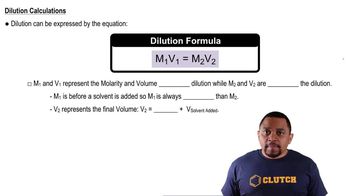
When a solution is diluted, the number of moles of solute remains constant, but the volume increases, resulting in a lower concentration. The dilution can be calculated using the formula C1V1 = C2V2, where C1 and V1 are the initial concentration and volume, and C2 and V2 are the final concentration and volume. This concept is crucial for determining the pH of diluted strong acid solutions.
추천 영상:
가이드 코스
00:58
Dilution Equation

Mixing Solutions and Total Volume

When mixing two solutions, the total concentration of hydrogen ions must be calculated based on the volumes and concentrations of each solution. The total volume after mixing affects the final concentration of H+. The combined concentration can be found using the formula: [H+] = (C1V1 + C2V2) / (V1 + V2), which is essential for accurately calculating the pH of the resulting mixture.
추천 영상:
가이드 코스
02:35
Constant-Volume Calorimetry