
Ch.17 - Additional Aspects of Aqueous Equilibria
Brown - Chemistry: The Central Science 14th Edition
Brown14th EditionChemistry: The Central ScienceISBN: 9780134414232당신이 사용하는 게 아니라요?교과서 변경
17장, 문제 114

What is the pH at 25 C of water saturated with CO2 at a partial pressure of 1.10 atm? The Henry's law constant for CO2 at 25 C is 3.1 * 10-2 mol>L@atm.

검증된 단계별 안내
1
Step 1: Use Henry's Law to calculate the concentration of CO2 in the water. Henry's Law states that the concentration of a gas in a liquid is directly proportional to the partial pressure of the gas above the liquid. The formula is: C = kP, where C is the concentration, k is the Henry's Law constant, and P is the partial pressure.
Step 2: Substitute the given values into the Henry's Law equation. The Henry's Law constant (k) for CO2 at 25 C is 3.1 * 10^-2 mol/L*atm and the partial pressure (P) is 1.10 atm.
Step 3: The CO2 in water will form carbonic acid (H2CO3), which is a weak acid. This will dissociate into H+ and HCO3- ions. Write the chemical equation for this reaction: CO2 + H2O -> H2CO3 -> H+ + HCO3-.
Step 4: Use the concentration of CO2 calculated in step 2 as the initial concentration of H2CO3. Since we are assuming that all the CO2 forms H2CO3, the initial concentration of H+ and HCO3- is zero.
Step 5: Use the definition of pH to calculate the pH of the solution. The pH is defined as the negative logarithm (base 10) of the concentration of H+ ions in the solution. Since the concentration of H+ ions is equal to the concentration of H2CO3, you can use the concentration calculated in step 2 to find the pH.

비슷한 문제에 대한 검증된 영상 답변:

이 영상 해법은 위 문제에 도움이 된다고 튜터들이 추천한 것입니다.
영상 길이:
7m

주요 개념

질문에 올바르게 답하기 위해 반드시 이해해야 하는 핵심 개념들은 다음과 같습니다.

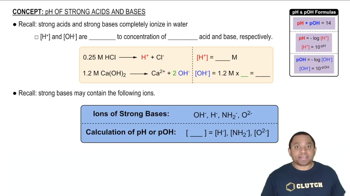
pH and Acidity

pH is a measure of the hydrogen ion concentration in a solution, indicating its acidity or basicity. A pH of 7 is neutral, below 7 is acidic, and above 7 is basic. The pH scale is logarithmic, meaning each whole number change represents a tenfold change in hydrogen ion concentration.
추천 영상:
가이드 코스
02:39
pH of Strong Acids and Bases

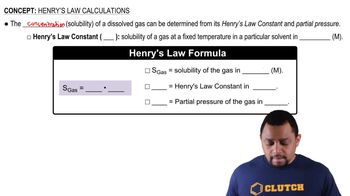
Henry's Law

Henry's Law states that the amount of gas that dissolves in a liquid at a given temperature is proportional to the partial pressure of that gas above the liquid. This relationship is expressed as C = kH * P, where C is the concentration of the gas in the liquid, kH is the Henry's law constant, and P is the partial pressure of the gas.
추천 영상:
가이드 코스
01:40
Henry's Law Calculations

Carbonic Acid Formation

When CO2 dissolves in water, it reacts to form carbonic acid (H2CO3), which can dissociate into bicarbonate (HCO3-) and hydrogen ions (H+). This increase in hydrogen ions lowers the pH of the solution, making it more acidic. Understanding this reaction is crucial for calculating the pH of water saturated with CO2.
추천 영상:
가이드 코스
01:41
Amide Formation