Ch.18 - Chemistry of the Environment
Brown - Chemistry: The Central Science 14th Edition
Brown14th EditionChemistry: The Central ScienceISBN: 9780134414232당신이 사용하는 게 아니라요?교과서 변경
18장, 문제 84

The standard enthalpies of formation of ClO and ClO2 are 101 and 102 kJ/mol, respectively. Using these data and the thermodynamic data in Appendix C, calculate the overall enthalpy change for each step in the following catalytic cycle: ClO(g) + O(g) → ClO(g) + O(g). What is the enthalpy change for the overall reaction that results from these two steps?

검증된 단계별 안내
1
Step 1: Identify the given data and the reaction. The problem provides the standard enthalpies of formation for ClO and ClO2 as 101 kJ/mol and 102 kJ/mol, respectively. The reaction given is ClO(g) + O(g) → ClO(g) + O(g).
Step 2: Recognize that the reaction provided is a balanced equation where the reactants and products are the same, indicating no net change in the chemical species involved.
Step 3: Understand that since the reactants and products are identical, the enthalpy change for this reaction is zero. This is because the enthalpy of formation of the reactants is equal to the enthalpy of formation of the products.
Step 4: Consider the concept of Hess's Law, which states that the total enthalpy change for a reaction is the same, no matter how many steps the reaction is carried out in. Since the reaction does not change the chemical species, the enthalpy change remains zero.
Step 5: Conclude that the enthalpy change for the overall reaction, given the identical reactants and products, is zero. This is consistent with the principle that no net chemical change results in no enthalpy change.

주요 개념

질문에 올바르게 답하기 위해 반드시 이해해야 하는 핵심 개념들은 다음과 같습니다.

Enthalpy of Formation

The enthalpy of formation is the heat change that results when one mole of a compound is formed from its elements in their standard states. It is a crucial concept in thermodynamics, as it allows for the calculation of the overall enthalpy change in chemical reactions by using standard enthalpy values for reactants and products.
추천 영상:
가이드 코스
02:34
Enthalpy of Formation

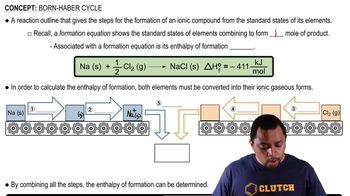
Thermodynamic Cycle

A thermodynamic cycle is a series of processes that return a system to its initial state, allowing for the calculation of changes in enthalpy or other thermodynamic properties. In the context of chemical reactions, it helps in understanding how the enthalpy changes during different steps of a reaction can be summed to find the overall change for the reaction.
추천 영상:
가이드 코스
03:49
Born Haber Cycle

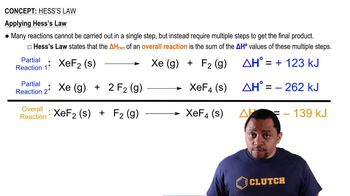
Hess's Law

Hess's Law states that the total enthalpy change for a reaction is the same, regardless of the number of steps or the pathway taken. This principle is essential for calculating the overall enthalpy change in a reaction by summing the enthalpy changes of individual steps, which is particularly useful when direct measurement is difficult.
추천 영상: