Ch.2 - Atoms, Molecules, and Ions
Brown - Chemistry: The Central Science 14th Edition
Brown14th EditionChemistry: The Central ScienceISBN: 9780134414232당신이 사용하는 게 아니라요?교과서 변경
2장, 문제 23d

Consider an atom of 10B. (d) Are either of the atoms obtained in parts (b) and (c) isotopes of 10B? If so which one?

검증된 단계별 안내
1
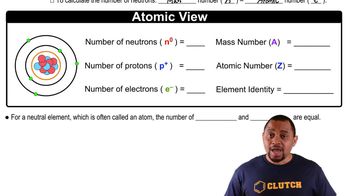
Step 1: Recall the definition of isotopes. Isotopes are atoms of the same element that have the same number of protons but different numbers of neutrons.
Step 2: Identify the number of protons in 10B. Boron (B) has an atomic number of 5, which means it has 5 protons.
Step 3: Determine the number of neutrons in 10B. The mass number is 10, so the number of neutrons is 10 - 5 = 5 neutrons.
Step 4: Review the atoms obtained in parts (b) and (c) of the problem. Compare their number of protons and neutrons to those of 10B.
Step 5: Conclude whether either of the atoms from parts (b) and (c) have the same number of protons (5) and a different number of neutrons compared to 10B, which would make them isotopes.

비슷한 문제에 대한 검증된 영상 답변:

이 영상 해법은 위 문제에 도움이 된다고 튜터들이 추천한 것입니다.
영상 길이:
1m

주요 개념

질문에 올바르게 답하기 위해 반드시 이해해야 하는 핵심 개념들은 다음과 같습니다.

Isotopes

Isotopes are variants of a particular chemical element that have the same number of protons but different numbers of neutrons. This results in different atomic masses for the isotopes. For example, boron has isotopes such as 10B and 11B, where 10B has 5 neutrons and 11B has 6 neutrons. Understanding isotopes is crucial for identifying whether two atoms belong to the same element but differ in mass.
추천 영상:

Atomic Number and Mass Number

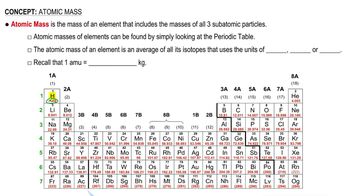
The atomic number of an element is the number of protons in its nucleus, which defines the element itself. The mass number is the total number of protons and neutrons in the nucleus. For boron, the atomic number is 5, and for the isotope 10B, the mass number is 10. This distinction helps in determining whether two atoms are isotopes based on their mass numbers.
추천 영상:

Nuclear Stability

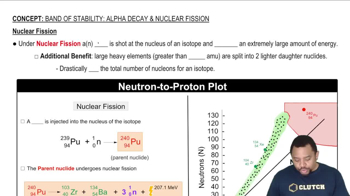
Nuclear stability refers to the stability of an atomic nucleus, which is influenced by the ratio of protons to neutrons. Isotopes can be stable or unstable; stable isotopes do not undergo radioactive decay, while unstable ones do. Understanding nuclear stability is important when discussing isotopes, as it can affect their occurrence and applications in fields like medicine and energy.
추천 영상:
가이드 코스
03:29
Band of Stability: Nuclear Fission