Ch.2 - Atoms, Molecules, and Ions
Brown - Chemistry: The Central Science 14th Edition
Brown14th EditionChemistry: The Central ScienceISBN: 9780134414232당신이 사용하는 게 아니라요?교과서 변경
2장, 문제 24b

Consider an atom of 58Ni. (b) What is the symbol of the ion obtained by removing two electrons from 58Ni?

검증된 단계별 안내
1
Identify the element based on the given symbol: 58Ni represents the isotope of nickel with a mass number of 58. The atomic number of nickel (Ni) is 28, which means it has 28 protons and, in a neutral atom, 28 electrons.
Understand what happens when electrons are removed: Removing two electrons from the neutral atom means the ion will have 2 fewer electrons than protons, resulting in a +2 charge.
Write the symbol of the ion: The element symbol remains Ni, the mass number stays 58 (since removing electrons does not change the number of protons or neutrons), and the charge is indicated as a superscript +2.
Express the ion symbol using proper notation: The ion is written as Ni58+2, where 58 is the mass number and +2 is the charge.
Summarize the ion's characteristics: The ion has 28 protons, 30 neutrons (58 - 28), and 26 electrons (28 - 2), resulting in the symbol Ni58+2.

비슷한 문제에 대한 검증된 영상 답변:

이 영상 해법은 위 문제에 도움이 된다고 튜터들이 추천한 것입니다.
영상 길이:
1m

주요 개념

질문에 올바르게 답하기 위해 반드시 이해해야 하는 핵심 개념들은 다음과 같습니다.

Isotopes and Atomic Notation

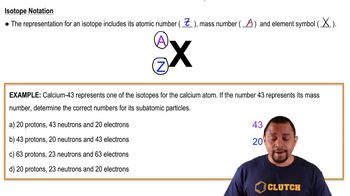
Isotopes are atoms of the same element with different numbers of neutrons, affecting their mass number. Atomic notation shows the element symbol with its mass number (protons + neutrons) as a superscript and atomic number (protons) as a subscript. For 58Ni, 58 is the mass number, and Ni is the element symbol.
추천 영상:
가이드 코스
03:57
Isotope Notation Example

Formation of Ions by Electron Removal

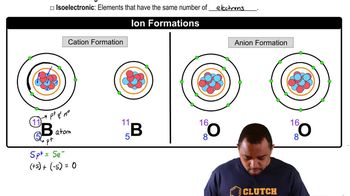
Ions form when atoms gain or lose electrons. Removing electrons creates a positively charged ion (cation). The charge equals the number of electrons lost, so removing two electrons from a neutral atom results in a 2+ charge.
추천 영상:

Writing Ion Symbols

Ion symbols combine the element symbol, mass number, and charge. The mass number remains unchanged when electrons are lost or gained. The charge is indicated as a superscript with a plus or minus sign and the number of charges, e.g., Ni²⁺ for a nickel ion with two electrons removed.
추천 영상:
가이드 코스
03:17
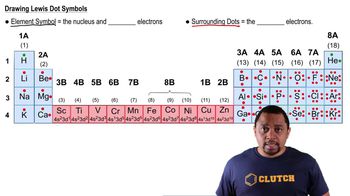
Lewis Dot Symbols