During the discharge of an alkaline battery, 4.50 g of Zn is consumed at the anode of the battery. (b) How many coulombs of electrical charge are transferred from Zn to MnO2?
Ch.20 - Electrochemistry
20장, 문제 73b
During a period of discharge of a lead–acid battery, 402 g of Pb from the anode is converted into PbSO4(s). (b) How many coulombs of electrical charge are transferred from Pb to PbO2?
검증된 단계별 안내1
Identify the chemical reaction occurring in the lead-acid battery during discharge. The anode reaction is: \[ \text{Pb} + \text{SO}_4^{2-} \rightarrow \text{PbSO}_4 + 2e^- \].
Determine the moles of Pb involved in the reaction. Use the molar mass of Pb (207.2 g/mol) to convert the given mass of Pb (402 g) to moles: \[ \text{moles of Pb} = \frac{402 \text{ g}}{207.2 \text{ g/mol}} \].
Calculate the total number of moles of electrons transferred. Since each mole of Pb produces 2 moles of electrons, multiply the moles of Pb by 2.
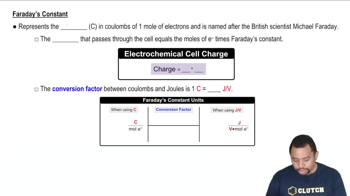
Use Faraday's constant to convert moles of electrons to coulombs. Faraday's constant is approximately 96485 C/mol. Multiply the moles of electrons by Faraday's constant to find the total charge in coulombs.
Summarize the process: The total charge transferred is the product of the moles of electrons and Faraday's constant, which gives the number of coulombs of electrical charge transferred from Pb to PbO2.

비슷한 문제에 대한 검증된 영상 답변:
이 영상 해법은 위 문제에 도움이 된다고 튜터들이 추천한 것입니다.
영상 길이:
4m주요 개념
질문에 올바르게 답하기 위해 반드시 이해해야 하는 핵심 개념들은 다음과 같습니다.
Electrochemistry
Electrochemistry is the branch of chemistry that deals with the relationship between electrical energy and chemical reactions. In the context of batteries, it involves the transfer of electrons during redox reactions, where oxidation and reduction occur simultaneously. Understanding electrochemical processes is essential for analyzing how batteries function and how charge is transferred.
추천 영상:
가이드 코스
Faraday's Constant in Electrochemistry
Molar Mass and Stoichiometry
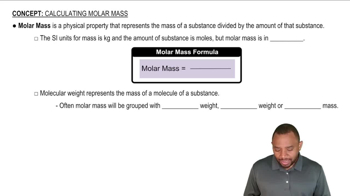
Molar mass is the mass of one mole of a substance, typically expressed in grams per mole. Stoichiometry involves the calculation of reactants and products in chemical reactions based on balanced equations. In this question, knowing the molar mass of lead (Pb) allows for the conversion of mass to moles, which is crucial for determining the amount of charge transferred during the battery's discharge.
추천 영상:
가이드 코스
Molar Mass Concept
Faraday's Law of Electrolysis
Faraday's Law states that the amount of substance transformed during electrolysis is directly proportional to the quantity of electric charge passed through the system. This principle allows for the calculation of the total charge (in coulombs) based on the number of moles of electrons involved in the reaction. In the case of the lead-acid battery, it helps determine how much charge is transferred when lead is converted to lead sulfate.
추천 영상:
가이드 코스
Faraday's Constant in Electrochemistry
관련 실천
교과서 질문
778
views
1
rank
교과서 질문
During a period of discharge of a lead–acid battery, 402 g of Pb from the anode is converted into PbSO4(s). (a) What mass of PbO2(s) is reduced at the cathode during this same period?
653
views
교과서 질문
During the discharge of an alkaline battery, 4.50 g of Zn is consumed at the anode of the battery. (a) What mass of MnO2 is reduced at the cathode during this discharge?
교과서 질문
A voltaic cell is constructed that is based on the following reaction: Sn2+(aq) + Pb(s) → Sn(s) + Pb2+(aq) (a) If the concentration of Sn2+ in the cathode half-cell is 1.00 M and the cell generates an emf of +0.22 V, what is the concentration of Pb2+ in the anode half-cell?
936
views