
Ch.7 - Periodic Properties of the Elements
Brown - Chemistry: The Central Science 14th Edition
Brown14th EditionChemistry: The Central ScienceISBN: 9780134414232당신이 사용하는 게 아니라요?교과서 변경
7장, 문제 22

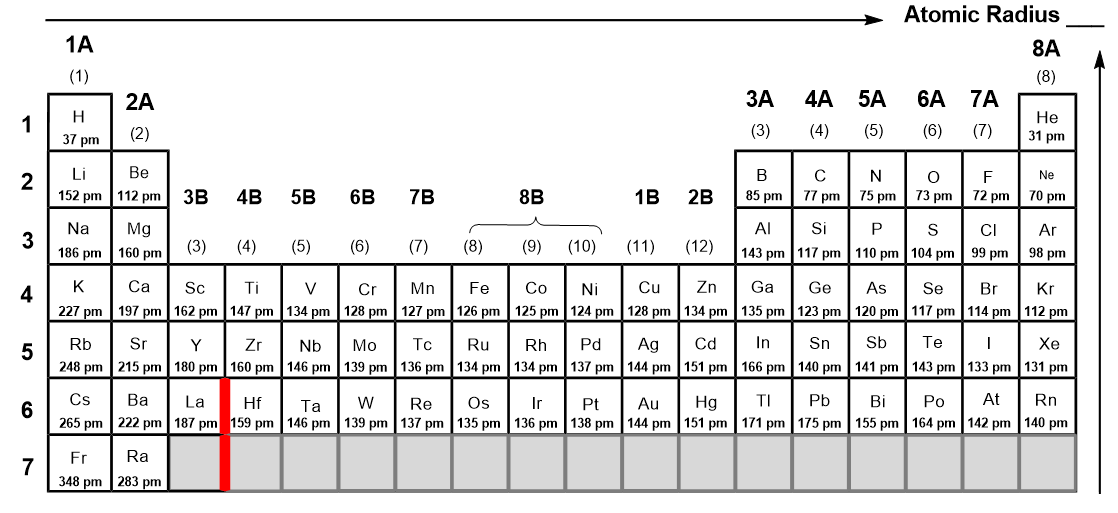
Which of the following statements about the bonding atomic radii in Figure 7.7 is incorrect? (i) For a given period, the radii of the representative elements generally decrease from left to right across a period. (ii) The radii of the representative elements for the n = 3 period are all larger than those of the corresponding elements in the n = 2 period. (iii) For most of the representative elements, the change in radius from the n = 2 to the n = 3 period is greater than the change in radius from n = 3 to n = 4. (iv) The radii of the transition elements generally increase moving from left to right within a period. (v) The large radii of the Group 1 elements are due to their relatively small effective nuclear charges.
Periodic table highlighting atomic radii of elements across periods and groups.

검증된 단계별 안내
1
Step 1: Review the periodic table image provided, focusing on the atomic radii values for each element.
Step 2: Analyze statement (i): For a given period, the radii of the representative elements generally decrease from left to right across a period. Verify this by checking the atomic radii values across a period.
Step 3: Analyze statement (ii): The radii of the representative elements for the n = 3 period are all larger than those of the corresponding elements in the n = 2 period. Compare the atomic radii of elements in period 3 with those in period 2.
Step 4: Analyze statement (iii): For most of the representative elements, the change in radius from the n = 2 to the n = 3 period is greater than the change in radius from n = 3 to n = 4. Compare the changes in atomic radii between these periods.
Step 5: Analyze statement (iv): The radii of the transition elements generally increase moving from left to right within a period. Check the atomic radii values of transition elements within a period to verify this statement.

비슷한 문제에 대한 검증된 영상 답변:

이 영상 해법은 위 문제에 도움이 된다고 튜터들이 추천한 것입니다.
영상 길이:
2m

주요 개념

질문에 올바르게 답하기 위해 반드시 이해해야 하는 핵심 개념들은 다음과 같습니다.

Atomic Radius Trends

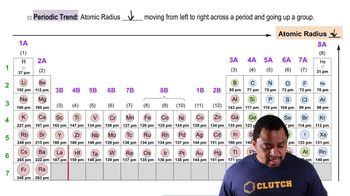
The atomic radius refers to the size of an atom, typically measured from the nucleus to the outermost electron shell. In general, atomic radii decrease across a period from left to right due to increasing nuclear charge, which pulls electrons closer to the nucleus. Conversely, atomic radii increase down a group as additional electron shells are added, increasing the distance between the nucleus and the outermost electrons.
추천 영상:
가이드 코스
01:42
Atomic Radius Trends

Effective Nuclear Charge (Z_eff)

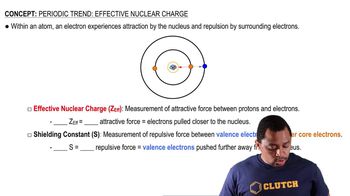
Effective nuclear charge is the net positive charge experienced by an electron in a multi-electron atom. It accounts for the shielding effect of inner-shell electrons that reduce the full nuclear charge felt by outer-shell electrons. A higher effective nuclear charge leads to a stronger attraction between the nucleus and the outer electrons, resulting in smaller atomic radii, particularly across a period.
추천 영상:
가이드 코스
01:51
Effective Nuclear Charge

Comparative Periodic Trends

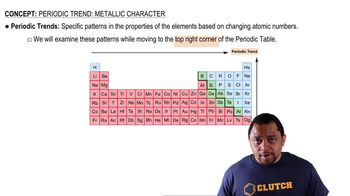
Comparative periodic trends involve analyzing how properties such as atomic radius, ionization energy, and electronegativity change across periods and down groups in the periodic table. For instance, while atomic radii generally decrease across a period, they can exhibit different behaviors in transition metals and lanthanides due to electron-electron interactions and subshell filling, which can complicate straightforward comparisons.
추천 영상:
가이드 코스
00:38
Periodic Trends