Ch.7 - Periodic Properties of the Elements
Brown - Chemistry: The Central Science 14th Edition
Brown14th EditionChemistry: The Central ScienceISBN: 9780134414232당신이 사용하는 게 아니라요?교과서 변경
7장, 문제 20b

With the exception of helium, the noble gases condense to form solids when they are cooled sufficiently. At temperatures below 83 K, argon forms a close-packed solid whose structure is shown below. (b) Is this value larger or smaller than the bonding atomic radius estimated for argon in Figure 7.7?

검증된 단계별 안내
1
Identify the type of solid structure argon forms at temperatures below 83 K, which is a close-packed solid.
Understand that in a close-packed structure, atoms are arranged in a way that maximizes the number of nearest neighbors, typically forming either a face-centered cubic (FCC) or hexagonal close-packed (HCP) structure.
Recognize that the atomic radius in a close-packed structure can be related to the distance between the centers of adjacent atoms, which is often referred to as the bonding atomic radius.
Refer to Figure 7.7 to find the estimated bonding atomic radius for argon, which is typically given in picometers (pm).
Compare the calculated or given atomic radius from the close-packed structure to the bonding atomic radius from Figure 7.7 to determine if it is larger or smaller.

비슷한 문제에 대한 검증된 영상 답변:

이 영상 해법은 위 문제에 도움이 된다고 튜터들이 추천한 것입니다.
영상 길이:
1m

주요 개념

질문에 올바르게 답하기 위해 반드시 이해해야 하는 핵심 개념들은 다음과 같습니다.

Noble Gases

Noble gases are a group of elements in Group 18 of the periodic table, known for their lack of reactivity due to having a full valence shell of electrons. They include helium, neon, argon, krypton, xenon, and radon. Understanding their unique properties, such as low boiling points and the ability to form solids at low temperatures, is essential for analyzing their behavior in different states of matter.
추천 영상:
가이드 코스
00:44
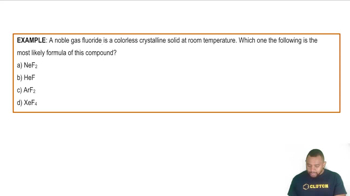
Noble Gas Compounds Example

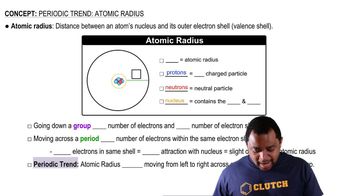
Bonding Atomic Radius

The bonding atomic radius is a measure of the size of an atom that is bonded to another atom, typically defined as half the distance between the nuclei of two bonded atoms. This concept is crucial for understanding how atoms interact and bond with each other, influencing the physical properties of substances, including their state at various temperatures.
추천 영상:

Phase Changes and Solid Structure

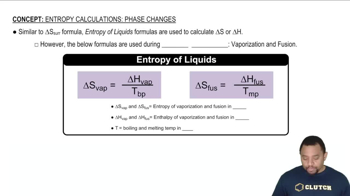
Phase changes refer to the transitions between solid, liquid, and gas states of matter, which occur due to changes in temperature and pressure. The solid structure of argon at low temperatures, such as below 83 K, involves close-packed arrangements of atoms, which affects its physical properties. Understanding these concepts helps in comparing the solid state of argon with its atomic radius and other characteristics.
추천 영상:
가이드 코스
01:46
Entropy in Phase Changes
관련 실천
교과서 질문
Which will experience the greater effect nuclear charge, the electrons in the n = 2 shell in F or the n = 2 shell in B? Which will be closer to the nucleus?
1455
views

교과서 질문

With the exception of helium, the noble gases condense to form solids when they are cooled sufficiently. At temperatures below 83 K, argon forms a close-packed solid whose structure is shown below. (c) Based on this comparison would you say that the atoms are held together by chemical bonds in solid argon?

601
views
교과서 질문
Arrange the following atoms in order of increasing effective nuclear charge experienced by the electrons in the n = 2 shell: Be, Br, Na, P, Se.
1234
views
교과서 질문

Tungsten has the highest melting point of any metal in the periodic table: 3422 °C. The distance between W atoms in tungsten metal is 274 pm. (b) If you put tungsten metal under high pressure, predict what would happen to the distance between W atoms.

9137
views
교과서 질문

Tungsten has the highest melting point of any metal in the periodic table: 3422 °C. The distance between W atoms in tungsten metal is 274 pm. (a) What is the atomic radius of a tungsten atom in this environment? (This radius is called the metallic radius.)

1063
views
1
rank
교과서 질문
Which quantity must be determined experimentally in order to determine the bonding atomic radius of an atom? (a) The distance from the nucleus where the probability of finding an electron goes to zero. (b) The distance between the nuclei of two atoms that are bonded together. (c) The effective nuclear charge of an atom.
478
views