(b) If you were to put HBr under very high pressure, so its bond length decreased significantly, would its dipole moment increase, decrease, or stay the same, if you assume that the effective charges on the atoms do not change?
Ch.8 - Basic Concepts of Chemical Bonding
8장, 문제 42c
Arrange the bonds in each of the following sets in order of increasing polarity: (c) C—S, B—F, N—O.
검증된 단계별 안내1
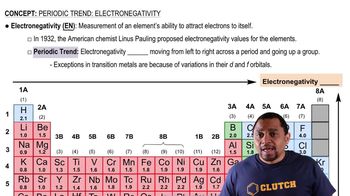
Identify the concept of bond polarity: Bond polarity is determined by the difference in electronegativity between the two atoms involved in the bond. The greater the difference, the more polar the bond.
List the electronegativities of the elements involved: Carbon (C) = 2.55, Sulfur (S) = 2.58, Boron (B) = 2.04, Fluorine (F) = 3.98, Nitrogen (N) = 3.04, Oxygen (O) = 3.44.
Calculate the electronegativity differences for each bond: C—S, B—F, and N—O.
Compare the electronegativity differences: The bond with the smallest difference is the least polar, and the bond with the largest difference is the most polar.
Arrange the bonds in order of increasing polarity based on the calculated electronegativity differences.

비슷한 문제에 대한 검증된 영상 답변:
이 영상 해법은 위 문제에 도움이 된다고 튜터들이 추천한 것입니다.
영상 길이:
2m주요 개념
질문에 올바르게 답하기 위해 반드시 이해해야 하는 핵심 개념들은 다음과 같습니다.
Electronegativity
Electronegativity is a measure of an atom's ability to attract and hold onto electrons in a chemical bond. The greater the difference in electronegativity between two bonded atoms, the more polar the bond will be. For example, fluorine is the most electronegative element, which significantly influences the polarity of bonds involving fluorine.
추천 영상:
가이드 코스
Electronegativity Trends
Bond Polarity
Bond polarity refers to the distribution of electrical charge across a bond between two atoms. A polar bond occurs when there is a significant difference in electronegativity between the two atoms, leading to a dipole moment. Nonpolar bonds, on the other hand, occur when the electronegativities are similar, resulting in an even distribution of charge.
추천 영상:
가이드 코스
Molecular Polarity
Comparative Bond Analysis
Comparative bond analysis involves evaluating the bonds in a set based on their polarity by comparing the electronegativities of the atoms involved. By determining the electronegativity values for each atom in the bonds C—S, B—F, and N—O, one can rank the bonds from least to most polar, providing insight into their chemical behavior.
추천 영상:
가이드 코스
Dimensional Analysis
관련 실천
교과서 질문
821
views
교과서 질문
(a) From the data in Table 8.2, calculate the effective charges on the H atom of the HBr molecule in units of the electronic charge, e.
2145
views
1
comments
교과서 질문
The iodine monobromide molecule, IBr, has a bond length
of 249 pm and a dipole moment of 1.21 D. (a) Which atom of
the molecule is expected to have a negative charge?
1344
views
교과서 질문
Arrange the bonds in each of the following sets in order of increasing polarity: (a) C—F, O—F, Be—F (b) O—Cl,S—Br, C—P
1222
views
교과서 질문
By referring only to the periodic table, select (d) the element in the group K, C, Zn, F that is most likely to form an ionic compound with Ba.
591
views
교과서 질문
Which of the following bonds are polar? (a) C—O, (b) Sl—F, (c) N—Cl, (d) C—Cl. Which is the more electronegative atom in each polar bond?
1752
views