Ch.10 - Gases
Brown - Chemistry: The Central Science 15th Edition
Brown15th EditionChemistry: The Central ScienceISBN: 9780137542970당신이 사용하는 게 아니라요?교과서 변경
10장, 문제 43c

Chlorine is widely used to purify municipal water supplies and to treat swimming pool waters. Suppose that the volume of a particular sample of Cl2 gas is 8.70 L at 895 torr and 24°C. c. At what temperature will the volume be 15.00 L if the pressure is 8.76×10² torr?

검증된 단계별 안내
1
Step 1: Convert the given temperatures from Celsius to Kelvin. The Kelvin temperature is found by adding 273.15 to the Celsius temperature. So, the initial temperature T1 is 24°C + 273.15 = 297.15 K.
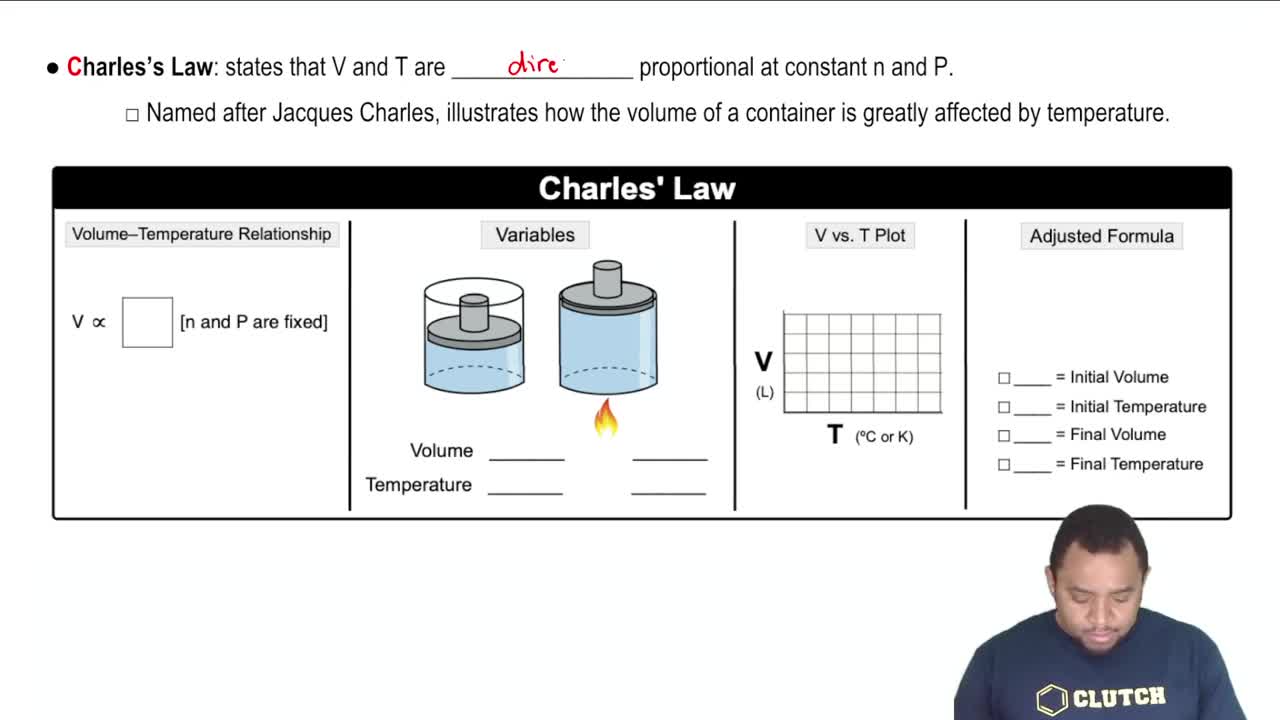
Step 2: Use the ideal gas law in the form of Charles's Law, which states that the volume of a gas is directly proportional to its temperature if the pressure and the amount of gas are kept constant. The formula is V1/T1 = V2/T2, where V1 and T1 are the initial volume and temperature, and V2 and T2 are the final volume and temperature.
Step 3: Substitute the given values into the formula. V1 is 8.70 L, T1 is 297.15 K, and V2 is 15.00 L. We are solving for T2, the final temperature.
Step 4: Rearrange the formula to solve for T2. This gives T2 = V2 * T1 / V1.
Step 5: Plug in the known values and solve for T2. Remember, the answer will be in Kelvin. To convert it back to Celsius, subtract 273.15 from the Kelvin temperature.

비슷한 문제에 대한 검증된 영상 답변:

이 영상 해법은 위 문제에 도움이 된다고 튜터들이 추천한 것입니다.
영상 길이:
4m

주요 개념

질문에 올바르게 답하기 위해 반드시 이해해야 하는 핵심 개념들은 다음과 같습니다.

Ideal Gas Law

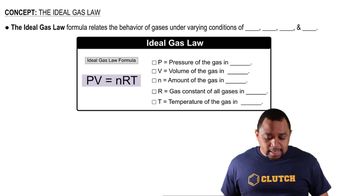
The Ideal Gas Law relates the pressure, volume, temperature, and number of moles of a gas through the equation PV = nRT. This law assumes that gases behave ideally under certain conditions, allowing for calculations involving changes in these variables. Understanding this law is crucial for solving problems involving gas behavior, such as the one presented.
추천 영상:
가이드 코스
01:15
Ideal Gas Law Formula

Charles's Law

Charles's Law states that the volume of a gas is directly proportional to its temperature (in Kelvin) when pressure is held constant. This relationship can be expressed as V1/T1 = V2/T2. In the context of the question, this law helps determine how the volume of chlorine gas changes with temperature when the pressure is altered.
추천 영상:

Gas Pressure Units

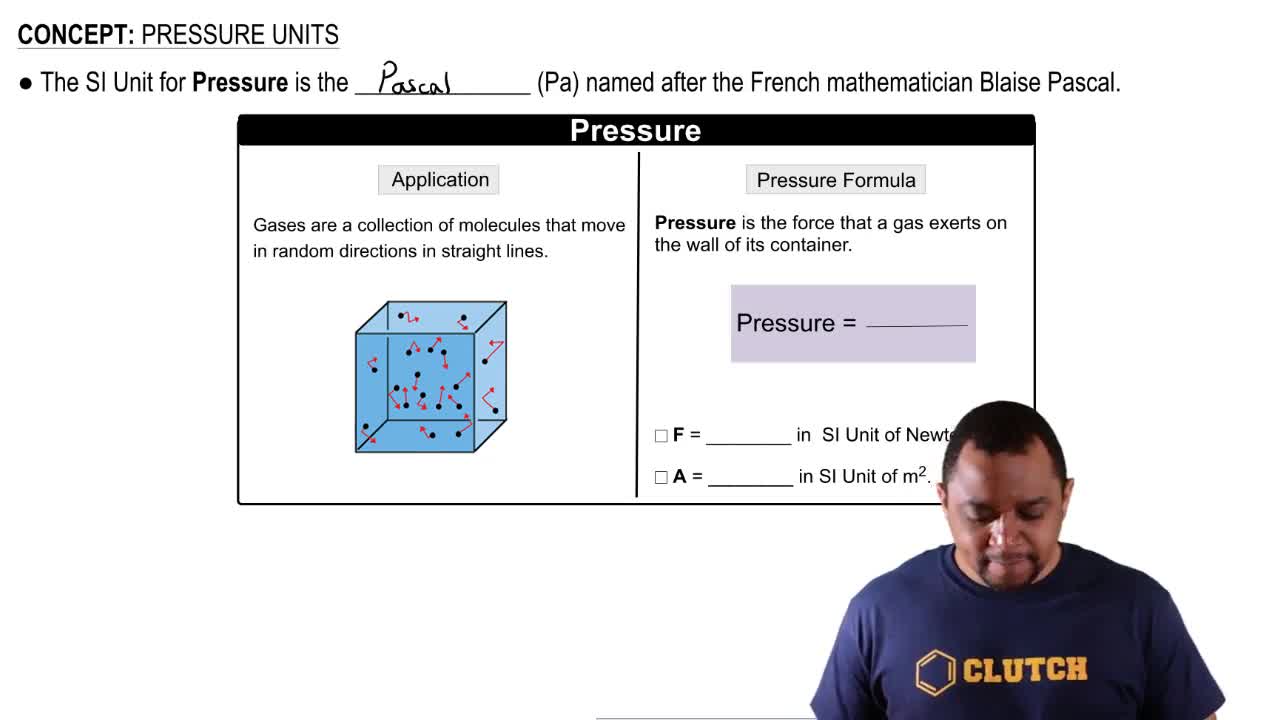
Gas pressure can be measured in various units, including torr, atm, and pascals. In this question, pressure is given in torr, which is a common unit in gas law calculations. Understanding how to convert between these units and how they relate to gas behavior is essential for accurately solving problems involving gas volumes and pressures.
추천 영상:
관련 실천
교과서 질문

Many gases are shipped in high-pressure containers. Consider a steel tank whose volume is 55.0 gallons that contains O2 gas at a pressure of 16,500 kPa at 23°C. c. At what temperature would the pressure in the tank equal 150.0 atm?

교과서 질문

Chlorine is widely used to purify municipal water supplies and to treat swimming pool waters. Suppose that the volume of a particular sample of Cl2 gas is 8.70 L at 895 torr and 24°C. b. What volume will the Cl2 occupy at STP?

교과서 질문

Many gases are shipped in high-pressure containers. Consider a steel tank whose volume is 55.0 gallons that contains O2 gas at a pressure of 16,500 kPa at 23°C. b. What volume would the gas occupy at STP?

교과서 질문

A 35.1 g sample of solid CO2 (dry ice) is added to a container at a temperature of 100 K with a volume of 4.0 L. If the container is evacuated (all of the gas is removed), sealed, and then allowed to warm to room temperature (𝑇=298 K) so that all of the solid CO2 is converted to a gas, what is the pressure inside the container?

교과서 질문

Many gases are shipped in high-pressure containers. Consider a steel tank whose volume is 55.0 gallons that contains O2 gas at a pressure of 16,500 kPa at 23°C. d. What would be the pressure of the gas, in kPa, if it were transferred to a container at 24°C whose volume is 55.0 L?

1
views
교과서 질문

A 334-mL cylinder for use in chemistry lectures contains 5.225 g of helium at 23°C. How many grams of helium must be released to reduce the pressure to 75 atm assuming ideal-gas behavior?