Ch.10 - Gases
Brown - Chemistry: The Central Science 15th Edition
Brown15th EditionChemistry: The Central ScienceISBN: 9780137542970당신이 사용하는 게 아니라요?교과서 변경
10장, 문제 44d

Many gases are shipped in high-pressure containers. Consider a steel tank whose volume is 55.0 gallons that contains O2 gas at a pressure of 16,500 kPa at 23°C. d. What would be the pressure of the gas, in kPa, if it were transferred to a container at 24°C whose volume is 55.0 L?

검증된 단계별 안내
1
1. First, we need to convert the initial conditions to the appropriate units. The volume needs to be converted from gallons to liters (1 gallon = 3.78541 liters) and the temperature from Celsius to Kelvin (K = °C + 273.15).
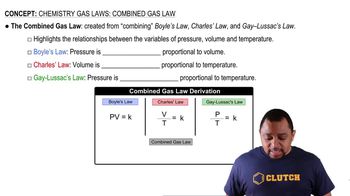
2. Next, we will use the ideal gas law equation, PV = nRT, where P is the pressure, V is the volume, n is the number of moles, R is the ideal gas constant, and T is the temperature in Kelvin. However, since we don't know the number of moles, we will use the combined gas law equation, which is derived from the ideal gas law and is used when the number of moles remains constant. The combined gas law equation is (P1V1/T1) = (P2V2/T2), where the subscripts 1 and 2 refer to the initial and final conditions, respectively.
3. We can rearrange the combined gas law equation to solve for the final pressure, P2. The rearranged equation is P2 = P1V1T2 / T1V2.
4. Now, we can substitute the given values into the rearranged combined gas law equation. Remember to use the converted values for volume and temperature.
5. Finally, solve the equation to find the final pressure, P2. This will give you the pressure of the gas in the new container at 24°C and a volume of 55.0 L.

비슷한 문제에 대한 검증된 영상 답변:

이 영상 해법은 위 문제에 도움이 된다고 튜터들이 추천한 것입니다.
영상 길이:
2m

주요 개념

질문에 올바르게 답하기 위해 반드시 이해해야 하는 핵심 개념들은 다음과 같습니다.

Ideal Gas Law

The Ideal Gas Law relates the pressure, volume, temperature, and number of moles of a gas through the equation PV = nRT. This law is fundamental for understanding gas behavior under varying conditions and allows for calculations involving changes in pressure and temperature.
추천 영상:
가이드 코스
01:15
Ideal Gas Law Formula

Gas Laws

Gas laws, including Boyle's Law and Charles's Law, describe how gases respond to changes in pressure, volume, and temperature. Boyle's Law states that pressure and volume are inversely related at constant temperature, while Charles's Law states that volume and temperature are directly related at constant pressure, both of which are essential for solving the given problem.
추천 영상:
가이드 코스
01:43
Combined Gas Law

Unit Conversion

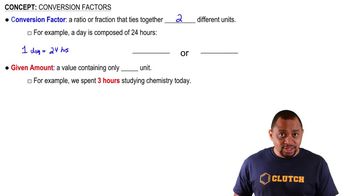
Unit conversion is crucial in chemistry to ensure that measurements are in compatible units. In this question, converting gallons to liters and understanding the relationship between kPa and other pressure units is necessary for accurate calculations and comparisons of gas properties.
추천 영상:
가이드 코스
01:56
Conversion Factors
관련 실천
교과서 질문

Many gases are shipped in high-pressure containers. Consider a steel tank whose volume is 55.0 gallons that contains O2 gas at a pressure of 16,500 kPa at 23°C. c. At what temperature would the pressure in the tank equal 150.0 atm?

교과서 질문

Chlorine is widely used to purify municipal water supplies and to treat swimming pool waters. Suppose that the volume of a particular sample of Cl2 gas is 8.70 L at 895 torr and 24°C. c. At what temperature will the volume be 15.00 L if the pressure is 8.76×10² torr?

교과서 질문

The physical fitness of athletes is measured by 'VO2 max,' which is the maximum volume of oxygen consumed by an individual during incremental exercise (for example, on a treadmill). An average male has a VO2 max of 45 mL O2/kg body mass/min, but a world-class male athlete can have a VO2 max reading of 88.0 mL O2/kg body mass/min. (a) Calculate the volume of oxygen, in mL, consumed in 1 hr by an average man who weighs 85 kg and has a VO2 max reading of 47.5 mL O2/kg body mass/min. (b) If this man lost 10 kg, exercised, and increased his VO2 max to 65.0 mL O2/kg body mass/min, how many mL of oxygen would he consume in 1 hr?

981
views
교과서 질문

Many gases are shipped in high-pressure containers. Consider a steel tank whose volume is 55.0 gallons that contains O2 gas at a pressure of 16,500 kPa at 23°C. b. What volume would the gas occupy at STP?

교과서 질문

Rank the following gases from least dense to most dense at 1.00 atm and 298 K: CO, N2O, Cl2, HF.

교과서 질문

In an experiment reported in the scientific literature, male cockroaches were made to run at different speeds on a miniature treadmill while their oxygen consumption was measured. In 1 h the average cockroach running at 0.08 km/h consumed 0.8 mL of O2 at 1 atm pressure and 24°C per gram of insect mass. a. How many moles of O2 would be consumed in 1 h by a 5.2-g cockroach moving at this speed?