Ch.17 - Additional Aspects of Aqueous Equilibria
Brown - Chemistry: The Central Science 15th Edition
Brown15th EditionChemistry: The Central ScienceISBN: 9780137542970당신이 사용하는 게 아니라요?교과서 변경
17장, 문제 6d

Match the following descriptions of titration curves with the diagrams: (d) strong base added to polyprotic acid. [Section 17.3]

검증된 단계별 안내
1
Identify the characteristics of a titration curve for a strong base added to a polyprotic acid.
Understand that a polyprotic acid can donate more than one proton, leading to multiple equivalence points in the titration curve.
Recognize that each equivalence point corresponds to the complete neutralization of one of the acidic protons.
Note that the pH at each equivalence point will increase as more protons are neutralized, and the curve will have multiple buffering regions.
Look for a titration curve with multiple steps or plateaus, each representing the neutralization of a different proton from the polyprotic acid.

비슷한 문제에 대한 검증된 영상 답변:

이 영상 해법은 위 문제에 도움이 된다고 튜터들이 추천한 것입니다.
영상 길이:
1m

주요 개념

질문에 올바르게 답하기 위해 반드시 이해해야 하는 핵심 개념들은 다음과 같습니다.

Titration Curves

Titration curves graphically represent the pH changes that occur during the titration of an acid or base. They illustrate how the pH of a solution changes as a titrant is added, showing distinct regions such as the initial pH, buffer regions, and equivalence points. Understanding these curves is essential for interpreting the behavior of acids and bases during titration.
추천 영상:
가이드 코스
02:16
Acid-Base Titration Curves

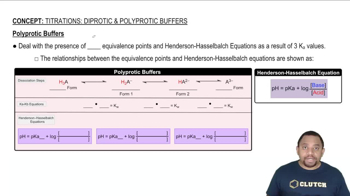
Polyprotic Acids

Polyprotic acids are acids that can donate more than one proton (H+) per molecule in a stepwise manner. Each dissociation step has its own equilibrium constant, leading to multiple equivalence points in a titration curve. Recognizing the characteristics of polyprotic acids is crucial for predicting the shape of their titration curves and understanding the pH changes at each stage.
추천 영상:
가이드 코스
03:25
Polyprotic Buffers

Equivalence Point

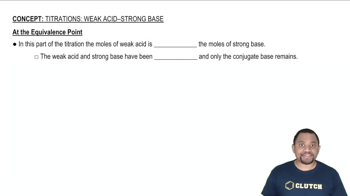
The equivalence point in a titration is the stage at which the amount of titrant added is stoichiometrically equivalent to the amount of substance being titrated. At this point, the reaction between the acid and base is complete, resulting in a significant change in pH. Identifying the equivalence point is vital for determining the concentration of the unknown solution and interpreting the titration curve accurately.
추천 영상:
가이드 코스
01:07
At the Equivalence Point
관련 실천
교과서 질문

Match the following descriptions of titration curves with the diagrams: (a) strong acid added to strong base. [Section 17.3]

544
views

교과서 질문

The following diagram represents a buffer composed of equal concentrations of a weak acid, HA, and its conjugate base, A-. The heights of the columns are proportional to the concentrations of the components of the buffer. (c) Which of the three represents a situation that cannot arise from the addition of either an acid or a base? [Section 17.2]

694
views
교과서 질문

The following figure represents solutions at various stages of the titration of a weak acid, HA, with NaOH. (The Na+ ions and water molecules have been omitted for clarity.) To which of the following regions of the titration curve does each drawing correspond: (b) after addition of NaOH but before the equivalence point? [Section 17.3]

1274
views
교과서 질문

Ca1OH22 has a Ksp of 6.5 * 10-6. (b) If 50 mL of the solution from part (a) is added to each of the beakers shown here, in which beakers, if any, will a precipitate form? In those cases where a precipitate forms, what is its identity? [Section 17.6]

739
views
교과서 질문

The following graphs represent the behavior of BaCO3 under different circumstances. In each case, the vertical axis indicates the solubility of the BaCO3 and the horizontal axis represents the concentration of some other reagent. (a) Which graph represents what happens to the solubility of BaCO3 as HNO3 is added? [Section 17.5]

700
views