Consider the following XF4 ions: PF4-, BrF4-, ClF4+, and AlF4-. (a) Which of the ions have more than an octet of electrons around the central atom?
Ch.9 - Molecular Geometry and Bonding Theories

9장, 문제 33c
Consider the following XF4 ions: PF4-, BrF4-, ClF4+, and AlF4-. (c) Which of the ions will have an octahedral electron-domain geometry?
검증된 단계별 안내1
Identify the central atom in each ion: P in PF4-, Br in BrF4-, Cl in ClF4+, and Al in AlF4-.
Determine the number of valence electrons for each central atom and add or subtract electrons based on the ion's charge.
Add one electron for each fluorine atom bonded to the central atom, as each F forms a single bond.
Calculate the total number of electron domains (regions of electron density) around the central atom, including both bonding pairs and lone pairs.
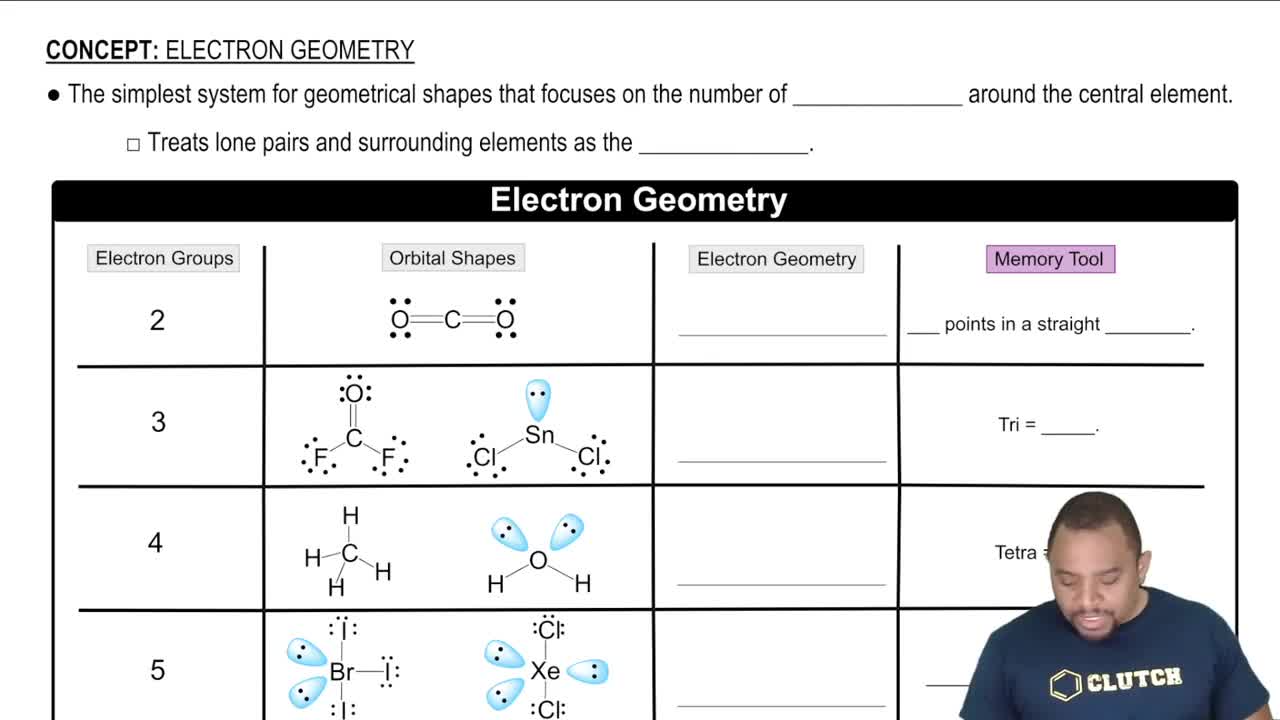
Identify the electron-domain geometry based on the total number of electron domains: 6 domains correspond to an octahedral geometry.

비슷한 문제에 대한 검증된 영상 답변:
이 영상 해법은 위 문제에 도움이 된다고 튜터들이 추천한 것입니다.
영상 길이:
3m주요 개념
질문에 올바르게 답하기 위해 반드시 이해해야 하는 핵심 개념들은 다음과 같습니다.
Electron-Domain Geometry
Electron-domain geometry refers to the spatial arrangement of electron pairs around a central atom, which can include bonding pairs and lone pairs. The VSEPR (Valence Shell Electron Pair Repulsion) theory is used to predict this geometry, where electron pairs repel each other and adopt an arrangement that minimizes repulsion. Common geometries include linear, trigonal planar, tetrahedral, and octahedral.
추천 영상:
가이드 코스
Electron Geometry
Octahedral Geometry
An octahedral geometry occurs when a central atom is surrounded by six electron domains, resulting in a symmetrical arrangement of atoms or groups at the corners of an octahedron. This geometry typically arises in molecules with six bonding pairs and no lone pairs, or in cases where lone pairs are present but do not alter the overall shape significantly.
추천 영상:
가이드 코스
Electron Geometry
Formal Charge and Stability
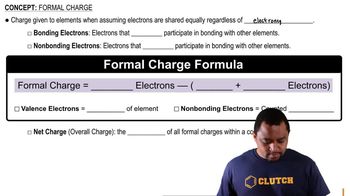
Formal charge is a theoretical charge assigned to an atom in a molecule, calculated based on the number of valence electrons, the number of non-bonding electrons, and half the number of bonding electrons. Understanding formal charge helps predict the most stable structure of a molecule, as lower formal charges on atoms generally indicate greater stability. This concept is crucial when determining the most likely electron-domain geometry for ions.
추천 영상:
가이드 코스
Formal Charge
관련 실천
교과서 질문
862
views
교과서 질문
Ammonia, NH3, reacts with incredibly strong bases to produce the amide ion, NH2-. Ammonia can also react with acids to produce the ammonium ion, NH4+. (a) Which species (amide ion, ammonia, or ammonium ion) has the largest H¬N¬H bond angle? (b) Which species has the smallest H¬N¬H bond angle?
1045
views
교과서 질문
Which of the following statements are true?
i. The overall dipole moment of a molecule is the vector sum of its individual bond dipoles.
ii. If atoms A and B in an AB𝑛 molecule have different electronegativities, then the AB𝑛 molecule must have a nonzero dipole moment.
iii. The bond dipoles in a tetrahedral AB4 molecule cancel one another.