Ch.9 - Molecular Geometry and Bonding Theories
Brown - Chemistry: The Central Science 15th Edition
Brown15th EditionChemistry: The Central ScienceISBN: 9780137542970당신이 사용하는 게 아니라요?교과서 변경
9장, 문제 35

Which of the following statements are true?
i. The overall dipole moment of a molecule is the vector sum of its individual bond dipoles.
ii. If atoms A and B in an AB𝑛 molecule have different electronegativities, then the AB𝑛 molecule must have a nonzero dipole moment.
iii. The bond dipoles in a tetrahedral AB4 molecule cancel one another.

검증된 단계별 안내
1
Step 1: Understand the concept of dipole moment. The dipole moment is a measure of the separation of positive and negative charges in a molecule. It is a vector quantity, meaning it has both magnitude and direction.
Step 2: Evaluate statement i. The overall dipole moment of a molecule is indeed the vector sum of its individual bond dipoles. This means that the direction and magnitude of each bond dipole contribute to the overall dipole moment of the molecule.
Step 3: Evaluate statement ii. Consider the electronegativity difference between atoms A and B. While a difference in electronegativity suggests a polar bond, the overall dipole moment of the molecule also depends on the geometry. If the molecular geometry allows for the dipoles to cancel out, the molecule can still have a zero dipole moment.
Step 4: Evaluate statement iii. In a tetrahedral AB4 molecule, the bond dipoles can cancel each other out if the molecule is symmetrical. This is because the vector sum of the dipoles in a symmetrical tetrahedral arrangement is zero.
Step 5: Conclude which statements are true based on the evaluations. Consider the role of molecular geometry and symmetry in determining the overall dipole moment.

비슷한 문제에 대한 검증된 영상 답변:

이 영상 해법은 위 문제에 도움이 된다고 튜터들이 추천한 것입니다.
영상 길이:
8m

주요 개념

질문에 올바르게 답하기 위해 반드시 이해해야 하는 핵심 개념들은 다음과 같습니다.

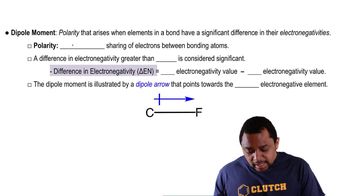
Dipole Moment

The dipole moment is a measure of the separation of positive and negative charges in a molecule, represented as a vector. It indicates the polarity of a bond or molecule, with a larger dipole moment signifying greater polarity. The overall dipole moment of a molecule is determined by the vector sum of all individual bond dipoles, taking into account both their magnitudes and directions.
추천 영상:

Electronegativity and Polarity

Electronegativity is the tendency of an atom to attract electrons in a chemical bond. When two atoms in a molecule have different electronegativities, the shared electrons are pulled closer to the more electronegative atom, creating a polar bond. If the molecule has an asymmetrical arrangement of these polar bonds, it will have a nonzero dipole moment, indicating overall molecular polarity.
추천 영상:
가이드 코스
02:38
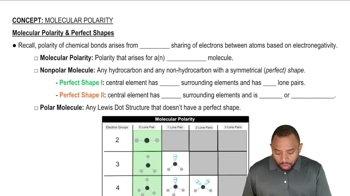
Molecular Polarity

Molecular Geometry and Dipole Cancellation

The geometry of a molecule significantly affects its dipole moment. In symmetrical molecules, such as tetrahedral AB4, the bond dipoles can cancel each other out due to their equal magnitude and opposite directions. This results in a net dipole moment of zero, meaning the molecule is nonpolar despite having polar bonds.
추천 영상:
가이드 코스
01:33
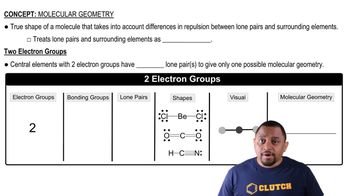
Molecular Geometry with Two Electron Groups