

Ch.10 - Gases: Their Properties & Behavior
McMurry - Chemistry 8th Edition
McMurry8th EditionChemistryISBN: 9781292336145당신이 사용하는 게 아니라요?교과서 변경
10장, 문제 32

A 1:1 mixture of helium (red) and argon (blue) at 300 K is portrayed below on the left. Draw the same mixture when the temperature is lowered to 150 K.

검증된 단계별 안내
1
Identify the initial conditions of the gases: The mixture contains equal amounts of helium and argon at a temperature of 300 K.
Understand the effect of temperature on gas behavior: Lowering the temperature to 150 K will decrease the kinetic energy of the gas particles, causing them to move slower.
Apply the ideal gas law (PV=nRT) conceptually: Since the volume and the amount of gas are constant, lowering the temperature will lead to a decrease in pressure if the container is flexible or a decrease in volume if the container is rigid.
Visualize the particle movement: At 150 K, both helium and argon atoms will move less vigorously compared to their movement at 300 K. This results in less frequent and less forceful collisions with the container walls.
Draw the scenario: In the new drawing for 150 K, depict the particles (helium in red and argon in blue) as being more closely packed together, indicating reduced movement and energy compared to the initial state at 300 K.

비슷한 문제에 대한 검증된 영상 답변:

이 영상 해법은 위 문제에 도움이 된다고 튜터들이 추천한 것입니다.
영상 길이:
3m

주요 개념

질문에 올바르게 답하기 위해 반드시 이해해야 하는 핵심 개념들은 다음과 같습니다.

Gas Behavior and Kinetic Molecular Theory

The Kinetic Molecular Theory explains the behavior of gases in terms of particle motion. It states that gas particles are in constant, random motion and that temperature is a measure of the average kinetic energy of these particles. As temperature decreases, the average kinetic energy of the gas particles also decreases, leading to reduced velocity and increased intermolecular forces.
추천 영상:
가이드 코스
01:19
Kinetic Molecular Theory

Ideal Gas Law

The Ideal Gas Law, represented as PV=nRT, relates the pressure (P), volume (V), number of moles (n), and temperature (T) of an ideal gas. This law helps predict how changes in temperature affect the behavior of gases. In this scenario, lowering the temperature from 300 K to 150 K will affect the pressure and volume of the gas mixture, assuming the number of moles remains constant.
추천 영상:
가이드 코스
01:15
Ideal Gas Law Formula

Gas Mixtures and Partial Pressures

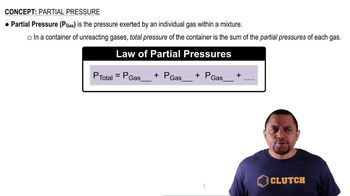
In a gas mixture, each component exerts pressure independently of the others, known as partial pressure. The total pressure of the mixture is the sum of the partial pressures of each gas. When the temperature is lowered, the behavior of each gas in the mixture (helium and argon) will change, affecting their respective partial pressures and the overall behavior of the mixture.
추천 영상:
가이드 코스
00:44
Law of Partial Pressures