
Ch.10 - Gases: Their Properties & Behavior
McMurry - Chemistry 8th Edition
McMurry8th EditionChemistryISBN: 9781292336145당신이 사용하는 게 아니라요?교과서 변경
10장, 문제 31

Show the approximate level of the movable piston in drawings (a), (b), and (c) after the indicated changes have been made to the gas. Three gas cylinder diagrams showing piston levels after changes in temperature and pressure.

검증된 단계별 안내
1
Identify the initial conditions: T_i = 200 K and P_i = 0.80 atm.
For drawing (a), note that the temperature increases to T_f = 250 K while the pressure remains constant at P_i = 0.80 atm. Use the ideal gas law (PV = nRT) to determine the change in volume.
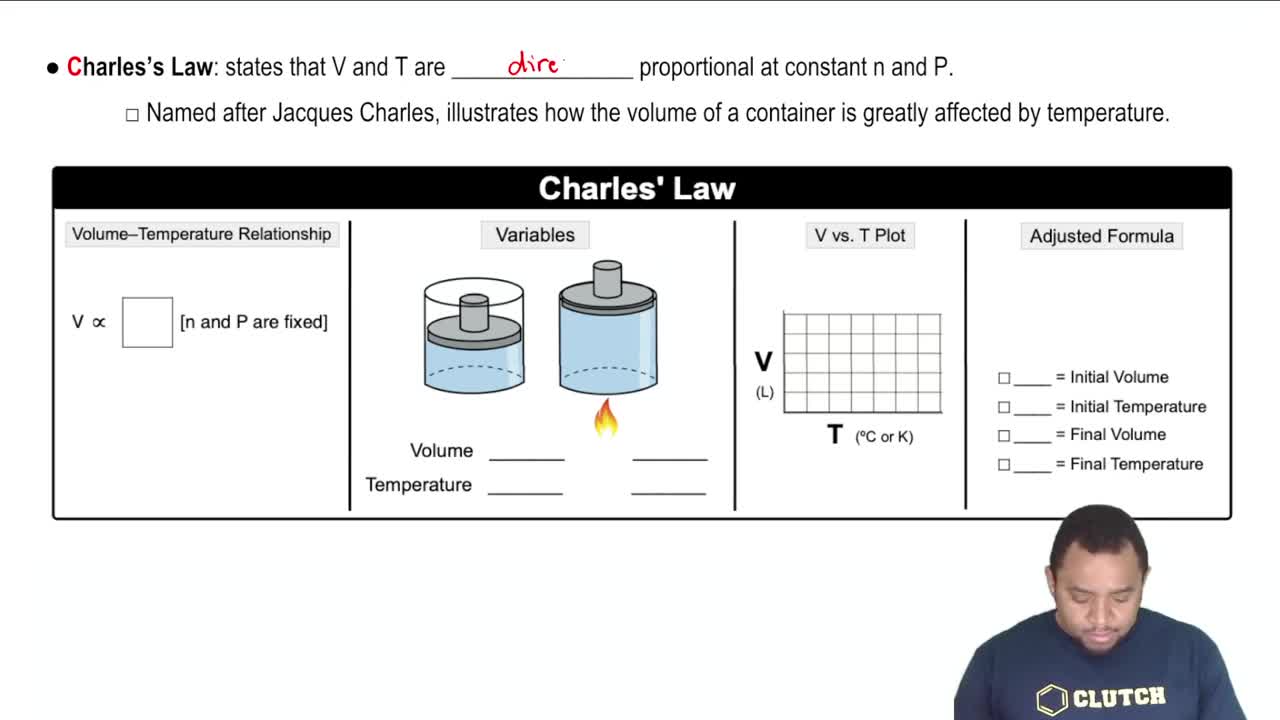
For drawing (a), since the pressure is constant, the volume is directly proportional to the temperature (Charles's Law: V1/T1 = V2/T2). Calculate the new volume V2.
For drawing (b), note that the temperature remains constant at T_f = 200 K while the pressure increases to P_f = 1.20 atm. Use the ideal gas law to determine the change in volume.
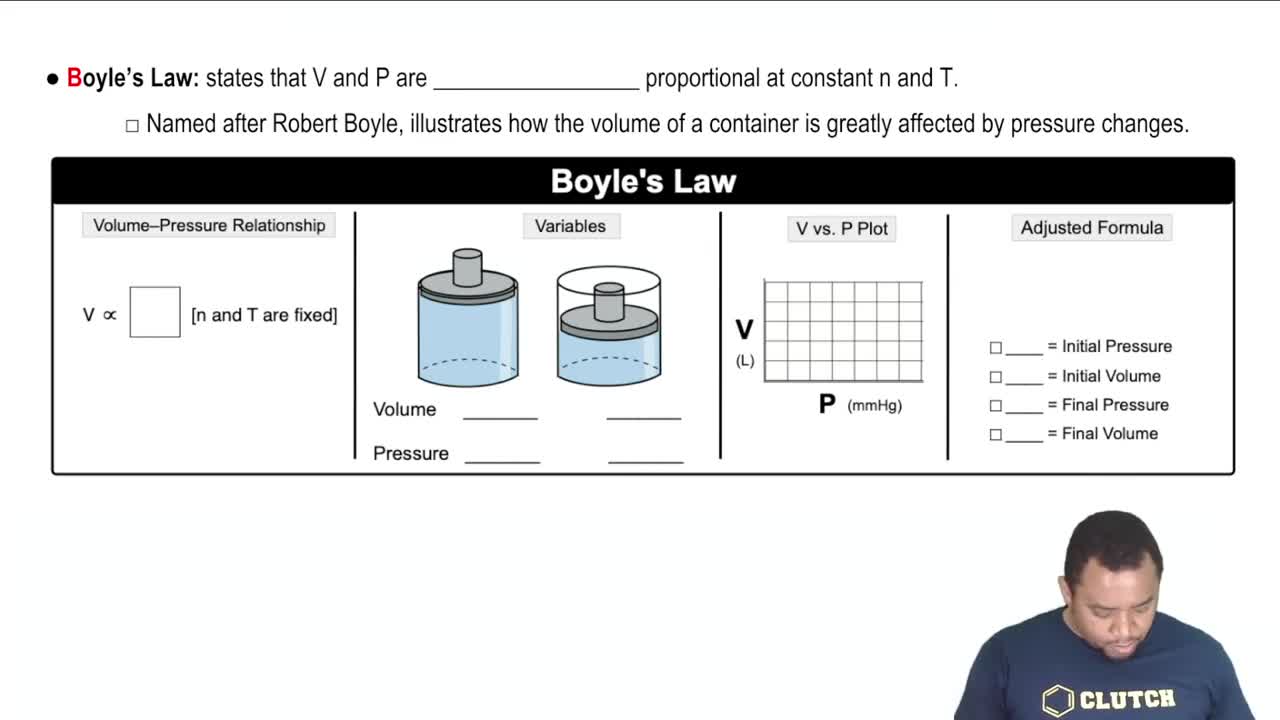
For drawing (b), since the temperature is constant, the volume is inversely proportional to the pressure (Boyle's Law: P1V1 = P2V2). Calculate the new volume V2.

비슷한 문제에 대한 검증된 영상 답변:

이 영상 해법은 위 문제에 도움이 된다고 튜터들이 추천한 것입니다.
영상 길이:
4m

주요 개념

질문에 올바르게 답하기 위해 반드시 이해해야 하는 핵심 개념들은 다음과 같습니다.

Ideal Gas Law

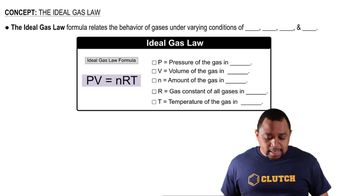
The Ideal Gas Law relates the pressure, volume, temperature, and number of moles of a gas through the equation PV = nRT. This law is fundamental for understanding how changes in temperature and pressure affect the behavior of gases, particularly in closed systems like the piston-cylinder setup shown in the diagrams.
추천 영상:
가이드 코스
01:15
Ideal Gas Law Formula

Charles's Law

Charles's Law states that the volume of a gas is directly proportional to its temperature when pressure is held constant. This concept is crucial for analyzing the changes in the piston level in the diagrams, especially in scenario (a) where the temperature increases while pressure remains constant.
추천 영상:

Boyle's Law

Boyle's Law states that the pressure of a gas is inversely proportional to its volume when temperature is held constant. This principle is essential for understanding the changes in the piston level in scenario (b), where an increase in pressure at constant temperature will result in a decrease in volume, thus affecting the position of the piston.
추천 영상: