


Ch.10 - Gases: Their Properties & Behavior
McMurry - Chemistry 8th Edition
McMurry8th EditionChemistryISBN: 9781292336145당신이 사용하는 게 아니라요?교과서 변경
10장, 문제 134

A driver with a nearly empty fuel tank may say she is 'running on fumes.' If a 15.0-gallon automobile gas tank had only gasoline vapor remaining in it, what is the farthest the vehicle could travel if it gets 20.0 miles per gallon on liquid gasoline? Assume the average molar mass of molecules in gasoline is 105 g/mol, the density of liquid gasoline is 0.75 g/mL, the pressure is 743 mm Hg, and the temperature is 25 °C.

검증된 단계별 안내
1
Step 1: Convert the pressure from mm Hg to atm. Use the conversion factor 1 atm = 760 mm Hg.
Step 2: Convert the temperature from Celsius to Kelvin. The formula to convert Celsius to Kelvin is K = °C + 273.15.
Step 3: Use the ideal gas law, PV = nRT, to calculate the number of moles of gasoline vapor in the tank. P is the pressure in atm, V is the volume of the tank in liters, n is the number of moles, R is the ideal gas constant (0.0821 L·atm/K·mol), and T is the temperature in Kelvin.
Step 4: Convert the number of moles of gasoline vapor to grams using the molar mass of gasoline (105 g/mol).
Step 5: Convert the mass of gasoline vapor to volume of liquid gasoline using the density of gasoline (0.75 g/mL). Then, convert this volume to gallons using the conversion factor 1 gallon = 3785.41 mL. Finally, multiply this volume by the fuel efficiency of the car (20.0 miles/gallon) to find the maximum distance the car could travel.

비슷한 문제에 대한 검증된 영상 답변:

이 영상 해법은 위 문제에 도움이 된다고 튜터들이 추천한 것입니다.
영상 길이:
7m

주요 개념

질문에 올바르게 답하기 위해 반드시 이해해야 하는 핵심 개념들은 다음과 같습니다.

Ideal Gas Law

The Ideal Gas Law relates the pressure, volume, temperature, and number of moles of a gas through the equation PV = nRT. This law is essential for understanding how gas behaves under different conditions. In this scenario, it helps determine the volume of gasoline vapor that can be produced from the remaining gasoline in the tank, which is crucial for calculating the distance the vehicle can travel.
추천 영상:
가이드 코스
01:15
Ideal Gas Law Formula

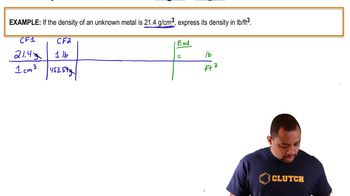
Density and Volume Conversion

Density is defined as mass per unit volume and is crucial for converting between mass and volume. In this question, the density of liquid gasoline (0.75 g/mL) allows us to convert the mass of gasoline vapor into a volume that can be used in calculations. Understanding how to manipulate these units is key to finding the total volume of gasoline vapor available for combustion.
추천 영상:
가이드 코스
05:30
Density Conversion Example

Molar Mass and Stoichiometry

Molar mass is the mass of one mole of a substance, which is vital for converting between grams and moles. In this case, the average molar mass of gasoline (105 g/mol) is used to determine how many moles of gasoline vapor are present. This information is necessary for calculating the total energy available for combustion and, ultimately, the distance the vehicle can travel based on its fuel efficiency.
추천 영상:
가이드 코스
02:11
Molar Mass Concept