
Ch.10 - Gases: Their Properties & Behavior
McMurry - Chemistry 8th Edition
McMurry8th EditionChemistryISBN: 9781292336145당신이 사용하는 게 아니라요?교과서 변경
10장, 문제 135c

Pakistan's K2 is the world's second-tallest mountain, with an altitude of 28,251 ft. Its base camp, where climbers stop to acclimate, is located about 16,400 ft above sea level. (c) Assuming the mole fraction of oxygen in air is 0.2095, what is the partial pressure of oxygen in mm Hg at the summit of K2?

검증된 단계별 안내
1
Identify the total atmospheric pressure at the summit of K2 using the altitude given. You can use the barometric formula or an approximation that atmospheric pressure decreases by about 12% for every 1000 meters of altitude increase.
Calculate the partial pressure of oxygen at the summit by using the mole fraction of oxygen in air. The formula for partial pressure is: \( P_{O_2} = X_{O_2} \times P_{total} \), where \( P_{O_2} \) is the partial pressure of oxygen, \( X_{O_2} \) is the mole fraction of oxygen, and \( P_{total} \) is the total atmospheric pressure.
Convert the altitude from feet to meters for more accurate calculations, knowing that 1 meter equals approximately 3.28084 feet.
Apply the conversion factor to convert the calculated pressure in atmospheres (atm) to millimeters of mercury (mm Hg), using the conversion 1 atm = 760 mm Hg.
Ensure all units are consistent throughout the calculations to avoid any errors in the final result.

비슷한 문제에 대한 검증된 영상 답변:

이 영상 해법은 위 문제에 도움이 된다고 튜터들이 추천한 것입니다.
영상 길이:
2m

주요 개념

질문에 올바르게 답하기 위해 반드시 이해해야 하는 핵심 개념들은 다음과 같습니다.

Partial Pressure

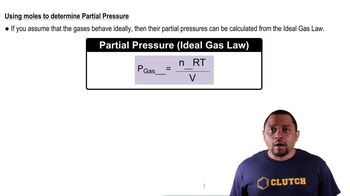
Partial pressure refers to the pressure exerted by a single component of a gas mixture. In the context of atmospheric gases, it is calculated by multiplying the total pressure of the gas mixture by the mole fraction of the specific gas. This concept is crucial for understanding how gases behave in different altitudes, where total atmospheric pressure decreases.
추천 영상:
가이드 코스
00:48
Partial Pressure Calculation

Mole Fraction

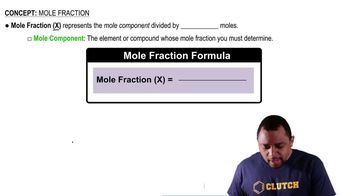
Mole fraction is a way of expressing the concentration of a component in a mixture, defined as the number of moles of that component divided by the total number of moles of all components in the mixture. In this case, the mole fraction of oxygen in air is given as 0.2095, indicating that approximately 20.95% of the air is oxygen, which is essential for calculating its partial pressure.
추천 영상:
가이드 코스
00:36
Mole Fraction Formula

Atmospheric Pressure at Altitude

Atmospheric pressure decreases with increasing altitude due to the reduction in the weight of the air above. At sea level, the average atmospheric pressure is about 760 mm Hg, but at higher altitudes, such as the summit of K2, this pressure is significantly lower. Understanding how to calculate the atmospheric pressure at different altitudes is vital for determining the partial pressure of gases like oxygen.
추천 영상:
가이드 코스
02:09
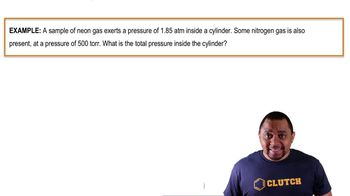
Total Pressure Example
관련 실천
교과서 질문

The apparatus shown consists of three temperature-jacketed 1.000-L bulbs connected by stopcocks. Bulb A contains a mixture of H2O(g), CO2(g), and N2(g) at 25 °C and a total pressure of 564 mm Hg. Bulb B is empty and is held at a temperature of -70 °C. Bulb C is also empty and is held at a temperature of -190 °C. The stopcocks are closed, and the volume of the lines connecting the bulbs is zero. CO2 sublimes at -78 °C, and N2 boils at -196 °C.

(b) How many moles of H2O are in the system?

768
views
교과서 질문

The apparatus shown consists of three temperature-jacketed 1.000-L bulbs connected by stopcocks. Bulb A contains a mixture of H2O(g), CO2(g), and N2(g) at 25 °C and a total pressure of 564 mm Hg. Bulb B is empty and is held at a temperature of -70 °C. Bulb C is also empty and is held at a temperature of -190 °C. The stopcocks are closed, and the volume of the lines connecting the bulbs is zero. CO2 sublimes at -78 °C, and N2 boils at -196 °C.

(a) The stopcock between A and B is opened, and the system is allowed to come to equilibrium. The pressure in A and B is now 219 mm Hg. What do bulbs A and B contain?

401
views
교과서 질문

Pakistan's K2 is the world's second-tallest mountain, with an altitude of 28,251 ft. Its base camp, where climbers stop to acclimate, is located about 16,400 ft above sea level. (a) Approximate atmospheric pressure P at different altitudes is given by the equation P = e-h/7000, where P is in atmospheres and h is the altitude in meters. What is the approximate atmospheric pressure in mm Hg at K2 base camp? (b) What is the atmospheric pressure in mm Hg at the summit of K2?

832
views
교과서 질문
Assume that you take a flask, evacuate it to remove all the air, and find its mass to be 478.1 g. You then fill the flask with argon to a pressure of 2.15 atm and reweigh it. What would the balance read in grams if the flask has a volume of 7.35 L and the temperature is 20.0 °C?
680
views
교과서 질문
A driver with a nearly empty fuel tank may say she is 'running on fumes.' If a 15.0-gallon automobile gas tank had only gasoline vapor remaining in it, what is the farthest the vehicle could travel if it gets 20.0 miles per gallon on liquid gasoline? Assume the average molar mass of molecules in gasoline is 105 g/mol, the density of liquid gasoline is 0.75 g/mL, the pressure is 743 mm Hg, and the temperature is 25 °C.
633
views