Ch.10 - Gases: Their Properties & Behavior
McMurry - Chemistry 8th Edition
McMurry8th EditionChemistryISBN: 9781292336145당신이 사용하는 게 아니라요?교과서 변경
10장, 문제 145b

An empty 4.00-L steel vessel is filled with 1.00 atm of CH4(g) and 4.00 atm of O2(g) at 300 °C. A spark causes the CH4 to burn completely, according to the equation
CH4(g) + 2 O2(g) → CO2(g) + 2 H2O(g) ΔH° = -802 kJ
(b) What is the final temperature inside the vessel after combustion, assuming that the steel vessel has a mass of 14.500 kg, the mixture of gases has an average molar heat capacity of 21 J/(mol·°C), and the heat capacity of steel is 0.449 J/(g·°C)?

검증된 단계별 안내
1
Step 1: Calculate the initial moles of CH4 and O2 using the ideal gas law, PV = nRT. Here, P is the pressure, V is the volume, R is the ideal gas constant (0.0821 L atm/mol K), and T is the temperature in Kelvin.
Step 2: Use the stoichiometry of the balanced chemical equation CH4(g) + 2 O2(g) → CO2(g) + 2 H2O(g) to determine the moles of O2 required for complete combustion of CH4 and to find the limiting reactant.
Step 3: Calculate the total energy released during the combustion using the given ΔH° value and the moles of CH4 that reacted. Remember that the energy released will be absorbed by the steel vessel and the gases inside it.
Step 4: Calculate the heat absorbed by the steel vessel using its mass, specific heat capacity, and the change in temperature. Use the formula Q = mcΔT, where m is mass, c is specific heat capacity, and ΔT is the change in temperature.
Step 5: Calculate the final temperature of the gases using the total heat absorbed by the gases, their average molar heat capacity, and the moles of gases present after the reaction. Use the formula Q = nCΔT, where n is the number of moles, C is the molar heat capacity, and ΔT is the change in temperature.

비슷한 문제에 대한 검증된 영상 답변:

이 영상 해법은 위 문제에 도움이 된다고 튜터들이 추천한 것입니다.
영상 길이:
17m

주요 개념

질문에 올바르게 답하기 위해 반드시 이해해야 하는 핵심 개념들은 다음과 같습니다.

Stoichiometry of Combustion Reactions

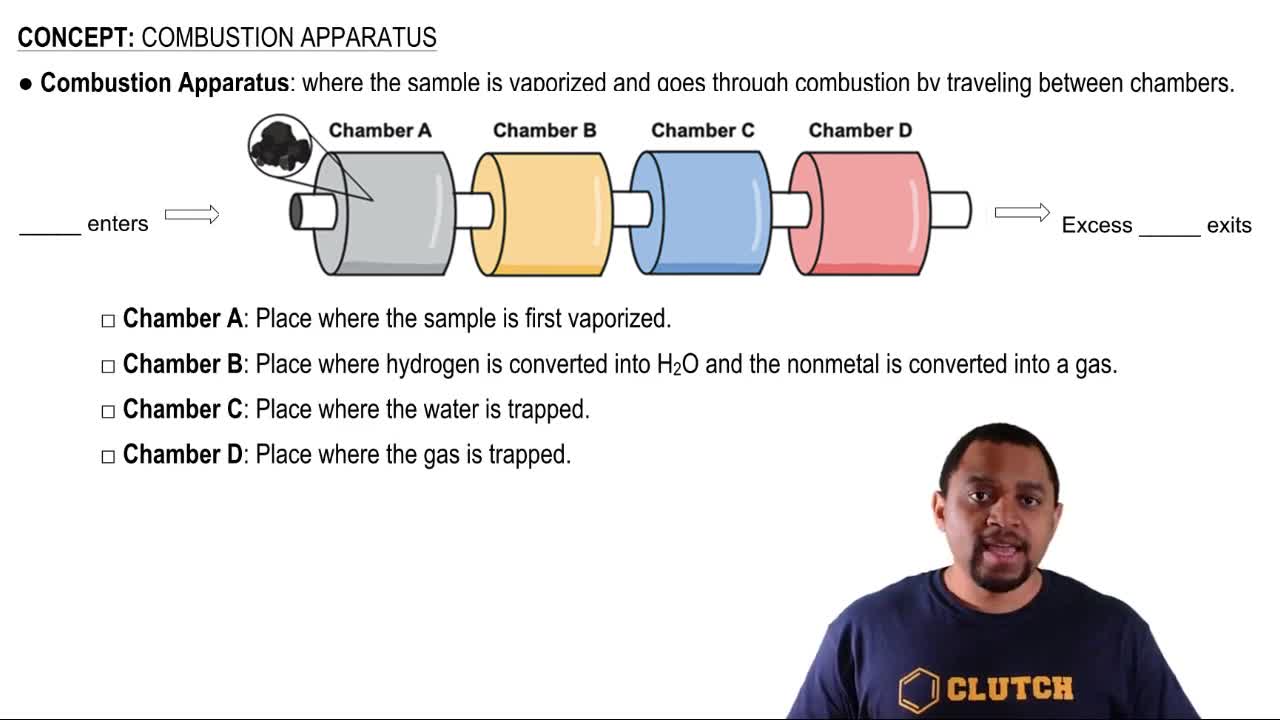
Stoichiometry involves the calculation of reactants and products in chemical reactions. In combustion reactions, such as the one between methane (CH4) and oxygen (O2), the balanced equation indicates the molar ratios of reactants consumed and products formed. Understanding these ratios is crucial for determining how much energy is released and how it affects the temperature of the system.
추천 영상:
가이드 코스
02:24
Combustion Apparatus

Heat Transfer and Specific Heat Capacity

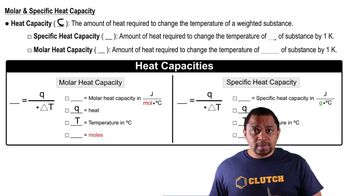
Heat transfer refers to the movement of thermal energy from one object to another, which can change the temperature of the objects involved. Specific heat capacity is the amount of heat required to raise the temperature of a unit mass of a substance by one degree Celsius. In this scenario, the specific heat capacities of both the gas mixture and the steel vessel are essential for calculating the final temperature after the combustion reaction.
추천 영상:

Thermodynamics and Enthalpy Change

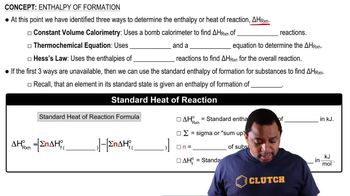
Thermodynamics is the study of energy transformations, particularly heat and work. The enthalpy change (ΔH) of a reaction indicates the heat released or absorbed during the reaction at constant pressure. In this case, the negative ΔH value of -802 kJ signifies that the combustion of methane releases energy, which will increase the temperature of the gases and the steel vessel, necessitating calculations to find the final temperature.
추천 영상:
가이드 코스
02:34
Enthalpy of Formation
관련 실천
교과서 질문

A steel container with a volume of 500.0 mL is evacuated, and 25.0 g of CaCO3 is added. The container and contents are then heated to 1500 K, causing the CaCO3 to decompose completely, according to the equation CaCO3(s) → CaO(s) + CO2(g). (b) Now make a more accurate calculation of the pressure inside the container. Take into account the volume of solid CaO (density = 3.34 g/mL) in the container, and use the van der Waals equation to calculate the pressure. The van der Waals constants for CO2(g) are a = 3.59 (L2-atm)/mol2 and b = 0.0427 L/mol.

507
views
교과서 질문

An empty 4.00-L steel vessel is filled with 1.00 atm of CH4(g) and 4.00 atm of O2(g) at 300 °C. A spark causes the CH4 to burn completely, according to the equation

CH4(g) + 2 O2(g) → CO2(g) + 2 H2O(g) ΔH° = -802 kJ

(c) What is the partial pressure of CO2(g) in the vessel after combustion?

교과서 질문

When a gaseous compound X containing only C, H, and O is burned in O2, 1 volume of the unknown gas reacts with 3 volumes of O2 to give 2 volumes of CO2 and 3 volumes of gaseous H2O. Assume all volumes are measured at the same temperature and pressure. (a) Calculate a formula for the unknown gas, and write a balanced equation for the combustion reaction.

793
views
교과서 질문

An empty 4.00-L steel vessel is filled with 1.00 atm of CH4(g) and 4.00 atm of O2(g) at 300 °C. A spark causes the CH4 to burn completely, according to the equation

CH4(g) + 2 O2(g) → CO2(g) + 2 H2O(g) ΔH° = -802 kJ

(a) What mass of CO2(g) is produced in the reaction?

575
views